The world may have lost the opportunity to keep global warming under 1.5 degree C over pre-industrial levels, the UN Intergovernmental Panel on Climate Change said in a new report on Monday, highlighting the climate crisis that the world faces.
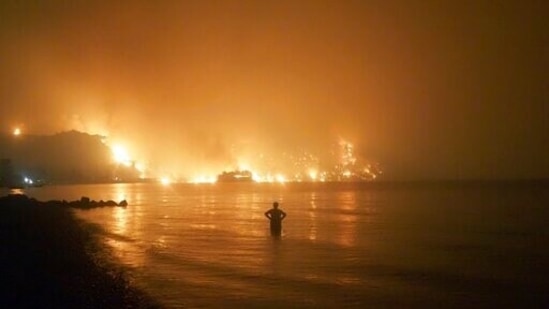
One of the report’s authors, Linda Mearns said it more evocatively during the release: “ I don’t see any area that’s safe... Nowhere to run, nowhere to hide.”
That isn’t hyperbole. Each of the five scenarios, based on varying levels of emission cuts, will see the world exceeding the 1.5 degree C mark set in Paris in 2015. And it will do this in the decade of the 2030s. And in three, it will exceed the 2 degree C mark, with “far worse heat waves, droughts and flood-inducing downpours”.
India is no stranger to any of those.
Glacial retreat in the Hindu Kush Himalayas; compounding effects of sea-level rise and intense tropical cyclones leading to flooding; an erratic monsoon and intense heat stress are likely to impact India in the years ahead, the report warned, even as it claimed that the Indian ocean has already warmed up faster than the global average.
Most worryingly, one of the five scenarios is a best-case one: carbon dioxide (CO2) emissions declining rapidly to net zero around 2050. Even in this, the rise in global mean sea level could be 1-2 feet by 2100, and “6-12 inches” by the middle of the century, according to Bob Kopp, one of the authors.
And to round off the summary of really bad news: the Arctic, according to the report, is now melting three times faster than originally estimated.
In a stark warning to world leaders, the 42-page summary for policy makers titled: “Climate Change 2021: The Physical Science Basis” drafted by 234 scientists from 66 countries (the report itself is an impressive 3,949 pages long, and based on an analysis of 14,000 scientific papers by experts) warned that global warming of 1.5 degree C relative to 1850-1900 levels would be definitely exceeded under intermediate, high and very high emission scenarios and will be “more likely than not to be exceeded” even when countries agree to switch to net-zero emissions by 2050.
{{/usCountry}}In a stark warning to world leaders, the 42-page summary for policy makers titled: “Climate Change 2021: The Physical Science Basis” drafted by 234 scientists from 66 countries (the report itself is an impressive 3,949 pages long, and based on an analysis of 14,000 scientific papers by experts) warned that global warming of 1.5 degree C relative to 1850-1900 levels would be definitely exceeded under intermediate, high and very high emission scenarios and will be “more likely than not to be exceeded” even when countries agree to switch to net-zero emissions by 2050.
{{/usCountry}}A net zero emission target implies that all human-caused greenhouse gas (GHG) emissions are balanced out by removing GHGs from the atmosphere in a process known as carbon removal.
But all may not be lost if the easier of the two Paris goals is met.
The IPCC report underlines that human actions still have the potential to determine the future course of climate change and can strive to keep global warming under 2 degree C.
That would involve zero emissions by the middle of the century, an immediate move away from fossil fuels, and a sustained effort at what is called engineered carbon removal (ways to suck CO2 from the air).
The Paris Agreement goal, agreed upon by 195 countries is of limiting global warming to well below 2 degree C and pursuing efforts to limit it to 1.5 degree C. At 2 degrees global warming, according to a simulation presented in the report, the Arctic will warm by at least 4-5 degrees C.
There is a near-linear relationship between cumulative CO2 emissions from anthropogenic sources and global warming, the report shows. Each 1000 GtCO2 (gigaton) of cumulative CO2 emissions is likely cause a 0.45 degree C increase in global surface temperature. This relationship implies that reaching net zero anthropogenic CO2 emissions is a requirement to stabilise global temperature increase at any level because of a very limited carbon budget, the report said.
“Stabilizing the climate will require strong, rapid, and sustained reductions in greenhouse gas emissions, and reaching net zero CO2 emissions. Limiting other greenhouse gases and air pollutants, especially methane, could have benefits both for health and the climate,” said IPCC Working Group I Co-Chair Panmao.
The report shows that emissions of greenhouse gases from human activities are responsible for approximately 1.1 degree C of warming compared to pre-industrial levels, and finds that averaged over the next 20 years, global temperature is expected to reach or exceed 1.5 degree C warming.
“Warming is an established fact. We are seeing widespread and rapid changes in every region of the world, affected in multiple ways by this changing climate. This includes heat waves, heavy rainfall events, droughts, compound extreme events see kit in every region of the earth. There is no going back from some of these changes even if we limit warming to 1.5 degree C. Compound flooding events, storm surges etc will continue. From a physical science point of view, it is still possible to limit global warming to 1.5 degree C and that would mean these changes could be slowed. If we reduce GHG emissions to net zero by 2040 there is still a two-thirds chance to limit global warming to 1.5 degree C and if we manage to reach net zero emissions by middle of the century there still a one third chance…” said Friederike Otto, associate director, Environment Change Institute, University of Oxford.
In the next decade-and-half as the world heads towards 1.5 degree C warming, it will witness an increasing occurrence of extreme weather events, which are unprecedented in the observational record, IPCC said, adding that with every additional 0.5 degree C warming there will be a discernible increase in intensity and frequency of heat waves, extremely heavy rain events, as well as agricultural and ecological droughts (a period with abnormal soil moisture deficit, which happens due to rain deficit and excess evapotranspiration).
The world will likely cross the 2 degree C threshold between 2041 and 2060 in the intermediate scenario when emissions decline slowly. And global temperature rise is likely to be 3.3 degree C to 5.7 degree C by 2100 under the very high greenhouse gas emissions scenario where little action is taken to reduce emissions. The IPCC considers five socioeconomic Pathways (SSPs), which are essentially possible paths of growth human societies could follow over the next century.
SSP2-4.5 or the intermediate scenario most closely mirrors the emissions trajectory that the total ambition of climate pledges (NDCs) submitted by 195 countries currently has the world on. CO2 continues to rise and stabilise around the mid-century, before finally starting to decrease, with the steepest drop just before the end of the century in this intermediate scenario. Under this scenario, the world is headed for a 2.7 degree C rise in global temperature by end of the century.
The last time global surface temperature was sustained at or above 2.5 degree C higher than 1850–1900 was over 3 million years ago.
How bad is it? As Paola Andrea Arias Gomez, another of the report’s authors said during its release, extreme heat waves, which are now occurring “five times as often as before” could occur “14 times as often” at 2 degrees C of global warming.
“This report reflects extraordinary efforts under exceptional circumstances,” said Hoesung Lee, chair of the IPCC in a statement. “This report is a reality check. We now have a much clearer picture of the past, present and future climate, which is essential for understanding where we are headed, what can be done, and how we can prepare,” said IPCC Working Group I co-chair Valérie Masson-Delmotte.
IPCC, however, clarified that occurrence of individual years with global surface temperature rise of 1.5 degree C or 2 degree C, relative to 1850–1900 does not imply that this global warming level has been reached.
Through its assessments of all five scenarios, the IPCC said it is certain that the land surface will continue to warm more than the ocean surface -- by around 1.4 to 1.7 times. It is also certain that the Arctic will continue to warm more than global surface temperature at two times the rate of global warming.
Some mid-latitude and semi-arid regions, and the South American Monsoon region, are projected to see the highest increase in the temperature of the hottest days, at about 1.5 to 2 times the rate of global warming. Extremely heavy rainfall events will intensify and become more frequent in most regions with additional global warming. At the global scale, extreme daily rain events are projected to intensify by about 7% for each 1 degree C of global warming. The proportion of intense, category 4/5 tropical cyclones will increase and the Arctic is likely to be practically sea ice free in September at least once before 2050 under all the five scenarios considered in the report.
“The IPCC numbers sadly show that as humans we have failed to curb the emissions that would have kept global warming under 1.5 degree C or 2 degree C limits. The mitigation and adaptation strategies submitted by nations through the Paris Agreement are insufficient, and we have even failed to reach near the committed curbs on emissions,” Roxy Mathew Koll, climate scientist, Indian Institute of Tropical Meteorology.
“This points to the fact that we need urgent measures to evaluate and adapt to the increasing risk due to intense cyclones, floods and heat waves in the near future. While climate change is global, the challenges are always local. IPCC reports provides only a global assessment, and it is our task to identify the local challenges and disaster proof those regions where the risk and vulnerability is the highest.”
India needs a plan, said M Rajeevan, former secretary, ministry of earth sciences.
“The present assessment report is based on much improved climate models and also using more observed and paleoclimatic data. Therefore, future projections of the climate could be considered to have reduced uncertainty…India should raise to the occasion and plan how to mitigate things. We need to develop technologies for mitigating these extreme weather events. Prediction capability should be improved. Disaster management system should be strengthened. A lot of coordination should happen between ministry of earth sciences, national disaster management authority (NDMA) and state governments also participation of industries. We should not delay. Anyway, MoES has plans to improve their forecasting skill of extremes,” he said.
The IPCC projections are expected to be a wake up call for world leaders ahead of UN climate negotiations (COP 26) in November. “The new IPCC report tells government leaders exactly what is at stake at COP26. Without rapidly cutting carbon dioxide emissions to net zero levels, we are headed for a 3 degree C hotter world with more frequent weather extremes, and dangerous disruptions in the climate. It is high time that developed countries seal the deal on adaptation finance and clean technology partnerships at COP26,” said Ulka Kelkar, director of the climate programme at the World Resources Institute, India.