E-Paper



Congress dividing people in name of caste even now: PM
Prime Minister Narendra Modi accused the Congress party of doing nothing for the development of India during its 60 years in power, alleging that it divided people on the basis of caste. He made these remarks while inaugurating development programs in Gwalior worth ₹19,000 crore. Modi claimed that his government is dedicated to providing development to every class and region without discrimination. He also criticized the Congress government in Rajasthan, claiming that it engaged in appeasement politics. The Prime Minister praised the Gwalior region for its historical significance and contributions to the nation.


Bhopal: Prime Minister Narendra Modi on Monday accused the Congress of doing “nothing for development” of the country for 60 years when it was in power, claiming that it “divided people in the name of caste” --- an allegation that came as the Opposition-ruled Bihar government made public results of a caste survey.
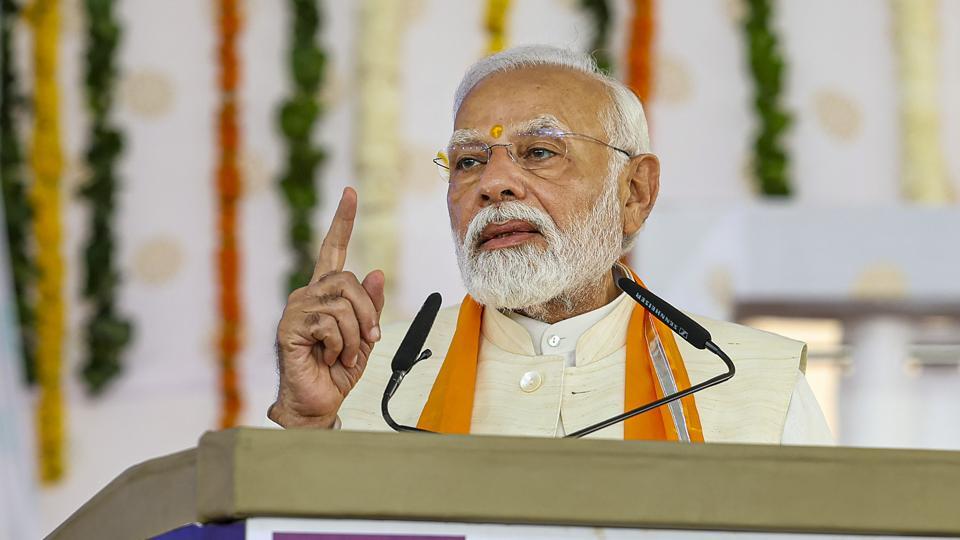
Modi, without referring directly to the Bihar government announcement, said the Congress was “playing with the feelings of the poor and they are doing it even now”.
“The people of the country had given those opposing development 60 years. 60 years is not a less time. If in nine years all this development and progress can happen in the country, a lot could have happened in 60 years… Then, they used to play with the feelings of the poor and they are doing it even now. They used to divide the country on the basis of caste then and are doing the same even now,” he said, while addressing a programme to inaugurate and lay foundation stones of programmes worth ₹19,000 crore in Gwalior.
The PM said that his government was “dedicated” to providing development to every class and every region in the country without discrimination. “Modi gave importance to those no one served. Modi worshipped them,” he said, adding that his government has worked for upliftment of the poor.
The PM said the Congress were not able to develop MP as they lacked “new thinking” and had no “road map.”
“Whereas our double engine government thinks about the future. Only our government can guarantee that Madhya Pradesh will be brought among the top states in the country on the scale of development,” Modi said.
Madhya Pradesh has had a BJP chief minister since 2003 except for a 1-year, three-month spell when the Congress was in power after it secured the highest number of seats in the last state elections.
Modi cited Congress government in Rajasthan to claim that the party indulges in “appeasement” politics, bringing up the beheading of a person in Udaipur in 2022.
“Where ever these anti-development parties come to power, they started appeasement. The goons, criminals, corrupt and other anti-social elements became active. The people were killed openly by slitting their throat and government doesn’t do anything. In MP you should be cautious of these people,” he said.
On the development works in Madhya Pradesh, the PM said it was result of “double engine government” and that the people of MP have faith in this model.
The PM praised Gwalior region by saying that it is a symbol of courage, self-respect, military glory, music, taste and mustard.
“I pay my respects to this historical land of Gwalior,” he said. “Gwalior gave one revolutionary after another for the country. We have given our brave children for the defence of the nation and our army. Gwalior has also shaped the policy and leadership of BJP. Rajmata Vijayaraje Scindia, Kushabhau Thackeray and Atal Bihari Vajpayee have been buried in the soil of Gwalior. Every patriot who emerged from this soil sacrificed himself for the nation,” the PM said.
CONGRESS REACTION
Chief minister Shivraj Singh Chouhan, civil aviation minister Jyotiraditya Scindia, agriculture minister Narendra Singh Tomar and state president VD Sharma along with other leaders participated in the programme.