Congress leader Rahul Gandhi brought finality to his decision to step down as party president on Wednesday when he tweeted a four-page farewell note listing the reasons why he resigned. The 49-year-old went public with the letter after party colleagues refused to accept the resignation he offered at the May 25 meeting of the Congress Working Committee (CWC), the party’s highest decision-making committee, after its back-to-back general election defeat.
Soon after sending the tweet, Gandhi changed his Twitter bio and removed its description of him being the Congress president. It now describes him as a member of the party and a member of Parliament. The note also paves the way for others in the top leadership of the 134-year-old party to be held accountable, along with him, for the election rout.
“It would be unjust to hold others accountable, but ignore my own responsibility as President of the party,” Gandhi, who succeeded his mother Sonia as the party president in December 2017, wrote in the signed note he posted on Twitter.
“Many of my colleagues suggested that I nominate the next Congress president. While it is important for someone new to lead our party, it would not be correct for me to select that person,” he added.
With Gandhi going public with the letter, a meeting of the CWC is expected soon to decide its future course of action.
{{/usCountry}}With Gandhi going public with the letter, a meeting of the CWC is expected soon to decide its future course of action.
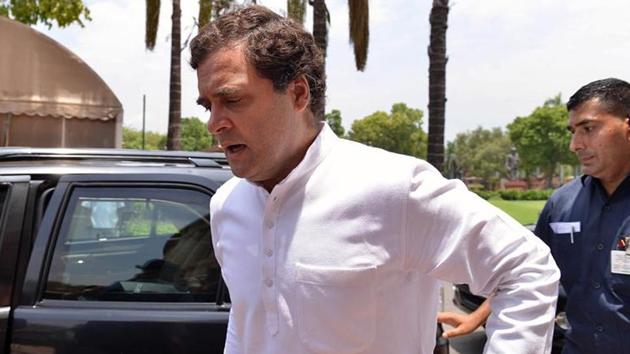
{{/usCountry}}Earlier in the day, Gandhi told reporters in the Parliament House complex that he had already resigned and the CWC should find a replacement for him soon.
“I am no longer the Congress president. I have already resigned. The CWC should convene a meeting immediately and decide on the new Congress president,” he said, when asked about the future course of the party.
The ruling Bharatiya Janata Party (BJP) used Gandhi’s move to take a swipe at the Congress. “It is a brand new drama of the party and we have nothing to do with it,” Union minister Mukhtar Abbas Naqvi said.
Gandhi stunned the top Congress leadership at the May 25 meeting of the CWC when he first conveyed his decision to quit after the party’s rout in the Lok Sabha polls, in which it managed to win just 52 seats in the 543-member House against the ruling party’s tally of 303.
He asked the CWC to appoint a new chief, but the decision-making body rejected the offer and passed a resolution authorising him to revamp the organisation.
Since then, Gandhi has had limited interactions with party colleagues and in all his meetings remained adamant on stepping down.
Even the party’s five chief ministers -- Amarinder Singh (Punjab), Ashok Gehlot (Rajasthan), Kamal Nath (Madhya Pradesh), Bhupesh Baghel (Chhattisgarh) and V Narayanasamy (Puducherry) -- failed to persuade Gandhi to reconsider his decision during their nearly two-hour-long meeting with him on Monday.
Several Congress functionaries too submitted their resignations to put pressure on him to change his mind, but to no avail.
As questions about his status continued, Gandhi finally turned to the social media to get his farewell message out.
“It is an honour for me to serve the Congress Party, whose values and ideals have served as the lifeblood of our beautiful nation. I owe the country and my organisation a debt of tremendous gratitude and love,” he said.
This time, the Congress Twitter handle also amplified his message.
In this, Gandhi signalled that he wasn’t going to be the only one without a leadership role when the exercise of rebuilding the party starts. “Rebuilding the party requires hard decisions and numerous people will have to be made accountable for the failure of 2019,” he said.
Gandhi also took a sharp dig at his party colleagues for the electoral drubbing the Congress received, saying he had stood completely alone in the fight against Prime Minister Narendra Modi and the Rashtriya Swayamsewak Sangh (RSS).
“I personally fought the Prime Minister, the RSS and the institutions they have captured with all my being. I fought because I love India. And I fought to defend the ideals India was built upon. At times, I stood completely alone and am extremely proud of it,” he wrote.
“I have learned so much from the spirit and dedication of our workers and party members, men and women who have taught me about love and decency,” he added.
Gandhi has been upset over the party’s dismal performance in the general elections and spoken about the lack of support from party colleagues.
At the fractious May 25 meeting, Gandhi slammed the veterans for “placing the interests” of their sons above the party. He also mentioned that some leaders had even lost the election from their strongholds even as he criticised a section of the so-called GenNext for hankering for posts.
Political analysts say Gandhi had posed a challenged to the Congress, but it failed to rise to the occasion. “Rahul Gandhi had given them an opportunity to look beyond the Gandhi family but the party failed to deliver,” said New Delhi-based political observer N Bhaskara Rao.
Rao added that while Gandhi could gain some popularity because of his resignation, the Congress had emerged as a “loser” in the entire episode.
In his note, Gandhi said the BJP used state institutions to help it win the polls.
“We didn’t fight a political party in the 2019 election. Rather, we fought the entire machinery of the Indian state, every institution of which was marshalled against the opposition.”
He also stressed the importance of institutional neutrality in conducting elections. “A free and fair election requires the neutrality of a country’s institutions; an election cannot be fair without arbiters – a free press, an independent judiciary, and a transparent election commission that is objective and neutral. Nor can an election be free if one party has a complete monopoly on financial resources,” Gandhi wrote.
‘It is now crystal clear that our once cherished institutional neutrality no longer exists in India.”
Attacking the RSS, he said its stated objective of capturing the country’s institutional structure had been met. “Our democracy has been fundamentally weakened. There is a real danger that from now on, elections will go from being a determinant of India’s future to a mere ritual.”
In an apparent reference to alleged wrongdoing in the Rafale jet fighter deal on which he ran his election campaign, Gandhi said the Prime Minister’s win “does not negate the breadth of corruption allegations” against him. “No amount of money and propaganda can ever hide the light of the truth,” he said.
The BJP and National Democratic Alliance government have denied any corruption in the deal to purchase 36 Rafale fighter jets from French military plane maker Dassault Aviation.