SHILLONG/KOHIMA/TRIPURA: The biggest political force in northeast till emergence of Bharatiya Janata Party in the region few years ago, the Congress party is looking at reviving its failing fortunes in Meghalaya, Nagaland and Tripura, states where assembly elections will be held early next year.
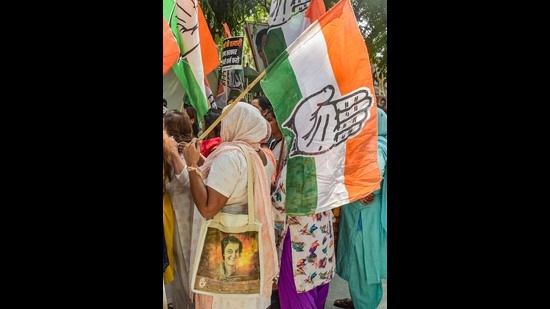
While the BJP is the major ruling party in Tripura and partners of the ruling coalitions headed by National Peoples’ Party (NPP) in Meghalaya and Nationalist Democratic Progressive Party (NDPP) in Nagaland, the Congress has been relegated to the sidelines in the three northeastern states. It has suffered multiple poll defeats and desertions in the past few years.
Meghalaya
In 2018, Congress emerged as the largest party in Meghalaya, winning 21 of the 60 seats in the assembly. But it failed cobble the required numbers, while the NPP, BJP and others came together to form the government. In the past five years, the party lost almost all its members to Trinamool Congress and NPP.
The first Congress MLA to leave was Martin M Danggo of Langrin-Jyrngam constituency, who quit the House soon after being elected. He contested the by-election on a NPP ticket but lost, with the seat going to the United Democratic Party (UDP). Then party stalwart and former chief minister Mukul Sangma, along with 11 other MLAs, quit the Congress to join the TMC.
The grand old party suffered a further setback with the untimely demise of three of its legislators - Clement Marak, David Nongrum and Azad Zaman. The final nail in the coffin was driven by M Ampareen Lyngdoh and four of her party colleagues, who were suspended by the party for openly extending support to the NPP-led state government. This left the party with no more legislators in the house.
{{/usCountry}}The grand old party suffered a further setback with the untimely demise of three of its legislators - Clement Marak, David Nongrum and Azad Zaman. The final nail in the coffin was driven by M Ampareen Lyngdoh and four of her party colleagues, who were suspended by the party for openly extending support to the NPP-led state government. This left the party with no more legislators in the house.
{{/usCountry}}But the party has not given up the fight and is confident of putting up a good fight in the ensuing assembly elections in early 2023.
“The party in spite of all the hardship and exodus of its members has stood strong with the majority of its grass root workers intact and its strength was felt in this hard time,” a Congress leader in the state said, declining to be named. According to him, AICC in-charge Manish Chatrath along with PCC president and parliamentarian Vincent H Pala has met numerous party members and visited various blocks and districts to instil confidence among party supporters.
“This has helped in rebuilding the party at various levels to its present strength,” he said. “The state party unit had to undertake a major overhaul and reorganise right from the grassroots level, which we have been able to do with the support of our dedicated party workers.”
Asserting that the party is taking the challenge head on, the leader said candidates for the forthcoming Assembly polls are almost finalised. “The party can boast of having many young educated individuals applying for party tickets...two IIM graduates who have worked in the corporate sector, one from IIT Guwahati, a doctor, a college teacher, and some have taken voluntary retirement from government service to join the party and contest the elections, as well as few retired officers have also joined for the same purpose,” he revealed.
Nagaland
In Nagaland, the Congress, which had once been a force to reckon with, has now been relegated to a mere party without a single MLA in the 60-member house. Although the state Congress chief K Therie has been saying that the party would fight all the seats in the upcoming assembly elections, political observers doubt the prospects of the party this time around unless it undergoes a major revamp. “The party lacks influential leaders, they said.
In 2018, the Congress fielded 18 candidates, but they failed to win. They could not poll even 30,000 votes out of a total 1,170,507 electorate.
Putting up a brave front, Therie said defeat and humiliation in a fair election is more bearable than MLAs defecting after being elected on the party ticket.
The state Congress on Friday held its extended executive meeting on Friday. As per a communique from the party, Therie’s strategy for the ensuing elections is to decentralize selection of candidates to the assembly constituency levels and the party would go to the grassroots with issues confronting Naga society today and the proposed solutions the Congress has to offer.
“The meeting also decided for the party to be open towards a secular front in the interests of the people,” the Congress statement said.
Therie has been outspoken that the aspirations of the people of Nagaland have been ignored by the present dispensation. “Congress is the only alternative,” he told the press earlier this year.
“It is undeniable that with a strong leadership, Congress can still revive is past legacy since it still has considerable grassroots level support, but infighting among top party leaders has contributed to the downfall of the party and there is hardly any strength in leadership as of now,” said K Angami, a Kohima-based political observer.
The party will need to bank on influential rival candidates, who were denied party tickets by the ruling opposition-less partners Nationalist Democratic Progressive Party (NDPP), BJP and Naga People’s Front (NPF), he added.
Angami also pointed out that eight Congress MLAs joining the government in 2015 and their subsequent suspension by the party, compelling the MLAs to join NPF, appears to be the final straw after which Congress could not come back and failed to make a mark in the 2018 elections. It is assessed that a major chunk of the Congress vote bank have been capitalised by the NNDP and BJP.
For journalist H Chishi, there is anti-incumbency factor for chief mInister Neiphiu Rio and religious sentiment against the BJP, but Congress is unlikely to take advantage of those factors.
“The state Congress leadership should also tone down rhetoric on Naga political issue because Naga nationalism issue plays major role in state politics. Congress should realise what had happened to the party after 2001 when the Bedrock of Naga Society, which nullified Naga nationalism, was published in the name of Nagaland Pradesh Congress committee (NPCC). Though the Congress leadership later refused to endorse the booklet and attributed to a former party leadership,” Chishi observed.
While the state Congress chief has often asserted that the party was open to form alliance with other parties or independent members, the onus is on it to win at least a few seats to demonstrate that the party is still one to reckon with in the state.
Tripura
After the setback in the 2018 assembly polls in Tripura, when it failed to win even one of the 59 seats from which it contested, the Congress is now attempting to regain its lost glory with aims of replacing the incumbent BJP-led government in the assembly elections due in February next year.
The party initially had a boost with joining of two BJP legislators -- Sudip Roy Barman and his old associate Asish Kumar Saha -- in February. They moved back to the Congress, the party they had once left to join Trinamool Congress in 2016 and a year later to the BJP.
A five-term MLA, Barman was given portfolio of health in chief minister Biplab Kumar Deb’s cabinet in 2018 after the BJP formed its first government in alliance with Indigenous People’s Front of Tripura (IPFT). A year later, he was dropped from the cabinet due to his alleged involvement in anti-party activities.
The return of the two MLAs to the party fold had instilled fresh energy among the Congress youth leaders to gear up its organizational activities. But poll watchers believe the party doesn’t have the required strength to replace the present government on its own.
The Congress secured 45.75% of the votes in the 2013 assembly polls, which later eroded to just 1.86% in 2018 as the anti-Left votes were shifted to the BJP. The Congress failed to get a single seat in the 2019 Lok Sabha polls and civic polls held last year.
The Congress first formed its government in Tripura in 1963 with Sachindra Lal Singha as chief minister, followed by Sukhamoy Sengupta in 1972, Prafulla Kumar Das and Radhika Ranjan Gupta in 1977. Later, the Congress formed its government in alliance with Tripura Upajati Juba Samiti in 1988 that continued till 1993. Prafulla Das served as chief minister since April till July 25, while he was replaced by Radhika Ranjan, who ruled since July 26 till November 4 in 1977.
For the coming polls, the Communist Party of India (Marxist) has stated that it was ready to join hands with all secular, democratic and anti-BJP forces on strategic issues. “Our main target is to save democracy and Constitution against the BJP and RSS (Rashtriya Swayamsevak Sangh). We want all secular and democratic forces to come together to fight against the saffron forces.” a party leader said, seeking anonymity.
Congress’s Barman too expressed willingness to strike a poll-alliance with any anti-saffron party to dethrone the incumbent BJP-IPFT government in the upcoming elections. Barman and Saha were seen sharing dais with senior leaders including CPI(M) secretary Jitendra Chaudhury and CPIM(L) national general secretary Dipankar Chatterjee at a programme to mark 75 years of Independence in Agartala earlier this year.
“We are not bothered about CPI(M) and Congress. People have faith in us and we will soon reach to every doorstep with report cards of our governance. We believe people will choose us again in 2023,” said BJP Tripura president Rajib Bhattacharya.
According to the poll watchers, the Congress has a negligible chance to replace the saffron party in the 2023 polls due to reasons including differences among leaders regarding alliance with any non-BJP party.
“There is no possibility on the part of the Congress to win the 2023 polls so far. If somehow they forge alliance with any non-BJP party, they may get 1-2 seats. Moreover, if any alliance is formed, it may divide the Congress in two sections,” said political analyst Chandan Dey.