“Untouchability in any form is abolished and the imposition of any disability on that account shall be an offence. . . . . There shall be no discrimination against any citizen on grounds of religion, race, caste or sex.”
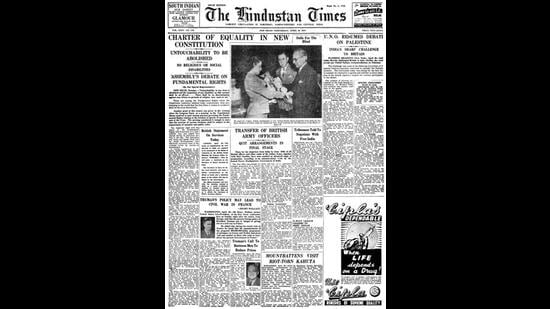
These are among the Fundamental Rights which the Constituent Assembly adopted today unanimously, thus proclaiming to the world that the free State it wishes to construct shall be the most democratic.
Another proof of this resolve was given in the evenning when the Congress Party at a meeting in the Constitution House resolved to omit various provisos governing the Fundamental Rights relating to the freedom of speech, of association and of the Press. The meeting considered it enough to state that the exercise of various freedoms shall be subject to the requirement of morality and public order.
The Assembly dealt with the report of the Fundamental Rights Sub-Committee in a businesslike way and passed five clauses during its four-hour sitting in the day. The discussion was lively and Sardar Patel and Sir Alladi Krishnaswami lyer effectively answered most of the criticism voiced by movers of amendments.
In moving consideration of the report, Sardar Patel spoke briefly, thinking that he would answer critics when they moved their amendments. But Pandit H. N. Kunzru surprised the front- benches by claiming the right of general discussion on the model of the Central Legislature. No one objected to this procedure until he began to indulge in detailed criticism. Finding that the Chair and the House were becoming impatient, he concluded after he had spoken for ten minutes.
{{/usCountry}}In moving consideration of the report, Sardar Patel spoke briefly, thinking that he would answer critics when they moved their amendments. But Pandit H. N. Kunzru surprised the front- benches by claiming the right of general discussion on the model of the Central Legislature. No one objected to this procedure until he began to indulge in detailed criticism. Finding that the Chair and the House were becoming impatient, he concluded after he had spoken for ten minutes.
{{/usCountry}}The Communist member, Mr Lahiri, seized the opportunity thus offered and made a frontal attack on the report. He described it as a ‘”cooked up affair” and as having been drawn up “from a constable’s point of view.” The Socialist Mr Ranga now jumped into the fray and hit out by remarking that the report was “a valuable document” which aimed at protecting the country from totalitarianism whether of the Nazi or Communist type.
In a characteristic retort, Sardar Patel said that the report had not been drawn up from the point of view of those who wanted no police, no restrictions and no laws. It was neither cooked nor uncooked. It had not been prepared in a haphazard way but had been got ready by eminent lawyers.
The critics felt smothered and the House took up consideration of clauses. The first two clauses giving definitions and assuring that all laws in conflict with the fundamental rights shall stand abrogated were passed without much discussion.
Then occurred a battle of legal wits on the definition of citizenship. It started on an innocent-looking question put by Mr B. Das as to whether the definition that every person born in the Union shall be a citizen of the Union was not too liberal to foreigners. The question assumed significance because the President, Dr Rajendra Prasad, declared that it required an answer. Sir Alladi Krishnaswami lyer, who is the brain behind the sub-committee’s report, gave a lucid exposition of the issues involved.
The political argument was provided by Sardar Patel, who said that the world was watching them and they must not bring in racial tinge while they were fighting against racial discrimination in South Africa and elsewhere. The House laughed when he clinched the issue by asking: ‘’How many foreign women are coming here to give birth to children to acquire Indian citizenship?” The President expressed himself us unconvinced and since some members had suggested postponement of the clause the general sense of the House favoured postponement. The President will form a committee of eminent lawyers to re-examine the definition.
When the House debated the clause stating that there shall be no discrimination on grounds of religion, race caste or sex Mr Lahiri (Communist) proposed that there shall be no discrimination on grounds of political creed. Sardar Patel reacted sharply to this plea by remarking: ‘There may be some political creeds which may be highly objectionable and may deserve not discrimination but suppression.” The amendment was rejected, not even the mover saying “aye.”
Mr Rohini Kumar Chaudhry suffered a similar rebuff when he suggested that discrimination on grounds of dress should be banned. His grievance was that some European hotels were still not admitting people wearing Indian dress. ‘They are all quitting,” said Sardar Patel. “Some people are still haunted by ideas of slavery.”