The Supreme Court on Monday called upon a constitution bench to lay down guidelines on how to provide a “real and meaningful” hearing to a convict before reaching a conclusion that hanging remained the only suitable punishment.
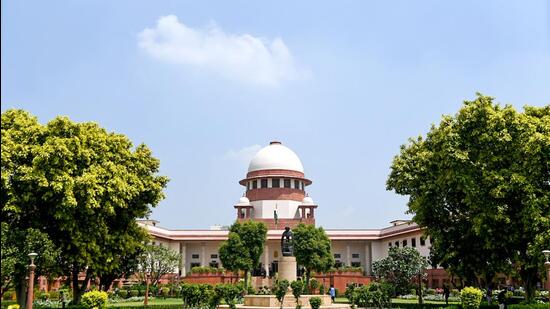
The bench, led by Chief Justice of India Uday Umesh Lalit, held that it is imperative for the top court to come up with an authoritative decision on various aspects of sentencing in cases where the death penalty is a choice of punishment.
It noted the differences of opinion reflected through some three-judge bench decisions on the time required to be given to a convict for bringing on record the mitigating circumstances before the punishment is pronounced.
“This court is of the opinion that it is necessary to have clarity in the matter to ensure a uniform approach on the question of granting real and meaningful opportunity, as opposed to a formal hearing, to the accused/convict, on the issue of sentence,” said the bench, which also comprised justices S Ravindra Bhat and Sudhanshu Dhulia.
The court noted with regret that in all cases where imposition of capital punishment is a choice of sentence, aggravating circumstances would always be on record, and would be part of the prosecution’s evidence, leading to conviction. “Whereas the accused can scarcely be expected to place mitigating circumstances on the record, for the reason that the stage for doing so is after conviction. This places the convict at a hopeless disadvantage, tilting the scales heavily against him,” it added.
{{/usCountry}}The court noted with regret that in all cases where imposition of capital punishment is a choice of sentence, aggravating circumstances would always be on record, and would be part of the prosecution’s evidence, leading to conviction. “Whereas the accused can scarcely be expected to place mitigating circumstances on the record, for the reason that the stage for doing so is after conviction. This places the convict at a hopeless disadvantage, tilting the scales heavily against him,” it added.
{{/usCountry}}Citing the landmark constitution bench ruling in Bachan Singh (1980), the top court pointed out that the verdict upheld the constitutionality of the death sentence, on the condition that it could be imposed in the “rarest of rare” cases. At the same time, the 1980 ruling underlined the safeguard of a separate hearing on the question of sentence to enable a convict to urge why the extreme penalty of death ought not to be imposed. “This aspect – presence of ‘valuable safeguards’ – therefore, was an important consideration to uphold the validity of death sentence, in the rarest of rare cases,” said the bench.
Subsequently, several three-judge bench decisions emphasised that a separate hearing on the question of sentence should be afforded to the accused after recording conviction. However, the court noted in its judgment on Monday, that some other three-judge bench decisions maintained that neither the same-day sentencing nor an absence of opportunity at the trial stage would constitute a violation of the nature that must set aside the conviction order. This line of judgment held that where real and effective hearing may not have been given to a convict at the trial stage, the flaw can be remedied by affording such opportunity at an appellate or review stage.
“The common thread that runs through all these decisions is the express acknowledgment that meaningful, real and effective hearing must be afforded to the accused, with the opportunity to adduce material relevant for the question of sentencing. What is conspicuously absent is consideration and contemplation about the ‘time’ this may require,” said the bench.
Making a reference to a larger bench of five judges, it added: “In light of the above, there exists a clear conflict of opinions by two sets of three judge bench decisions on the subject...The question of what constitutes ‘sufficient time’ at the trial court stage, in this manner appears not to have been addressed... This, in the court’s considered opinion, requires consideration and clarity.”
In March, the bench initiated proceedings on its own motion (suo motu) for revamping the manner in which death sentences are handed down by the courts in the country, observing that it is time to usher in more objectivity in the criminal justice delivery system. It also mulled making psychological evaluation of the condemned prisoner mandatory along with seeking a report on the inmate’s conduct at the time of examining whether gallows remain the only fitting punishment.
In May, another bench led by CJI Lalit and comprising Justice Bhat, issued a slew of directives requiring the sentencing courts to call for a mental health report of each criminal and even assess their conduct in jail. This order was passed while dealing with an appeal filed by three death row convicts from Madhya Pradesh.