Farmers of Punjab trooped to the mandis, or agricultural markets, to sell their produce on Baisakhi, the spring harvest festival, on Monday, holding invitations sent by the state government.
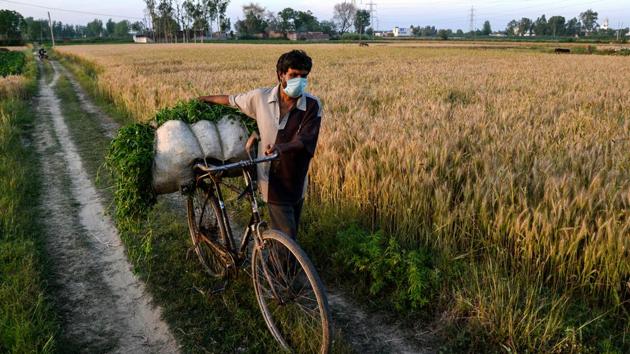
The government of chief minister Capt. Amarinder Singh is trying to limit crowds at the mandis and maintain social distancing norms to avoid the spread of the coronavirus disease and has restricted the entry into markets to invitees.
“To ensure smooth procurement and also follow the instructions in the wake of the Covid-19 outbreak, no farmer can enter a mandi without the invitation of the Punjab Mandi Board through the {agricultural produce} market committee,” Punjab agriculture secretary KS Pannu said.
Each day, a limited number of farmers will be sent coupons with holograms and more coupons will only be issued after the produce that is already in the market is lifted. The sale of wheat of up to 50 quintals of per farmer started on Monday.
The procurement by invitation is an innovation adopted by the Punjab government n the backdrop of Covid-19 and the ensuing lockdown that have already delayed procurement of foodgrains by state agencies by a fortnight in the northern state, neighbouring Haryana and in Madhya Pradesh.
The nationwide lockdown due to Covid-19 had pushed states like Punjab, Haryana and Madhya Pradesh to delay the procurement from farmers by a fortnight. Many states such as Rajasthan, Uttar Pradesh and Telangana have already relaxed lockdown norms allowing work in agriculture fields for harvest.
{{/usCountry}}The nationwide lockdown due to Covid-19 had pushed states like Punjab, Haryana and Madhya Pradesh to delay the procurement from farmers by a fortnight. Many states such as Rajasthan, Uttar Pradesh and Telangana have already relaxed lockdown norms allowing work in agriculture fields for harvest.
{{/usCountry}}Punjab’s food and civil supplies minister Bharat Bhushan Ashu said that to spread out the procurement, 1,897 rice shelling mills with large open spaces have been converted into procurement centres, in addition to 1,864 markets and procurement centres. Gloves, masks and sanitisers are being provided at all procurement centres, said additional chief secretary (development) Viswajeet Khanna.
India is expecting a 7% increase in rabi, or winter-sown, crop production this year, the highest in a decade, because of a wetter-than-usual winter, which prompted farmers to increase acreage by 15-20%. The Centre has announced an increase in the minimum support price ranging from 4.5% to 7.5% for rabi crops this season.
Punjab alone is expecting an output of 13.5 million tonnes of wheat worth ₹26,000 crore. Haryana’s production is estimated at 12 million tonnes, Uttar Pradesh 10 million tonnes and Madhya Pradesh about 6 million tonnes.
In Haryana, procurement will start at 140 purchase centres from Tuesday, April 14, of harvested mustard seeds. The real test will begin on April 20 when wheat will arrive in about 2,000 procurement centres.
“Until last year most of the procurement operations used to be over in 25 days, now we will stagger the procurement operations up to two months. The procurement will continue till June 20,” Haryana chief minister Manohar Lal Khattar said.
The farmers will be allowed to visit Mandi in two time slots from 8am to 2pm and from 2:30 pm to 6pm and there will be one procurement center for three villages. Every possible covered space, like sheds owned by the Dera Sacha Sauda, empty grounds of rice millers and school premises will be used for procurement, Haryana officials said.
In Uttar Pradesh, despite the lockdown, 34% of the wheat crop has been harvested. “Of the total wheat coverage 9.88 million hectares, 33.89 hectares was harvested by April 12 and this is 34% of the total wheat sown in UP,” said UP’s director (agriculture) Soraj Singh said.
“The rabi harvesting is going as smoothly as earlier and the coronavirus lockdown has had no impact on agricultural activities although people are taking precaution against the disease,” said Ram Saran Verma of Barabanki, a Padam Shri awardee progressive farmer.
Soraj Singh said inter-district movement of farm workers and equipment had not been restricted and farm equipment from other states too can come in, provided the local district magistrates issue passes. The government has also extended the period of payment of short-term farm loans.
In Madhya Pradesh, the procurement of rabi crops including wheat, pulses and mustard will start on Tuesday except in the Covid-19 hotspots of Indore, Ujjain and Bhopal. Farmers would be given specific time slots to bring their produce to 1,241 markets and not more than 10 farmers will be invited in a particular time frame.
Farmers have been advised to sell produce to traders through letter of sale, MP chief minister Shivraj Singh Chouhan said. The MP government has told farmers to make that before bringing their crops to markets, the grains should are cleaned and dried.
The biggest hurdle in the staggered procurement is a shortage of labour. “We plan to use workers under the Mahatma Gandhi National Rural Employment Guarantee Scheme for procurement,” said Haryana deputy chief minister Dushyant Chautala. States such as Punjab and Uttar Pradesh also intend to employ migrant workers for procurement, officials said.
Another issue the states are facing is a shortage of jute bags to pack the wheat in because of the closure of mills in West Bengal, whose chief minister Mamata Banerjee has refused to allow the mills to function on grounds that it would violate lockdown norms.