Many of the farmers in this Punjab village admit that they are going to burn the paddy stubble left after the harvest — the main source of pollution in the National Capital Region in October and November.
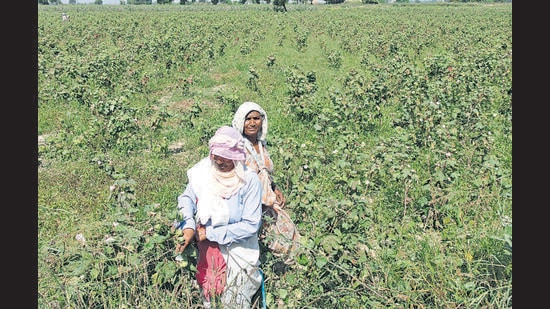
Most are also desperate to move out of the paddy-wheat cycle of cropping. The Central Ground Water Board (CGWB) has warned them that they have groundwater left for 15 more years — at a stretch. As they prepare to harvest their nearly mature
Many of the farmers in this Punjab village admit that they are going to burn the paddy stubble left after the harvest — the main source of pollution in the National Capital Region in October and November.
Most are also desperate to move out of the paddy-wheat cycle of cropping. The Central Ground Water Board (CGWB) has warned them that they have groundwater left for 15 more years — at a stretch. As they prepare to harvest their nearly mature paddy crop, they say they have realised that farming has become unsustainable for several reasons: a water table that has fallen to the “red”, or “overexploited” category; rising costs of pesticide and other inputs; extreme weather events such as unseasonal rain of the sort that hit all of northwest India in early October; and the problem of dealing with paddy stubble.
CGWB’s groundwater resource assessment for 2020 shows most blocks in Punjab are in the “overexploited” or “critical” categories. Bajakhana, a small village in Faridkot district, is in one such block. The entire region is also affected by water salinity, and high fluoride, nitrate and arsenic levels.
“We have groundwater left for only 15 years in this village. What will our children do? They are already selling farmland to move abroad. Every farming family has suicide cases here driven by debt and every family here has at least one case of cancer. The issue of paddy stubble is linked to our farming practices in this region. If we did not practice intensive paddy-wheat farming, this problem would have never arisen,” said Inderjeet Singh, farm leader, Bharatiya Kisan Ekta, Bajakhana.
“We realise that the only solution to the problem is crop diversification. Farmers also want to diversify but government has to provide minimum support price and the crop has to be accepted in the market, otherwise how can farmers diversify confidently?”
Diversification comes with risks that many farmers aren’t equipped to handle.
For instance, this year, farmers who chose to grow cotton in Punjab and Haryana are devastated because entire crop has failed due to bad seeds. “Since the implementation of Green Revolution 1960 onwards university scientists and government recommended that we follow extremely chemical dependent farming. We knew that during desi kheti (traditional agriculture) our grandparents used to grow 4-5 quintals of paddy in one acre. We were told by the government that if we adopt their methods each acre will produce 50 to 60 quintals. So, we adopted it and now we are in a vicious cycle of complete dependence on the market and universities for seeds, manure, pesticides, entire economics of what we are selling is dependent on them. Now this farming is unsustainable in Punjab,” Singh said.
He claimed that their demands for alternative crops have received no response from the government.
Agriculture minister Kuldeep Singh Dhaliwal said that diversification is on top of the priority list of the state government. “We actually need to stop growing paddy in Punjab as it is not a native crop and is also causing environmental hazard,” he said.
According to the minister, a policy on agriculture will soon be announced to address the issue. “The Punjab government will also approach the Centre for support to help it pull the state out of the stubble trouble which is negatively impacting the north Indian states and nation’s capital,” he said.
An official in the Union agriculture ministry, requesting anonymity, said, “This is a complicated issue that needs a very detailed response. We have to look at what efforts are being made.”
The dependence on paddy (rice), especially, has ruined Punjab’s water table, and with the availability of water (controlled by the government) governing cropping cycles, it is indirectly the cause for stubble burning.
Unseasonal rain and prolonged extreme heat (of the sort seen earlier this year; and the climate crisis will increase the frequency of these events) have also increased input costs in these regions.
Hira Singh from Sirsa used pesticides worth ₹15,000 per acre this time for his paddy. “The cost on pesticides is way too high for paddy because it is so vulnerable to pests. At least 7 different kinds of pesticide and insecticides are used. Over and above that due to unpredictable weather use of pesticides has gone up. Due to unseasonal rain like the one we saw in late September, the chances of fungal infestation is high. Extreme heat causes damage to wheat. In fact, too much difference in the day and night temperatures also affects the paddy crop. Now the days are extremely hot while nights are colder than expected. Over the years, this too has played a major role in the increase of agri-inputs used. We are now cultivating cotton also to see how we can diversify our crop,” he said.
Farm leaders said the government does not understand ground realities. “When the government is not helping farmers diversify their crop, they should at least understand the compulsions for burning stubble. Nobody wants to expose themselves and their families to the smoke from stubble fires but the solutions provided by governments are not practical and I don’t think they have tried it on ground. The decomposer for instance may work well in the lab but it takes at least 20 days to decompose and has led to pest infestation in many farms,” said S Agrej Singh Khara, general secretary, BKE in Sirsa.
Pusa decomposer, a consortium of seven fungi, has been developed on the basis of their lingo cellulolytic enzyme production potential. This composting technology has been recognized as the most suitable means to convert and decompose agro-wastes according to Indian Agricultural Research Institute (IARI).
“We have always said that Pusa decomposer will take 20 to 25 days to decompose stubble. It cannot happen earlier. We haven’t found any pest or fungal infestation issue. We will check if there is any such concern,” said Trilochan Mohapatra, former DG, ICAR who was closely associated with development of the decomposer.
There is a fear among farmers that their soil quality has irreversibly deteriorated and the rising cases of cancer and suicides in these districts are associated with increased use of pesticides and rising debt. In Kot Kapura, HT met more farmers whose paddy crop will be ready for harvesting after October 20. “Most of us here suffer from mental health issues. The treatment costs are high. We believe that this has got to do with the mix of pesticides we use for paddy because the environmental conditions are not suited for it. Some farmers tried moong dal last year but did not get a fair price,” said Sukhmandar Singh, farmer leader from Kot Kapura, another village in the “overexploited” zone.
An additional challenge for the arid regions of Haryana and Punjab is the failure of the cotton crop and use of spurious DAP fertilizer in many places. “In neighbouring Ellenabad we caught a huge consignment of spurious DAP but by then most farmers had already procured DAP for paddy. Then again the cotton seeds turned out to be spurious. We do not know whether they are in fact Bt Cotton seeds or not,” said Khara.
“The sustainable long-term solution will emerge from diversification of crops and reduction in non-basmati paddy. Currently, area under paddy continues to dominate Punjab’s Kharif (monsoon) crop mix leading to enormous paddy residue generation. Setting of targets for eliminating incidents of fire count due to stubble burning shall help to guide the performance planning of in-situ and ex-situ measures,” the Policy to Curb Air Pollution in NCR released by Commission for Air Quality Management (CAQM) in July states.
CAQM, in its action plan, acknowledges that the practice of stubble burning continues despite several government and judicial interventions.
“Apart from various directions from NGT, and former EPCA, there have been multiple advisories/directions from CAQM in 2021. There are policies and schemes from central government, which include National policy for management of crop residue (2014), Central scheme on promotion of agricultural mechanisation for in-situ management of crop residue in the states of Punjab, Haryana, UP and NCT of Delhi (2018 onward) — in this scheme a total amount of ₹1,726.67 crore (2018- 2021) has been provided to state. Another scheme — the Sustainable Agrarian Mission on Use of Agro Residue in Thermal Power Plants (SAMARTH) — has been initiated in 2022. Plans and schemes to reduce the generation of paddy straw aim to promote basmati variety (some basmati varieties can be harvested early so the stubble can be allowed to degenerate); short duration and early maturing varieties; and crop diversification.”
According to the report, CAQM has planned to totally suspend certification and use of the PUSA 44 variety of paddy seeds. PUSA 44 is a long duration paddy and hence its stubble needs to be managed in a very short window so as to prepare the farmland for Rabi crops. Due to this, farmers often resort to burning the PUSA 44 paddy stubble. HT reported on June 19 that Punjab government plans to phase out this water-intensive non-basmati variety in the next three kharif seasons.
Among several in-situ and ex-situ measures, CAQM has recommended schemes to reduce generation of paddy straw through crop diversification and diversification to short duration paddy varieties, in its policy to curb air pollution in Delhi NCR released in July. The BJP-JJP government in Haryana has set a target to diversify at least one lakh acre land under paddy cultivation to crops such as pulses, cereals, cotton and maize every year to check Haryana’s rapidly deleting ground water table. Under the state’s flagship ‘mera pani- meri virasat’ policy, farmers sowing alternative crops in place of paddy are paid ₹7,000 per acre, of which ₹2,000 is paid after first verification, and ₹5,000 at the time of harvesting, HT reported on May 25.
There is a push for crop diversification in Punjab as well. Market trends indicate that the Punjab government’s push for pulse cultivation did not do well as most of the summer moong was being purchased up to 30% less than the MSP of ₹ 7,225 per quintal, HT reported on June 27.
One Subscription.
Get 360° coverage—from daily headlines
to 100 year archives.
Archives
HT App & Website