
 E-Paper



Public bike-sharing cheapest mode for last-mile connectivity in Mumbai: Survey
The analysis by World Resources Institute (WRI) India shows that while public bike-sharing costs ₹2 for a five km ride, the same distance costs ₹5 in a BEST bus and local train (second class), ₹50 in first class and ₹20 in Metro


Cycling could turn out to be the cheapest mode of transport for the last-mile connectivity in Mumbai, shows a recent survey.
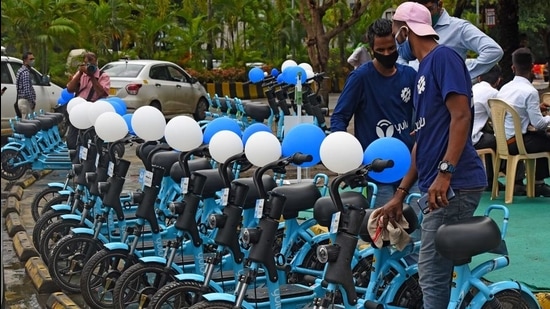
The analysis by the World Resources Institute (WRI) India shows that while public bike-sharing (introduced at two Mumbai Metro stations) costs ₹2 for a five km ride, the same distance costs ₹5 in a BEST bus and local train (second class), ₹50 in first class and ₹20 in Metro.
It gets more expensive if one opts for an auto ( ₹60.67), a black and yellow taxi ( ₹74) or an app-based cab ( ₹115). The analysis has assessed the cycling speed to be around 6km per hour. The newly-introduced public bike-sharing scheme at the Versova and Jagruti Nagar Metro station costs ₹2 per hour.
For trains, the report looks at the pricing between the Churchgate and Chhatrapati Shivaji Terminus (CST) stations.
First- and last-mile connectivity refers to the beginning and end of a commute made using public transportation and has been a huge issue in the city.
Prateek Diwan, senior project associate - urban innovative and integrated transport, WRI India said, “Public transportation becomes effective when commuters have a range of last-mile connectivity options, which is usually at a distance of about 2-5 kms. Apart from being a low-cost mode of travel, cycling also allows commuters flexibility to change routes and is the most sustainable transport option.”
Almost 35% of vehicular trips in India are short trips (less than 5 kms). The Brihanmumbai Municipal Corporation’s (BMC) development plan 2032 also states that 60% of the start and end of public transport trips are by walking and more than 80% of it is for less than 15 minutes, which effectively means that these trips, in conducive weather, can also translate into cycling trips.
The Mumbai Metropolitan Region Development Authority (MMRDA), which is implementing a 337km-Metro network in Mumbai and its adjoining areas, is also giving a lot of importance to cycling as an attractive last-mile option. Apart from introducing cycling in two Metro stations, it has introduced e-scooters in Bandra-Kurla Complex. MMRDA has also planned cycle bays across all upcoming 200+ Metro stations as part of its larger multimodal integration plan.


