Several districts in south Tamil Nadu and south Kerala will receive heavy to very heavy rainfall and extremely heavy rain (over 20 cm) with cyclonic storm Burevi heading towards the Tamil Nadu coast, the India Meteorological Department (IMD) said on Wednesday.
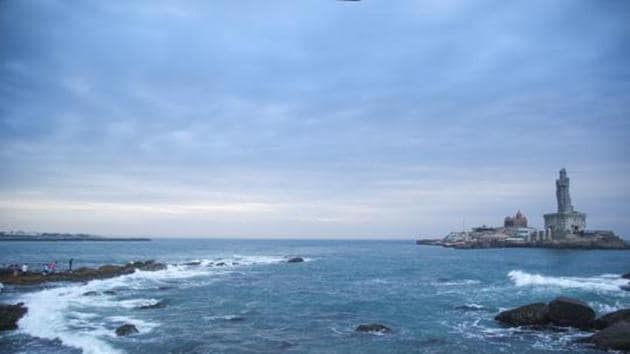
Burevi crossed the Sri Lanka coast close to north of Trincomalee between 10.30pm and 11.30pm on Wednesday as a cyclonic storm with a wind speed of 80-90 kmph gusting to 100 kmph. It lay centred over Sri Lanka (close to north of Trincomalee), about 40 km north-northwest of Trincomalee, 190 km east-southeast of Pamban (India) and 380 km east-northeast of Kanyakumari (India).
It is very likely to move nearly west-northwestwards and emerge into Gulf of Mannar Thursday morning. The cyclonic storm with wind speed of 70-80 gusting to 90 kmph would be centred very close to Pamban around noon. It would then move nearly west-southwestwards across Pamban area by afternoon and cross south Tamil Nadu coast between Pamban and Kanyakumari between Thursday night and Friday early morning as a cyclonic storm with wind speed of 70-80 gusting to 90 kmph. Thus, its impact on south Tamil Nadu’s coastal districts is very likely to commence from forenoon today initially over Ramanathapuram district and gradually towards Kanyakumari district.
“Adverse weather in south Tamil Nadu is likely to begin much before Burevi makes landfall on Friday. This is because the storm will be crossing a narrow strip of ocean between two landmasses along the Palk Strait. Though it will first make landfall over Sri Lanka, it will cross a very narrow strip of land and continue to draw energy from the ocean and hence make landfall again as a cyclonic storm,” Sunitha Devi, in charge of cyclones at IMD said on Wednesday.
{{/usCountry}}“Adverse weather in south Tamil Nadu is likely to begin much before Burevi makes landfall on Friday. This is because the storm will be crossing a narrow strip of ocean between two landmasses along the Palk Strait. Though it will first make landfall over Sri Lanka, it will cross a very narrow strip of land and continue to draw energy from the ocean and hence make landfall again as a cyclonic storm,” Sunitha Devi, in charge of cyclones at IMD said on Wednesday.
{{/usCountry}}“It’s likely to intensify further. The sea surface temperature in the Bay is around 0.5 degree Celsius above normal presently,” she added. Heavy to very heavy rainfall at a few places with isolated extremely heavy rain is likely over south Tamil Nadu (Kanyakumari, Tirunelveli, Thoothukudi, Tenkasi, Ramanathapuram and Sivagangai) on December 2 and 3; over south Kerala (Thiruvananthapuram, Kollam, Pathanamthitta and Alappuzha) on December 3 and isolated heavy to very heavy rainfall likely over south Tamil Nadu on December 2 and 4 December and south Kerala on December 3 and 4.
Also read | ‘Praying for the safety and well-being,’ PM Modi assures help to Kerala, Tamil Nadu ahead of cyclone Burevi
Heavy to very heavy rainfall is also likely over north Tamil Nadu, Puducherry, Mahe, Karaikal and north Kerala on December 2 and 3 and heavy rainfall is likely over south coastal Andhra Pradesh on December 2 and 3 and over Lakshadweep on December 3 and 4.
Squally winds reaching 45-55 kmph gusting to 65 kmph is very likely over Comorin Area, Gulf of Mannar and along and off south Tamil Nadu coast (Kanyakumari, Tirunelveli, Thoothukudi and Ramanathapuram districts) and south Kerala coast (Thiruvananthapuram, Kollam, Pathanamthitta and Alappuzha districts) from December 2 forenoon. It will gradually increase becoming 55-65 kmph gusting to 75 kmph from Wednesday evening and 70-80 kmph gusting to 90 kmph from Thursday evening for subsequent 12 hours and decrease thereafter.
Authorities urged fishermen not to venture into southeast Bay of Bengal, southwest Bay of Bengal and along and off east Sri Lanka coast from December 2 to 3; Comorin Area, Gulf of Mannar and south Tamil Nadu-Kerala and west Sri Lanka coasts from December 2 to 4, over Lakshadweep-Maldives area and adjoining southeast Arabian Sea from December 3 to 4.