
 E-Paper



Day not far when Chhattisgarh and India will be free from Maoist terror: PM Modi
PM Modi hailed Chhattisgarh on its formation day, saying that the seed sown 25 years ago has now grown into a ‘vat vriksh’ (banyan tree) of development


Raipur: Prime Minister Narendra Modi on Saturday said the number of Maoist-affected districts in the country has dropped from 125 to just three in the last 11 years, expressing confidence that the day is not far when every corner of Chhattisgarh and India will be completely free from the menace of Maoism.
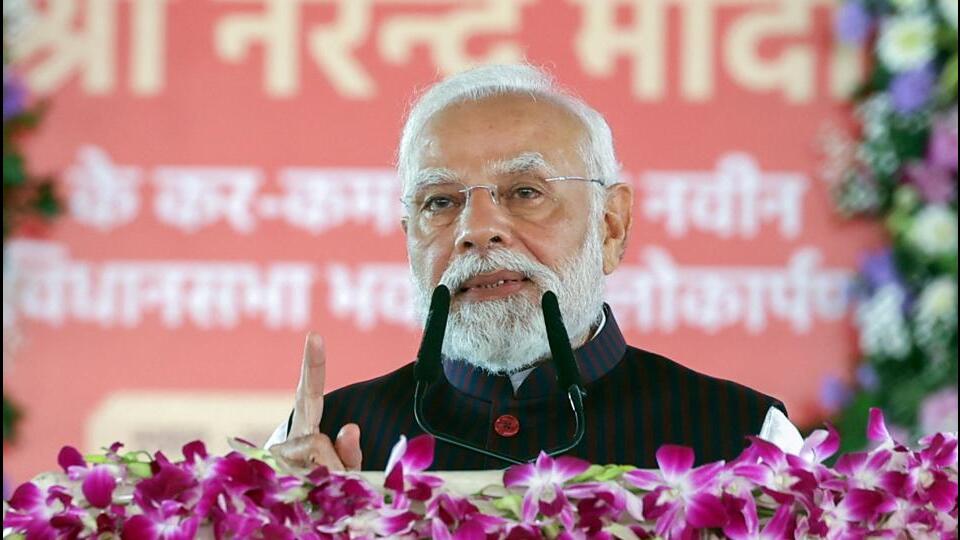
Speaking at the Chhattisgarh Rajat Mahotsav in Nava Raipur, marking the 25th anniversary of the state’s formation, Modi hailed Chhattisgarh’s journey of progress, saying that the seed sown 25 years ago had now grown into a “vat vriksh” (banyan tree) of development.
“For 50 years, the people here suffered unbearable pain because of Maoism. Those who show off the Constitution and shed crocodile tears in the name of social justice have committed injustice to you for their vested interests,” he said.
“Maoist ideology deprived tribal regions of basic facilities. For years, tribal villages lacked roads, schools and hospitals. The existing ones were blown up with bombs. Doctors and teachers were killed. Those who ruled the country for decades abandoned you while they enjoyed life in their air-conditioned offices,” Modi said
“I could not stand by and watch my tribal brothers and sisters being destroyed by violence. I could not bear to see mothers crying for their children. In 2014, when you gave us the opportunity, we resolved to free India from Maoist terror. Today, the results are before the nation,” he said.
Modi also inaugurated the new Chhattisgarh Legislative Assembly building in Nava Raipur Atal Nagar and unveiled a statue of former prime minister late Atal Bihari Vajpayee on the premises.
Addressing the gathering, Modi said Chhattisgarh’s 25-year journey has been inspiring — from being known for Maoist violence and backwardness to emerging as a symbol of prosperity, security, and stability.
“The state’s transformation reflects the hard work of the people of Chhattisgarh and the visionary leadership of successive BJP governments,” he said, adding that development and peace have now reached even the areas once dominated by Maoists.
Modi said that 11 years ago, 125 districts across India were affected by Maoist extremism, but today only three remain. “I guarantee that the day is not far when every corner of Chhattisgarh and India will be completely free from Maoist terror,” he asserted.
Highlighting recent surrenders of Maoists, the Prime Minister said dozens of Maoists — including those carrying rewards worth lakhs and crores of rupees — had laid down arms in the past few months. “In Kanker, more than 20 Maoists surrendered recently, and earlier in October, over 200 Maoists gave up arms in Bastar. They have accepted the Indian Constitution and chosen the path of peace,” he said.
Modi said that areas once dominated by fear and violence were now witnessing change. “Electricity has reached Chikapalli village of Bijapur for the first time in 70 years, and a school has opened in Rekawaya village of Abujhmad since Independence. Development work is in full swing at Puvarti, once known as a terror hub, and today the tricolour flies proudly where the red flag once stood,” he said.
“Despite facing the challenge of Maoism for 25 years, Chhattisgarh kept moving forward. Now, with the end of Maoism, our pace of development will only accelerate,” he asserted.
Referring to the newly inaugurated assembly building, Modi said it represents not just a space for making laws, but a vibrant centre for shaping Chhattisgarh’s destiny. “Every thought emerging from the assembly should reflect the spirit of public service, a commitment to development, and confidence in taking India to greater heights,” he said.
He stressed that laws made in the assembly should promote reforms, ease people’s lives, and remove unnecessary government interference. “There should be neither a lack of government presence nor unnecessary influence,” he said, adding that the mantra of good governance should be ‘Nagrik Devo Bhava’ (Citizen is God).
Modi also underlined India’s success in combating terrorism and left-wing extremism, saying, “India has broken the backbone of terrorists. Now Chhattisgarh too is moving towards becoming free of Maoist violence.”
He said India is moving forward by balancing heritage and development, and this sentiment is visible in every policy and decision of the government. The Prime Minister added that Chhattisgarh’s 25th foundation anniversary marks the beginning of a larger goal — contributing to the vision of a developed India by 2047, when the nation celebrates 100 years of independence.
Earlier in the day, the Prime Minister inaugurated the Shanti Shikhar centre for spiritual learning and meditation of the Brahma Kumaris in Nava Raipur. Addressing the gathering, Modi said India has always been the first to respond during any global crisis and has consistently stepped forward as a reliable partner to provide help.
“Whenever a crisis arises anywhere in the world, whenever a disaster strikes, India steps forward as a reliable partner to provide assistance. India is always the first responder,” he said.
“We are those who see Shiva in every living being,” he added, noting that in India’s spiritual tradition, every ritual ends with the wish for universal peace and well-being.
Guided by the mantra that the development of states leads to the development of the nation, Modi said his government is working on the Viksit Bharat Mission to make India a developed country. Institutions like the Brahma Kumaris, he said, have an important role to play in this journey.
He also interacted with 2,500 children who were successfully treated for congenital heart diseases at the Gift of Life ceremony held at Sri Sathya Sai Sanjeevani Hospital in Nava Raipur, as part of the Dil Ki Baat programme. Former India cricket captain Sunil Gavaskar was also present on the occasion.
Later in the day, Modi inaugurated and laid the foundation stones for development projects worth ₹14,260 crore across key sectors such as roads, industry, healthcare, and energy in the state.
-kW0H-U20214218012MgB-250x250%40HT-Web.jpg)


