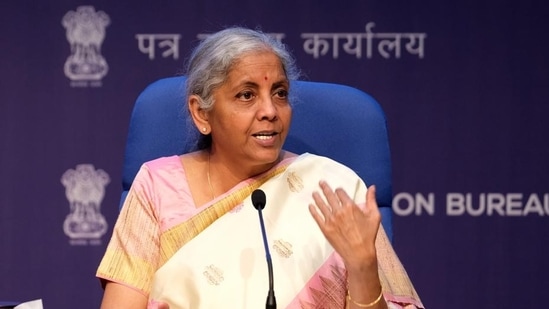
Finance minister Nirmala Sitharaman’s 10-day visit to the US, during which she met with officials of the World Bank and the International Monetary Fund (IMF); G20 finance ministers; and industry representatives was, apart from other things, focused on promoting India as a reliable, trustworthy, democratic country which is committed to a predictable rules-based regime and provides a globally competitive environment for investors to manufacture in India and supply to the world, two people familiar with the matter said.
The minister
Finance minister Nirmala Sitharaman’s 10-day visit to the US, during which she met with officials of the World Bank and the International Monetary Fund (IMF); G20 finance ministers; and industry representatives was, apart from other things, focused on promoting India as a reliable, trustworthy, democratic country which is committed to a predictable rules-based regime and provides a globally competitive environment for investors to manufacture in India and supply to the world, two people familiar with the matter said.
The minister travelled to several cities in the US and sought to promote India as a reliable global supply chain node even as she met US government representatives to deeper economic ties between the two democracies, and, in multilateral fora, stressed on the need for tougher action against terror financing, and underscored the need to rein in rising fuel prices for quicker energy transition, they added, asking not to be named.
American technology giants and multinationals firms either committed to invest in India or evinced interest in setting up their facilities in world’s fastest growing economies. Senior executives of several American firms, including First Solar, Bloom Energy, Starwood Energy, Applied Materials Inc, Western Digital Corporation, AMD, Azure, Accenture, MasterCard, MicronTech, Deloitte, Uber, Boeing, and FedEx met Sitharaman during the visit, the people said.
They added that the minister had four kinds of meetings during her visit: those in multilateral fora such as the World Bank, IMF, the Financial Action Task Force (FATF), and the G20; bilateral discussions with the US, Sri Lanka, Indonesia, Korea and South Africa; interactions with industry; and engagements with academia and think tanks.
“At various forums, the FM highlighted the vision and policies of Prime Minister Narendra Modi – such as ‘Atamnirbhar Bharat Abhiyan’ (self-reliant India campaign) and enhanced capital expenditure – which not only minimised disruptions due to the Covid-19 pandemic, but also ensured rapid economic recovery post-pandemic,” one of the two people said.
IMF’s latest estimate puts India’s growth at 8.2% this financial year, down from the 9% projected in January, but still the fastest among major economies. IMF revised global and country growths down recently on account of Russia’s invasion of Ukraine and the impact of this on food and commodity markets around the world.
American industry representatives such as Western Digital senior vice president Dan Steere, AMD chief financial officer Devinder Kumar, and Azure Hardware systems & infrastructure vice president Rani N Brokar said they were looking at India as important investment destination for development of new age technologies, the people said. Semiconductor Industry Association president and CEO John Neuffer told Sitharaman that he was “upbeat” about the initiatives taken by the Indian government in promoting investments in the semiconductor ecosystem and appreciated India’s commitment to become a reliable player in global supply chain. The government last year announced a ₹76,000 crore plan to boost the manufacturing of semiconductors and displays in India.
On Tuesday, while addressing a roundtable on ‘Investing in India’s Digital Revolution’ in San Francisco, Sitharaman assured investors all support in facilitating their investments in the country and promised that the government would address any possible pain points to encourage investments in the country. The finance minister also interacted with women CXOs from various sectors such as fintech, health, education and information technology and spoke about the Indian government’s focus on economically empowering women.
“Earlier, FM also met the US secretary of commerce Gina M Raimondo and spoke about economic interests of the two countries – how to further strengthen the ties in both bilateral and global contexts,” the first person said.
Russia’s invasion of Ukraine did come up, but the finance minister reiterated India’s position. India has consistently spoken of the need to respect territorial integrity even as it has stressed its long-standing relationship with Russia. Last week, commenting on the orchestrated walkout by some officials from the US, Britain and Canada at the G20 finance meeting when Russian officials spoke, Sitharaman said: “There are some of us who did not walk out...” She said the chairperson [Indonesia] discussed such concerns prior to the meeting with India also as New Delhi is the part of the troika (the country holding past presidency, the current chair and the next to hold the presidency) and that a call was taken that the G20 article of association doesn’t have anything that gives the right to the chairperson not to invite a member.
Sitharaman pointed out on Tuesday after the G20 meetingthat sanctions have collateral impact on global economies and it is not just confined to the specific country being targeted (in this case Russia) as the world is globally interconnected, “much more than ever before”. She said the interconnectedness in the digital era has great advantages, but it also brings lots of collateral or unintended consequences due to sanctions. The minister referred to global supply chain disruptions, high fuel prices and shortage of essential commodities in many countries.
“I think, when sanctions are decided to be imposed these set of unintended consequences may have to be factored in from now,” she said. Referring to the current sanctions against Russia, she said India’s position is on account of its geopolitical location and because of the way in which “over the decades” it had to defend itself almost alone. “So, India definitely remembers those instances. But, in a globally connected world... digitally connected world, remembering this is just not good enough. We have to work with the current situation…,” she said.
Replying to a specific query on India’s policy position on cryptocurrencies at Stanford University, she acknowledged the potential of technology behind them – the distributed ledger and the blockchain – because they are used for many purposes other than just for making payments. She, however, said that besides positive contributions, they could also be “manipulated for not so desirable ends” such as “money laundering” or “financing terror” and these concerns are being discussed at global multilateral forums such as the World Bank and IMF. “If there is impatience outside in the world – what are you doing about crypto? – I can under the impatience... At least with given available information we are taking a discerned decision. It can’t be rushed through”. India has said that its central bank will launch a digital currency later this year.
While speaking at a business roundtable organised by FICCI and USISPF in Palo Alto, California on Tuesday, she said: “There is a continuous digital nudge by the government across sectors.”
She was referring to the recently announced Central Bank Digital Currency (CBDC) expected 2023, 75 digital banks, and the digital university, among other such initiatives. She invited stakeholders interested in Indian startups to engage with the Startup Cell at the Department for Promotion of Industry and Internal Trade (DPIIT) under the ministry of commerce and industry.
One Subscription.
Get 360° coverage—from daily headlines
to 100 year archives.
Archives
HT App & Website