
 E-Paper



De-escalation of border conflict with China the way forward, says Rajnath Singh
India and China’s armies still have 50,000 to 60,000 troops and advanced weaponry deployed in the Ladakh theatre despite three rounds of disengagement at friction points on the Line of Actual Control (LAC)

 Prefer HTon Google


NEW DELHI: Defence minister Rajnath Singh on Thursday said that disengagement of rival troops and de-escalation of the border conflict with China in the Ladakh sector was the way forward, and the ongoing talks for peaceful resolution of the standoff would continue even as Indian troops stood firm on the ground.
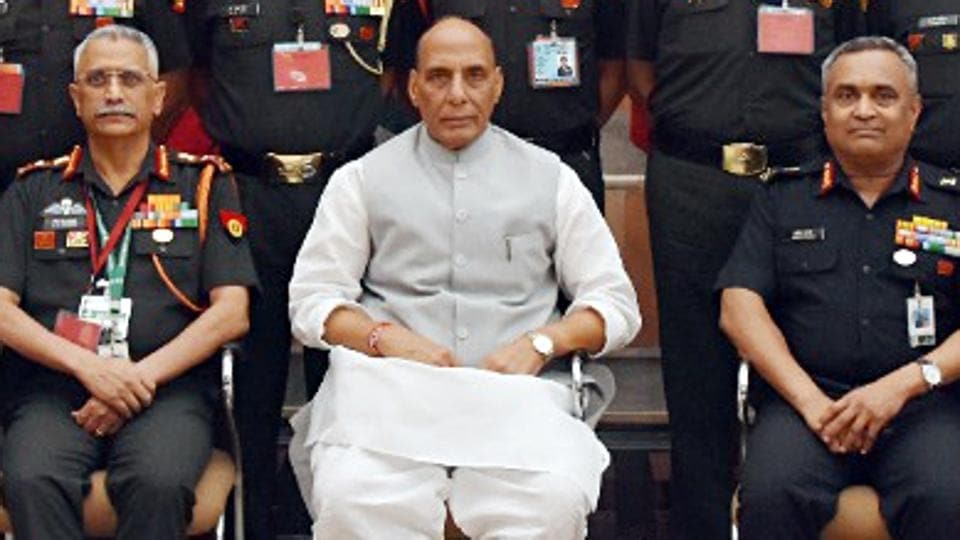
He said the government was committed to providing the best weapons and gear to soldiers guarding the country’s farthest frontiers. Singh also announced an upward revision in risk and hardship allowance for soldiers posted in field areas.
“It is our ‘whole-of-the-government’ approach to ensure availability of best weapons, equipment and clothing to our troops braving extreme weather and hostile forces to defend our territorial integrity,” Singh said, while addressing the army’s top commanders during an ongoing conference.
Despite three rounds of disengagement at friction points on the Line of Actual Control (LAC) - Galwan, Pangong Tso and Gogra - the two armies still have 50,000 to 60,000 troops each and advanced weaponry deployed in the Ladakh theatre.
Also Read: China focus, jointness key tasks for new army chief
In a joint statement issued after 15th round of military talks held on March 11, Indian and Chinese commanders agreed to carry on dialogue through military and diplomatic channels to reach a mutually acceptable resolution of outstanding problems at friction points on LAC. The two countries have been locked in a border row since May 2020.
Lieutenant General Rakesh Sharma (retd), a military affairs expert and former commander of the Leh-based HQs 14 Corps, said while disengagement and de-escalation was the way forward, it was essential to read into the extensive infrastructure being created by the Chinese People’s Liberation Army (PLA) in proximity to LAC and in Tibet, which sends out ominous signals.
“Also, there is a trust deficit, which cannot be easily obviated, and mandates caution. The temporary patrolling moratoriums being created are not a long-term solution. Delineation and demarcation are the way forward, but on the latter, there is just no movement. We have to keep our guard up till some tangible movement is evident,” Sharma added.
During the ongoing conference, which ends on Friday, the army’s top brass also assessed the impact of the Russia-Ukraine war on India’s military preparedness as two-thirds of the country’s military equipment is of Russian-origin, reviewed the situation along the country’s borders with China and Pakistan, and deliberated on modernisation through indigenisation, officials familiar with the matter said.
“Unconventional and asymmetric warfare, including hybrid war, will be part of the future conventional wars. Cyber, information, communication, trade and finance have all become an inseparable part of future conflicts. The armed forces will have to keep all these facets in consideration while planning and formulating strategies,” the defence minister said.
He said the formalisation of theatre commands was the need of the hour and he was happy with the progress being made. “I have full confidence in the senior military leadership.”
India is working on a roadmap for the military’s theaterisation – a long-awaited defence reform - to best utilise the resources of the three services for future wars and operations. The current theaterisation model to enhance tri-service synergy seeks to set up four integrated commands - two land-centric theatres, an air defence command and a maritime theatre command.
The three services are expected to submit comprehensive reports on theaterisation and join structures this month.
Army’s risk and hardship allowance enhanced
Defence minister Rajnath Singh announced an upward revision in the risk and hardship allowance for soldiers posted in field areas during the Army Commanders’ Conference.
This allowance was enhanced for men from the central armed police forces after the February 2019 Pulwama attack in which 40 CRPF personnel were killed in a suicide attack. The allowance was hiked when Singh was the home minister.
However, the risk and hardship allowance for soldiers was not increased. This anomaly has been sorted out by the defence ministry.
“After the Pulwama attack a CRPF jawan posted in a field area was drawing a risk and hardship allowance of around ₹20,000, compared to ₹10,000 that a soldier posted in the same location was getting. It’s good that parity has been restored now,” said an official familiar with the matter.


