The agreements for the supply of BrahMos cruise missiles and Astra beyond visual range air-to-air missiles to Indonesia’s armed forces are expected to provide fresh momentum to India’s defence export push, officials aware of the matter said on Tuesday.
The development further elevates the country’s profile as a credible defence exporter, officials said asking not to be named. India has set a target of achieving ₹50,000 crore in defence exports by 2029-30.
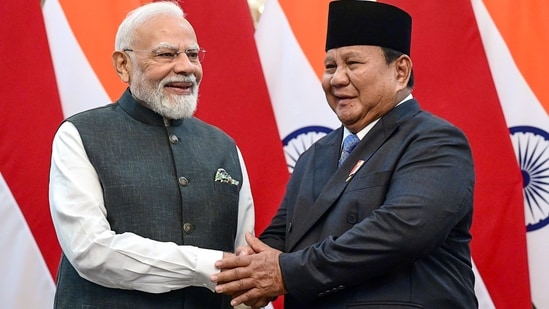
BrahMos Aerospace, an Indo-Russian joint venture, signed a contract with Indonesia’s defence ministry for the BrahMos missile system, while state-run Bharat Dynamics Limited inked a deal with Republikorp, Indonesia’s leading private defence holding company, for the Astra missile, as Prime Minister Narendra Modi and President Prabowo Subianto agreed to further strengthen defence cooperation.
Boosting defence exports is a key government priority. India’s defence exports hit a record ₹38,424 crore in 2025-26, up 63% from ₹23,622 crore in the previous financial year.
India is expected to supply two batteries of the BrahMos missile system, including missiles, launchers and radars, as part of Indonesia’s effort to modernise its military, people familiar with the matter said. Indonesia initially sought only one battery but this was later increased to two, they added. Earlier reports had said the deal would be worth about $350 million.
Indonesia is the third Asean member state, after the Philippines and Vietnam, to acquire the BrahMos cruise missile jointly developed by India and Russia. The missile proved its lethality during last year’s conflict with Pakistan.
{{/usCountry}}Indonesia is the third Asean member state, after the Philippines and Vietnam, to acquire the BrahMos cruise missile jointly developed by India and Russia. The missile proved its lethality during last year’s conflict with Pakistan.
{{/usCountry}}The deal for the indigenous Astra missile marks the first export of the weapon system.
Modi and Subianto agreed to deepen defence cooperation and expand engagement across traditional and emerging areas, including defence dialogue, joint exercises, joint research and co-production of new defence technologies, port calls, peacekeeping activities, information sharing, capacity building, and defence industrial cooperation, a joint statement said.
India has reorganised its defence attache network abroad to drive military exports, focusing on countries likely to buy weapons and systems from India rather than those selling it military hardware, as HT previously reported. The hardware exported by India includes missiles, artillery guns, rockets, armoured vehicles, offshore patrol vessels, personal protective gear, radars, surveillance systems, ammunition, components, and systems/sub-systems.
Several policy reforms have been ushered in by the government in the past few years to boost the Indian defence industry, including simplification of the industrial licensing procedure, removal of parts and components from the license regime, and simplification of export authorisation.
Defence public sector undertakings (DPSUs) accounted for 54.84% of defence exports in 2025-26, while the private sector contributed the remaining 45.16%. Official data shows that DPSU exports jumped 151% over the previous year, while private firms recorded a 14% increase. The private sector accounted for ₹17,353 crore worth of defence exports, while DPSUs contributed ₹21,071 crore. Their respective figures in the previous financial year stood at ₹15,233 crore and ₹8,389 crore.
This rise, the defence ministry earlier said, highlighted the increasing global acceptance of India-made defence products and the sector’s growing integration into the international supply chains. The number of exporters increased from 128 to 145 in FY 2025-26.
India’s arms imports fell 4% between 2016-20 and 2021-25, but the country remains the world’s second largest importer of military hardware, accounting for 8.2% of global weapon imports, according to a Stockholm International Peace Research Institute (SIPRI) report published in March.