Delhi wakes up to Diwali on Sunday after its most polluted festival eve in a decade, with a perfect storm gathering over the night to come.
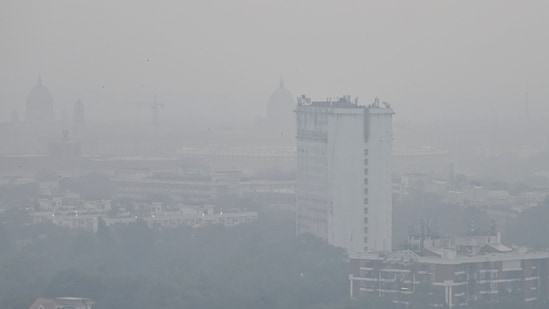
Farm fires in Punjab and Haryana climbed to their highest this season on Saturday — and the Isro satellite’s count rose for a 10th straight day, the ground wind fell calm after sunset, and within two hours of the first evening window for firecrackers opening at 8pm, the city’s air was 30% dirtier than a night earlier.
All of that came before the festival night itself, when most of the city’s firecrackers are burst, and light winds are forecast for Sunday.
Deep Dive
Why was Delhi's air pollution so high on Diwali eve?
How severe was Delhi's air expected to get after Diwali?
Do green firecrackers reduce Delhi's Diwali pollution, and when were they allowed?
The 4pm air quality index (AQI) on Saturday was 369, “very poor” on the Central Pollution Control Board’s (CPCB) 0-500 scale and the highest for the day before Diwali since 2016, when it was 404. The index, an average of the past 24 hours, has climbed from 261 on November 1. Measured pollution first peaked on Saturday morning: between 10am and 11am, PM2.5 — the fine particulate matter small enough to lodge deep in the lungs — averaged 295 micrograms per cubic metre across Delhi’s 59 monitoring stations, and 36 of them were above 250, where CPCB’s “severe” band for PM2.5 begins.
Saturday afternoon was the best-ventilated afternoon of the week, with the layer of air that pollution mixes into returning to its usual depth after four days at about half that. A shallower mixing layer means less room for pollutants to disperse into. Yet every hour from 11am to 5pm was dirtier than on Friday.
{{/usCountry}}Saturday afternoon was the best-ventilated afternoon of the week, with the layer of air that pollution mixes into returning to its usual depth after four days at about half that. A shallower mixing layer means less room for pollutants to disperse into. Yet every hour from 11am to 5pm was dirtier than on Friday.
{{/usCountry}}Then the evening window for bursting opened. PM2.5 jumped from 177 micrograms per cubic metre at 7.45pm, to 208 at 8pm, and climbed every 15 minutes to 289 at 10pm across the 55 stations that had reported, HT’s analysis of CPCB’s 15-minute readings shows.
Also Read | Hindustan Times launches pollution dashboard that puts air quality data in context
Over the same hours on Friday, the air moved only from 202 to 229. Saturday evening’s trends will show up in Sunday’s bulletin.
The surge was sharpest in residential neighbourhoods such as Punjabi Bagh, where PM2.5 nearly tripled in an hour, from 208 at 7pm to 593 at 8pm, and RK Puram, which read 621 at 9pm, more than double its level at that hour on Friday. By 9pm nine stations were above 400, against none on Friday, and from 10pm even the median station was above 250. Mundka read 718.
Saturday evening’s surge came inside the firecracker bursting hours the Supreme Court allowed. Like last year, firecrackers have been allowed for Diwali. The Supreme Court’s order, made public on November 2, permits certified green crackers for one hour in the morning and two in the evening on Saturday and Sunday; the bench said a complete ban had neither significantly improved the air nor stopped the illegal sale of conventional crackers, and that the right to religious practice remained subject to the right to health.
The Delhi Police have formed more than 250 special enforcement teams, at least one in every police station, but the officers charged with enforcing the order concede that full compliance may not be possible. “It is nearly impossible to determine whether a cracker that a person burst was green or not,” one officer told HT on Saturday, and said covering the whole city to enforce the time slots “is not humanly possible”.
Already, the rules have been broken. HT found conventional crackers available on request in Chandni Chowk, Sadar Bazaar and other markets, and boxes without the QR codes the court made mandatory, a report the Supreme Court itself took note of on November 3.
Last year, at 2am on the night of Diwali, the average PM2.5 reading across 27 stations that reported through the night reached 1,137 micrograms per cubic metre, up from 535 at 10pm, the cut-off for bursting; India’s limit for a 24-hour average is 60.
This year could be worse, owing to the weather and the higher pollution base: last year, the eve read 296, and the day after Diwali, whose bulletin takes in the festival night, 351. The Indian Institute of Tropical Meteorology (IITM) forecasts the AQI climbing through Sunday night to 406 by 4am on Monday, past 400 into “severe”, the worst category.
“The next 48 hours look worse. Winds stay weak, and the forecasts already put Delhi at or near ‘severe’ for Diwali and the day after. Every Diwali since 2015 has left the city’s air worse the next day than the day before Diwali, and this year starts from a much higher base. Cutting firecrackers, sending fewer trucks into the city and stopping waste burning over the next two days are the measures most likely to make a difference,” said Sunil Dahiya, founder and lead analyst at think-tank Envirocatalysts.
Farm fires unrelenting
The fires show no sign of easing. INSAT-3DS, an Isro satellite that scans the region every half hour, counted 415 fire pixels in Punjab and Haryana on Saturday, 5.5 times its count on November 1, and 647 of its 652 detections came between 4pm and 6pm, after the early-afternoon passes of NASA’s satellite, whose widely quoted count stood at 1.7 times its November 1 level. The two satellites detect fires differently, so only their growth can be compared. Light winds are forecast for Sunday afternoon, about 3km/h through the lowest layer of air, in Saturday’s run of the Global Forecast System (GFS), the US National Weather Service’s global model, which also shows no rain through November 14.
With so little wind to carry the smoke away, it will build up under the layer of warmer air that forms over the city on calm nights and holds pollution near the ground until the morning sun breaks it up. On Saturday morning, that layer lay 578 metres up, 5.2°C warmer than the ground.
The one change in the forecast is in the winds that carry farm smoke. All week, north-westerly winds one to three kilometres above the ground have carried smoke from Punjab and Haryana towards Delhi; GFS on Saturday predicted them coming from the south-south-east on Sunday afternoon, which should ease that flow, but it is unlikely to flush out the smoke trapped at ground level.
Also Read | IIT to Rohini: 10 most polluted areas in Delhi amid ‘very poor’ AQI on Diwali eve
In 2020, the last Diwali with winds this light, the AQI was 414 on the day and 435 the day after. The index has crossed 400 the day after Diwali in four of the 11 years since 2015.
This year’s festival also falls on the worst dates of Delhi’s air calendar: from November 6 to 9, the AQI has typically been about 376 since 2015, higher than on any other days of the year.