
 E-Paper



Delhi high court dismisses Arvind Kejriwal’s petition challenging his arrest
In his plea, Kejriwal argued his arrest was a calculated move aimed at humiliating him and sabotaging the Aam Aadmi Party (AAP) Lok Sabha poll prospects

 Prefer HTon Google


The Delhi high court on Tuesday dismissed chief minister Arvind Kejriwal’s petition challenging his arrest on March 21 in connection with Enforcement Directorate (ED)’s money laundering probe into alleged irregularities in the now-scrapped Delhi excise policy 2021-22 and the subsequent remand order of March 22.
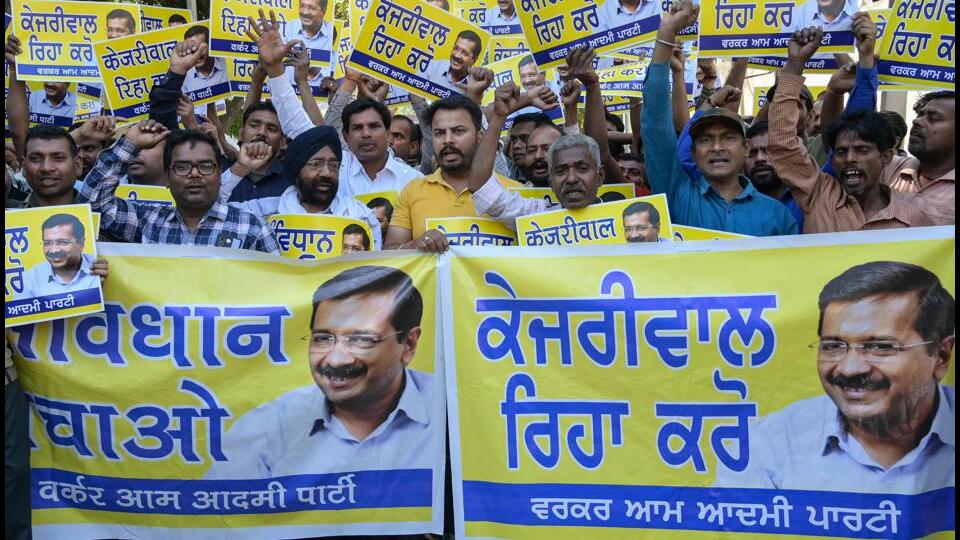
“ED was able to trace enough material in the form of the statement of approver, Hawala dealer, AAP [Aam Aadmi Party] candidate in the Goa election...arrest of Kejriwal and his remand cannot be termed as illegal,” said the court
In his plea, Kejriwal argued his arrest was a calculated move aimed at humiliating him and sabotaging the AAP prospects “even before the first vote is cast” in the Lok Sabha elections.
ED contended that “the Aam Aadmi” cannot evade incarceration despite his involvement in money laundering simply because of his position as the chief minister. The agency denied any connection between the arrest and the elections, saying its probe into the case was going on for months.
A single bench of Justice Swarana Kant Sharma last week reserved its judgment on Kejriwal’s petition on the day AAP leader Sanjay Singh was released on bail in the excise policy case after six months on the Supreme Court’s orders.
Senior counsel Abhishek Manu Singhvi, who appeared for Kejriwal, called Kejriwal’s arrest a brazen attempt to silence dissent using ED’s whimsical powers under the Prevention of Money Laundering Act (PMLA) and derail the AAP’s electoral prospects. He said that the agency did not have sufficient material to apprehend Kejriwal and that the chief minister was arrested without any inquiry, statement, or material.
Singhvi responded to ED claims that Kejriwal was vicariously liable for the AAP’s offences committed, arguing that Section 70 of PMLA was sought to be used “falsely, inaccurately and wrongly”.
“Section 70 cannot arise at all. It is a specific provision to impute vicarious liability on ‘companies’. When AAP is registered under the Representation of People Act, a different statute which differently recognised the party cannot be subsumed in PMLA,” he said.
Singhvi called ED’s contention that the chief minister waived his right to oppose his arrest after giving a statement before the trial court that he had no objection to the custody “extraordinary”. He added the plea challenging his arrest was filed prior to his statements on March 28 and April 1 before the trial court.
Singhvi contended that ED has turned PMLA on its head. “There is no evidence against him [Kejriwal] that he is involved in the offence of money laundering. It is preposterous to say that the chief minister of Delhi will be handling hawala transactions. I want to ask how awareness of conspiracy becomes a valid ground for offence of Section 3 under PMLA. Just because you are aware of the conspiracy you are an accused of PMLA?”
ED maintained Kejriwal’s position did not grant him immunity from legal proceedings and the investigation. It argued his attitude was that he was a “saint”, but he carried out the entire scam “very tactfully” and was not only individually but also vicariously liable. It insisted finding proceeds of crime was irrelevant if the agency was able to make out a case of Kejriwal’s involvement in the offence of money laundering.
ED, which said the probe against Kejriwal was at a nascent stage, referred to Kejriwal’s argument that his arrest was politically motivated. “Take the case of a terrorist who is also a politician. He blows up an army vehicle and says I want to contest elections so you can’t touch me? What kind of argument is this?” asked additional solicitor general SV Raju, who appeared for ED.
Singhvi objected to the analogy even as Raju said that Kejriwal was arrested because he was responsible for the affairs of AAP, which benefited from the money laundering. “Forget his role. The role is not required to be looked at. What is required to be looked at is that he was responsible for the affairs of the party.”
On March 23, Kejriwal approached the high court claiming his arrest violated his fundamental rights. The court on March 27 only issued notice on his plea, emphasising the need for a response from ED to address the legal and validity issues raised.
In his affidavit submitted to the high court, ED opposed Kejriwal’s petition citing his statements to a trial court — that he had no objection to a further extension of his remand.
ED has accused Kejriwal of being the “kingpin and key conspirator” of the Delhi excise policy scam, who acted in cahoots with ministers of his cabinet and other AAP leaders while seeking to implicate the party as the beneficiary of the alleged crime in the form of a “company”.


