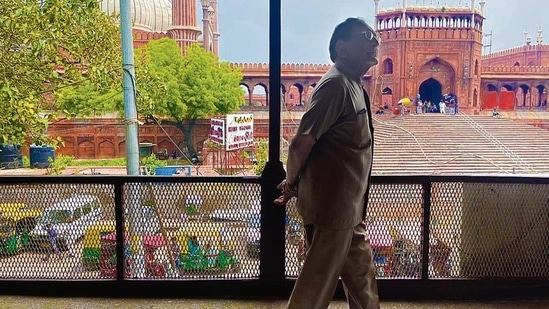
He is silently taking turns. Razi Zahoor Qureshi is exercising his routine walk, here on Haji Hotel’s balcony with a panoramic view of the Mughal-era Jama Masjid (see photo). This elderly man in a safari suit is on his way to be an Old Delhi living landmark. Partly so for being a patriarch of the family that owns this iconic institution, founded by his father in 1952.
It was his brother, the legendary Haji Mian (Faiyazuddin), who used to be
He is silently taking turns. Razi Zahoor Qureshi is exercising his routine walk, here on Haji Hotel’s balcony with a panoramic view of the Mughal-era Jama Masjid (see photo). This elderly man in a safari suit is on his way to be an Old Delhi living landmark. Partly so for being a patriarch of the family that owns this iconic institution, founded by his father in 1952.
It was his brother, the legendary Haji Mian (Faiyazuddin), who used to be the area’s living landmark. If a passerby walking down the street didn’t spot him up there, sitting behind the large table on the hotel’s balcony, something essential was missing. Haji Mian died last year following Covid-related complications, and his absence became the new normal. Eventually, that new normal became Haji Mian’s brother’s presence.
A retired doctor in his 70s and the youngest of five brothers (of whom three have died), he is in the hotel for a few hours in the morning and a few hours in the evening, passing the rest of the day at the family home in nearby Chawri Bazar. In the hotel, he takes brief walks to distract himself from gloomy thoughts, he says.
“The only reason I come to the hotel is because of my late brother.” His voice is full of feeling. “Haji Mian continues to command love from people, and I must keep alive his memory.”
There is also the consideration of hotel’s legacy. “In the old days, artists like Ustad Hafiz Ali Khan, Rasoolan Bai and Begum Akhtar would stay in the hotel for as long as a week,” he recalls, explaining that these legends would come to Delhi to make recordings for the All India Radio (AIR).
During his walks on the balcony, the gentleman confesses of often imagining his brother sitting on his customary chair, engaging with musafir (hotel guests) and Walled City citizens who would come to meet him. “The other day, Raju, a cap merchant, arrived from Rampur, sat in front of Haji Mian’s empty chair and wept non-stop for thirty minutes.”
A month ago, the finial of the Jama Masjid was damaged in a storm. “I cried that evening on seeing at the damaged dome… it was something I had seen standing since childhood.”
Once the ongoing repairs are complete, the dome will hopefully give as much consoling satisfaction as the gentleman’s graceful silhouette at the hotel’s balcony, his walking figure a new aspect ensuring an old continuity.
One Subscription.
Get 360° coverage—from daily headlines
to 100 year archives.
Archives
HT App & Website