
 E-Paper



Delhiwale | Midnight, but mid-work
Noorjehan is at work. “I’m like a mazdoor who builds grand houses for the rich but who can never live in them.”

 Prefer HTon Google


It is midnight. The pavement on Lodhi Road is immersed in darkness, but you can see figures slumped along it, presumably asleep. One spot on the pave is lit with a narrow beam of light.
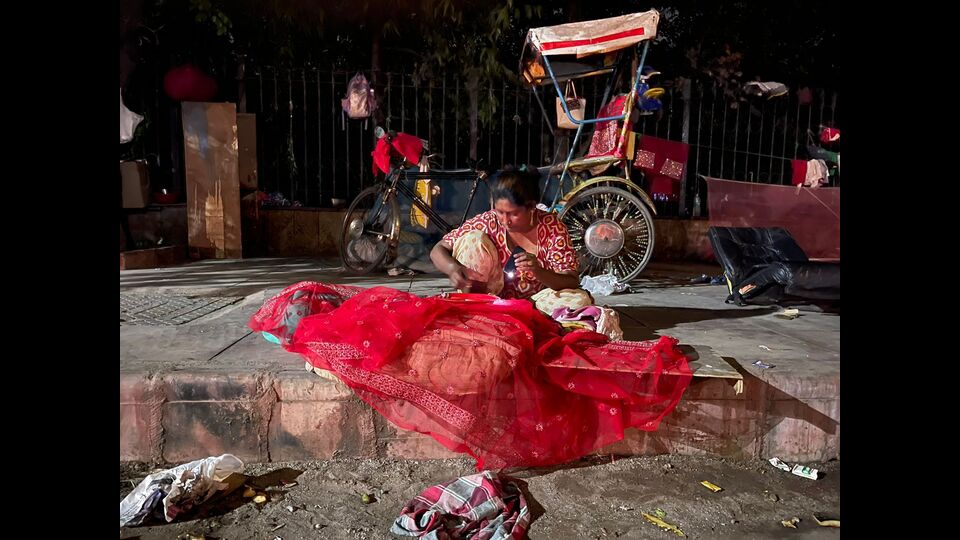
Noorjehan is at work. The light is coming from the mobile phone that she is holding in her left hand. “I’m laying material (sic) on the dupatta,” she mutters, referring to small glass pieces often employed to adorn dresses. Noorjehan doesn’t have to stay awake so late “but I will earn more if I do more dupattas.” To decorate one dupatta with these glasses takes about three days and 4,000 glass pieces, the woman says, and it pays her 300 rupees.
Noorjehan gets these fabrics and “material” from a “bichaulia”, a middle man, who gets them from a dress “factory” in nearby Sarai Kale Khan. The payment depends on the kind of clothes. A dupatta needs extensive work, but less than a lehenga. “One lehenga earns me 700 rupees.” Even as she talks, Noorjehan is not allowing herself to be distracted from work. A pile of these small glass pieces are lying in a heap beside her, they are shining the way a water puddle does at night, on reflecting the light of the street lamp. Noorjehan picks one glass at a time, and carefully lays it on the fabric, sticking it with a gum. Each piece is the size of a grain of arhar dal.
“I work during the day too,” she says, adding that her sister Afsana gives her a hand. “And sometimes other women living here” — she waves her hand towards the figures sleeping on the pavement — “come to help me when they are free.”
Noorjehan’s husband, Muhammed Taufeeq, is a rickshaw puller. He is asleep somewhere close. The rickshaw is parked just behind Noorjehan. The spokes of its wheels are decked with multicoloured beads. “He himself decorated it.”
The couple has been living on this spot for three decades, soon after their arrrival from Calcutta. They have six children.
Minutes later, following her sustained immersion in the work, Noorjehan notes that “tomorrow I might get a lehenga.” She points out that she doesn’t own such glittering clothes. “I’m like a mazdoor who builds grand houses for the rich but who can never live in them.” Noorjehan says she will continue to work until the dupatta is complete, or until the mobile phone battery dies, whichever happens first.


