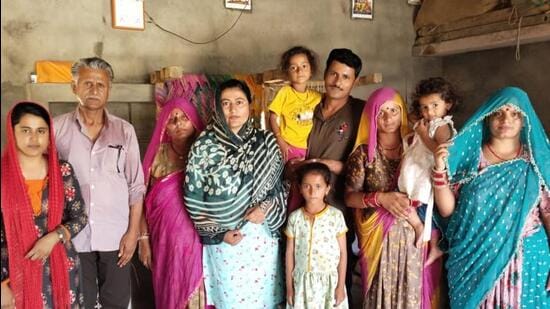
Jaipur/Barmer: A Hindu Dalit family of 10 has undertaken a circuitous journey to reach Barmer in western Rajasthan via Nepal from their home at Mirpur Khas city in Sindh province of Pakistan after their request for an Indian visa, to flee from harassment and threats in the neighbouring country, was rejected.
The distance between Mirpur Khas and Barmer is 240 km. The two cities were connected through the Thar Express but operations of the train were suspended by Pakistan in 2019 after the Indian government revoked the special status to the erstwhile state of Jammu and Kashmir under Article 370 of the Constitution and bifurcated it into two Union territories.
Rajesh Kumar (32) told HT his family was facing harassment and threats from friends of his younger brother Harish (34) after the latter was arrested by local law enforcement agencies in Pakistan on charges of money laundering and released in September 2021.
“Soon after his (Harish’s) release in September 2021, he was kidnapped by his own friends and ransom was demanded. Abductors threatened to rape women of the family if money was not given. He was released by abductors after 47 days realising that we have no money to give,” Kumar said.
“I don’t know what would have happened had we stayed back in Pakistan,” he said.
{{/usCountry}}“I don’t know what would have happened had we stayed back in Pakistan,” he said.
{{/usCountry}}The family belongs to the Dalit Meghwal community. Sindh in Pakistan, which neighbours Rajasthan and Gujarat, has a sizeable population of Dalit Hindus.
As the threats continued and local authorities did not take any action and the family decided to leave Pakistan, said Kumar. On December 9, the entire family including 54-year-old Ooda Ram and eight women left for Dubai with the exception of Harish. From Dubai, they applied for Indian visa, which, Kumar said, was rejected.
Ooda Ram’s cousin stays at Rohilla village in Barmer district and the family decided to make a beeline there.
On December 16, 10 family members left for Nepal. “We came to Nepal thinking that it would be easier to get visa from there. Harish stayed back to arrange for a visa,” Kumar said.
But, when his visa application was rejected again, Harish joined them in Nepal on February 12. “It was then we decided to cross over to India,” he said.
Kumar said that since a case was pending against Harish, he decided not to travel to India, and is still in Nepal.
“We took help of a local person to reach close to the border and walked about 12 km to cross the border. We reached Gorakhpur in Uttar Pradesh on February 25,” he said.
Recalling the journey, Kumar said they hired a car from Gorakhpur and reached Jodhpur via Lucknow on February 27 and Barmer the next day.
They informed the local foreigner’s office about their presence only on April 23 after villagers told them that their stay was illegal and they can be detained.
“My uncle came to India during Partition in 1947 but we were stuck in Pakistan as my grandfather was reluctant to relocate,” Kumar, whose family still owns land in Mirpur town, said.
The family urged the Indian government to grant them visa immediately and citizenship as they cannot go back to Pakistan. “They kidnapped my son, and threatened to kidnap daughters. We had no option besides running away from there,” said Kumar’s mother, Rani Devi.
Barmer Superintendent of Police, Deepak Bhargav, said around 10 people, majority of them women and children from Pakistan, are residing in Dhorimana area of the district, and nothing suspicious has been found in the investigation so far. “The police will also initiate its inquiry. There is a provision to stay as Pakistani migrants but further clarity will come from union home ministry,” he said.
Activist for Pakistani minorities living in India, and President of Seemant Lok Sangathan, Hindu Singh Sodha, who advised the family to contract the foreigner’s office, said, “This is the case of persecuted and discriminated minorities (Hindus) from Pakistan. Although these people don’t have proper documents to travel to India, still they should be considered on humanitarian grounds as coming to India was the only option for them.”