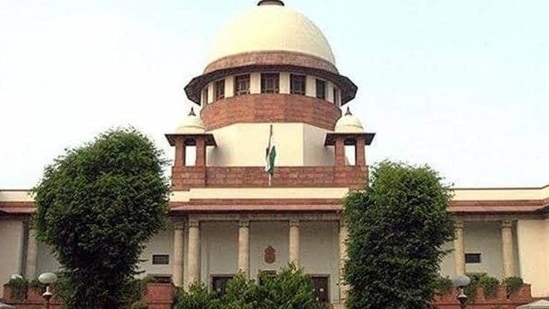
The Supreme Court clarified on Friday that it has not restrained high courts from passing urgent orders to combat the crisis triggered by the second Covid-19 wave, as was widely believed on Thursday. A bench, headed by Chief Justice of India (CJI) SA Bobde, maintained that the top court did not stop the high courts from taking up the matter when it initiated a public interest litigation on its own on Thursday, asking the Centre to present before it on Friday, a national plan to deal with the crisis that has now made India the worst hot spot of the global pandemic.
With the Centre seeking more time, much of Friday’s hearing was not devoted to the ballooning Covid-19 crisis, but to the clarification, and a recusal.
The clarification by the top court came after a controversy ensued over justice Bobde’s bench taking suo motu (on its own motion) cognisance of the surge in infections the day before his retirement and appointing senior advocate Harish Salve as the amicus curiae to assist the court . This, even though Salve represented Vedanta, which wanted its controversial shuttered plant in Tamil Nadu’s Thoothukudi reopened for producing oxygen.
On Thursday, the apex court issued notices to the petitioners before the high courts, asking why uniform orders should not be passed by the Supreme Court, something interpreted by most people as the bench taking over all the cases.
When the proceedings commenced, Salve opted to withdraw as amicus, citing adverse comments by some lawyers in the media against his “friendship” with justice Bobde and a possible conflict of interest.
{{/usCountry}}When the proceedings commenced, Salve opted to withdraw as amicus, citing adverse comments by some lawyers in the media against his “friendship” with justice Bobde and a possible conflict of interest.
{{/usCountry}}“It is the most sensitive case this court will look into. I don’t want this case to be decided under a shadow that I knew the CJI from school and college and allegations being made or there is a conflict of interest.”
SG Tushar Mehta, appearing for the Union government, requested Salve not to succumb to the “pressure” and stay on but Salve remained firm. Mehta also asked for an adjournment till next week to present a national plan on availability and distribution of essential supplies and services, saying he would not want justice Bobde’s last day in office to get mired in any controversy. The surging second wave of the coronavirus disease has resulted in the number of active Covid-19 cases in the country rising to around 2.4 million by Thursday evening, leaving people scrambling for hospital beds, oxygen, and key medicines.
Subsequently, the CJI accepted Salve’s withdrawal, observing: “We were also pained at reading what some senior advocates had to say. But everyone is entitled to their opinion. In future, we will have to appoint someone as amicus only when we don’t know that person. Bu we will honour your sentiments and allow you to recuse.”
The bench, which included justices L Nageswara Rao and S Ravindra Bhat, also expressed its displeasure at “some senior lawyers” questioning the suo motu proceedings and the purported attempts to hold the hands of at least six high courts across the country which have kept the Centre as well as the state governments concerned on their toes regarding the supply of essential medicines, medical oxygen and hospital beds. For instance, the Delhi High Court’s interventions may well have prevented a series of medical tragedies in the national Capital.
An anguished justice Rao said: “Even before the order was passed, motives were imputed that we were going to stop the high courts. Some senior advocates are destroying the institution.”
The judge then turned to senior advocate Dushyant Dave, who was among those who questioned the intervention of the Supreme Court at a time when high courts were proactively working for the benefit of people, and asked: “You have imputed motives to us without reading the order. Is there anything in our order to transfer the case? Is this how a senior advocate should speak? Without reading the order?”
Dave retorted: “No motives have been imputed but we all thought that your lordship was going to do it (transfer the case)... entire country thought like that. It was a genuine perception. My lordships have done this before. And there is still an indication in your order.”
Intervening at this point, justice Bhat told Dave: “We never said a word and did not stop the high courts. We in fact asked the Centre to go to high courts and report to them. What kind of perception are you talking about?”
Solicitor general Tushar Mehta, appearing for the Union government, asked Dave whether a senior counsel should react on the basis of a perception or should rely on a judicial order, which prompted Dave to respond: “Mr Mehta, you represent a government that runs only on perception.”
At this juncture, president of the Supreme Court Bar Association and senior lawyer Vikas Singh submitted that the lawyers’ body was opposing the transfer of proceedings from the high courts and referred to how the Supreme Court simply accepted a statement from the S-G during the pandemic last year that no migrant was on the roads.
Singh also complained about the shortage of oxygen in the hospitals of Delhi, getting CJI Bobde to respond: “That is exactly the kind of issues we wanted to deal with. But anyway, now since the S-G has requested for an adjournment, we will adjourn this case to Tuesday next week.”
On Thursday, the Supreme Court called the crisis triggered by the second Covid-19 wave a “national emergency”, and asked the Centre to present before it on Friday a national plan. Issuing notices to the Union and state governments, the order said its focus areas at this time were the supply of medical oxygen, essential medicines, the method and manner of vaccination, and the declaration of lockdowns to check the spread of the disease. It also issued notices to the petitioners before the high courts, asking why uniform orders should not be passed by the Supreme Court.