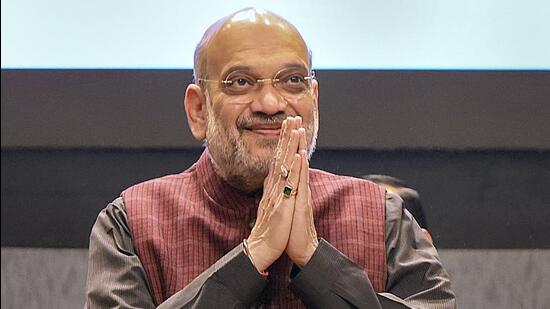
New Delhi Union minister for home and cooperation, Amit Shah, on Tuesday launched a ₹225 crore drive to computerise over 1,000 agriculture and rural development banks and offices of the registrar of cooperative societies in states and Union territories across the country.
The cooperation ministry has identified 1,851 agriculture banks in 13 states and Union territories for the project. They will eventually be linked to the National Bank for Agriculture and Rural Development (Nabard), the largest state-backed bank for rural business and infrastructure, through a common national software.
This is the second major digitisation project undertaken by the ministry after an ongoing project involving 63,000 primary agricultural cooperative societies. The launch was organised by the cooperation ministry in collaboration with National Cooperative Development Corporation.
“The projects will go on to modernise and bring efficiency in the cooperative sector by bringing the entire ecosystem on a digital platform. This will help in improving transparency and accountability,” Shah said.
Of the total outlay of ₹225 crore, ₹95 crore will be spent on computerisation of the registrar of cooperative societies, the local authorities mandated to register cooperatives, which are businesses run jointly by members who share profits and losses.
Digitisation of cooperative banks will help farmers get medium- and long-term loans, the minister said, adding the project will involve linking rural banks and primary agricultural cooperative societies, or PACS, too.
{{/usCountry}}Digitisation of cooperative banks will help farmers get medium- and long-term loans, the minister said, adding the project will involve linking rural banks and primary agricultural cooperative societies, or PACS, too.
{{/usCountry}}“Agriculture banks are present only in 13 states and there is a need to expand it to other states as well,” Shah said.
In July 2021, the Modi government created a ministry for cooperation, helmed by Union minister Amit Shah, carving it out of the agriculture ministry. The Centre has since rolled out several changes to digitise and expand a sector that plays a key role in the rural economy.
At the time, Shah said the cooperative sector was “going to make the largest contribution to Prime Minister Narendra Modi’s dream of making India a $5 trillion economy”.
Under the Constitution’s Seventh Schedule, which divides responsibilities between the Centre and states, state governments have jurisdiction over cooperatives. However, the Centre has control over policymaking for cooperatives that operate in more than one state, known as multistate cooperatives.
At the heart of the push for a cooperatives-led rural economy lies a little-known network of nearly 63,000 rural grassroots financial centres. They have been in existence for decades, some since the time of India’s Independence. The Modi government wants to transform these entities, known as PACS, to overcome the challenges of unemployment and spur business opportunities.
The latest computerisation initiative will increase the operational efficiency, accountability and transparency in agriculture and rural development banks by “standardising business procedures through a Common Accounting System (CAS) and Management Information System (MIS)”, an official said separately.
Digitisation will also reduce transaction costs, facilitate loan distribution to farmers and enable real-time data access for better monitoring and assessment of schemes, the minister added.
Shah said 63,000 PACS were already being computerised and linked to Nabard through the common national software. PACS are also being enabled to offer digital services to customers.
The cooperation ministry has set up a national cooperative database, containing data of more than 800,000 cooperative societies and this database will be launched soon and made available to all stakeholders.