E-Paper



Economic Survey's optimism on labour markets warrants caution
Data from quarterly PLFS rounds are available till the three months ended September 2022. Rural employment numbers, however, are released in the annual PLFS reports. These reports show tangible improvement on three key labour market statistics.

 Prefer HTon Google


Have labour markets recovered from the pandemic shock? While the 2022-23 Economic Survey says they have, using statistics from the Periodic Labour Force Survey (PLFS), there is reason to be cautious about this claim. Here’s why.

Data from quarterly PLFS rounds are available till the three months ended September 2022. Rural employment numbers, however, are released in the annual PLFS reports. These reports show tangible improvement on three key labour market statistics.
Also Read | India’s Budget ray of hope in uncertain times: PM Modi
Labour force participation rate (LFPR) and worker participation rate (WPR) were at their highest in the two quarters till September last year. LFPR is the share of population working or looking for work, and WPR is the share of workers in the population. Unemployment rate was at its lowest level in both these quarters. These comparisons are made on annual basis rather than sequentially, as seasonal factors affect labour market conditions. “This trend highlights that the labour markets have recovered from the Covid-19 impact,” the survey said.
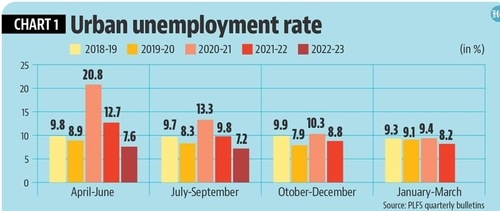
While there is nothing factually wrong with this claim, it might be missing the qualitative worsening in labour markets after the pandemic, as HT has been pointing out in its analysis of the quarterly PLFS rounds.
UNION BUDGET 2023: FULL COVERAGE
The share of salaried or regular wage urban workers, who are the best paid, was 48.6% and 48.7% in the first two quarters of 2022-23, the second-lowest and lowest in the quarterly bulletin data, and lower than in 2019-20, the financial year preceding the pandemic. On the other hand, the share of self-employed urban workers was higher than pre-pandemic levels.
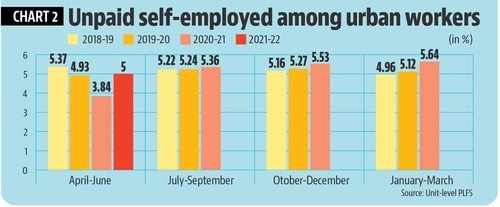
The higher proportion of self-employed workers suggests that LFPR, WPR and unemployment rate numbers must be read with caution. Self-employed workers also include the subcategory of unpaid workers in family enterprises. Their share among urban workers has been higher than pre-pandemic levels after the lockdown-affected June quarter of 2020.
To be sure, the data on unpaid workers can be found only from the annual report, or the unit-level data of PLFS, which is available only up to June 2021. Therefore, it is difficult to comment with certainty on the nature of the recovery in urban labour markets, as HT has reported earlier (https://bit.ly/3HniDZy).
The Economic Survey has noted the decline in quality of employment in the annual data for June 2020-July 2021 and declining rural wages in real terms in 2022-23. The deterioration in quality of urban jobs is another alarming aspect of the labour markets, even as quantitative indicators continue to recover.
This is all the more important given the fact that domestic demand is expected to be the major driver of growth, as the global economy faces volatility in the year ahead.