Uttarakhand chief minister Puskhar Singh Dhami, claimed in an interview to the Hindustan Times on January 25 that the Uniform Civil Code (UCC), which would come into force in the state from January 27, does not discriminate against anyone and introduces a uniform set of rules for everyone.
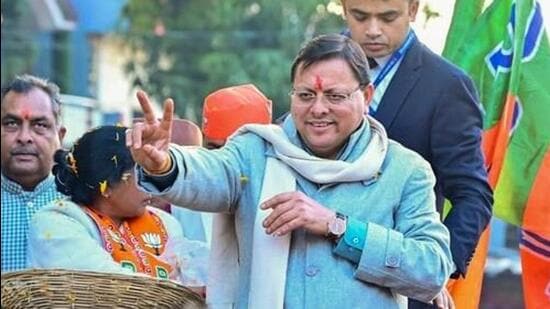
Dhami is correct in saying so as the name suggests that same regulations are being introduced for all communities except the scheduled tribes, who have their own customs and has Constitutional protection.
Uttarakhand chief minister Puskhar Singh Dhami, claimed in an interview to the Hindustan Times on January 25 that the Uniform Civil Code (UCC), which would come into force in the state from January 27, does not discriminate against anyone and introduces a uniform set of rules for everyone.
Dhami is correct in saying so as the name suggests that same regulations are being introduced for all communities except the scheduled tribes, who have their own customs and has Constitutional protection.
The law is, however, seems to impose certain restrictions on the Muslim community as it would prohibit certain marriage practices such as men allowed to marry four times and marriage among extended family members.
Muslim women right activists have welcomed the UCC with regard to ending of polygamy, saying that such gender unequal Shariah rule needs to be abolished in a modern society. The activists also say there is no place for the marriage of underage girls and that such marriages such be considered rape. They also urge that the UCC will provide Muslim women the voice they need to challenge some unequal Shariah rules.
In addition, the UCC law prohibits relationships and marriages between immediate family relations of a man and a woman. The law listed prohibited relationships in schedule 1 and schedule 2.
The schedule 1 listing 37 prohibited relations such as son’s widow, daughter’s son’s widow, grandson’s widow and granddaughter’s widow and schedule 2 also lists 37 prohibited relations like brother’s son, sister’s son, mother’s brother, father’s brother, father’s brother’s son, father’s sister’s son, mother’s sister’s son and mother’s brother’s son.
Relationships have been defined as half-blood (when they are descended from a common ancestor but by different wives), uterine blood (when they are descended from a common ancestress but by different husbands), full-blood (when they are descended from a common ancestor by the same wife), adoption, surrogacy or assisted reproductive technology and illegitimate child. Experts say that marriages among such relationships are mostly allowed in the Muslim community and prohibiting these unions could be seen as targetting the community.
The All-India Muslim Personal Law Board has opposed the uniform code, saying it would hinder one’s Constitutional right to practices and profess his or her faith and religious beliefs and his not useful for a vast multi-religious country like India.
Also Read: Uniform Civil Code to be implemented in Uttarakhand on January 27, says CM’s aide
Many Muslim scholars argue that the UCC violates Articles 25 to 28 of the Constitution that ensures that every Indian has the right to freedom of religion. Under Article 25, each and every citizen is entitled to the freedom of conscience, as well as the right to profess, practice and spread their faith and Article 26 provides for following religious practices subject to morality, health and public order.
Dhami said that the law will not target any community but bring uniformity in society. “It is for everybody. The UCC will override provisions of the personal laws...even our Constitution mentions UCC...,” he said.
Uttarakhand is the first state in India to introduce UCC and other Bharatiya Janata Party (BJP)-ruled states are expected to follow the suit. On January 20, 2025, the Uttarakhand cabinet passed the UCC manual which would enforce the UCC law enacted in March 2023.
The state government has conducted two mock drills to check the readiness of the portal where registration of all personal agreements from marriage to divorce, live-in relationship to its termination and property inheritance would be mandatory.
To make the registration process easy and simple for the citizens, the Common Service Centres (CSC) have been authorised by the state government to carry out the registration through online platform. In hilly and remote areas where internet facilities are not available, Common Service Centre (CSC) agents will go door-to-door to provide the above facilities to citizens.
Officials said in rural areas, the Gram Panchayat Development Officer has been appointed as Sub-Registrar for the works related to the registration, so that the facility of registration can be made available to rural citizens. The portal also provides for instant registration with a fee under tatkal seva.
The All-India Muslim Personal Law Board and other Muslim organisations plan to challenge the implementation of the UCC in Uttarakhand in the constitutional courts, terming it violation of the Constitutional norm. The Uttarakhand high court had earlier rejected a plea against the UCC law, saying it can be challenged only once the rules are implemented.
Once the UCC is challenged in the court, the decision of the constitutional body will have far reaching implication in either of two scenarios --- court upholding or rejecting or suggesting modifications in the law.
The ruling BJP would like to make successful implementation of the UCC in Uttarakhand as is major poll plank for the forthcoming assembly elections in big states having significant Muslim population such as Uttar Pradesh, Bihar and West Bengal and for the 2029 Lok Sabha polls. The opposition Congress, which has not spoken against the UCC much so far and did not oppose the abolition of triple talak (divorce through three pronouncements), may find it difficult to oppose the UCC.
One Subscription.
Get 360° coverage—from daily headlines
to 100 year archives.
Archives
HT App & Website