European Commission president Ursula von der Leyen on Wednesday called it the “age of tipping points”, highlighting the risks of artificial intelligence (AI), climate change, social media, and the dependence on China in her state of union (SoTU) address.
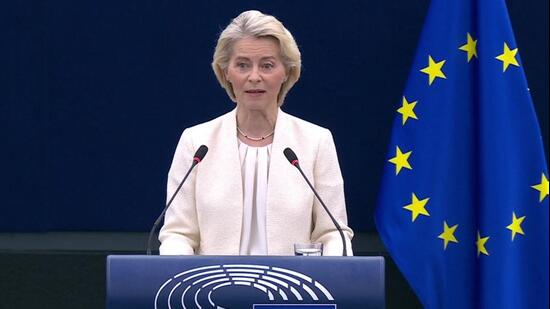
Here are five key takeaways from the nearly one and a half hour-long speech setting out the bloc’s agenda for the year ahead.
‘Europe needs its own Article 4’
Calling it the “latest proof” and blaming the attempted drone attack at the airport in Leipzig, Germany, in August, on Russia, von der Leyen said “threats are mounting on our soil” as the war in Ukraine war, continues.
“An attack not only on one member state — but against all our Union. And honourable members, we will not allow it,” she said, calling for Europe to build its own “counter-hybrid playbook”.
Europe, she said, urgently needs tools on how to respond to incidents that fall “below armed aggression but threaten national security”.
{{/usCountry}}Europe, she said, urgently needs tools on how to respond to incidents that fall “below armed aggression but threaten national security”.
{{/usCountry}}That’s why Europe needs its own security protocol — it’s own Article 4, she said, referring to the North Atlantic Treaty Organisation (Nato) mechanism that allows any of its 32 members to call an emergency meeting to discuss issues that threaten security. It is followed by Article 5 which states that the attack on one member is an attack on all. “To deter further escalation and to mitigate the impact.”
“For a long time, we have discussed a leaders’ format focused on the security of our continent with partners like Ukraine, UK, Norway, Canada and others involved,” she said, adding that a European Security Council must become a “reality”.
The idea is not a new one and has been put forward in many forms in the past, as far back as the 1980s. It has gained new impetus with Russia’s war on Ukraine and US President Donald Trump’s repeated criticism of the Nato.
“Europe will defend each and every square metre of its territory,” von der Leyen said.
Social media ban and the risks of AI
A EU Kids Act that includes age-wise tailored protections for children on social media will be put forward by the commission on Thursday, von der Leyen said.
Giving details, she said, it would ban social media for kids under the age of 13, restrict personal accounts until age 15, and require “safe designs” for the age group between 15 to 18.
“We do not have to accept addictive features. We do not have to accept children being drawn into ever more extreme content. We do not have to accept that girls have their photos used for AI-generated sexualised images,” said von der Leyen, emphasising that the burden of proof will now fall on Big Tech platforms to prove that they are “safe” to use.
In Autumn, she said, a wider framework will be proposed for Digital Services Act.
The ban, however, still has to clear the European Parliament and EU member states and is not expected to come into force in the near future.
On AI, she said, Europe wants “AI with human agency”, emphasising that the risks of the technology must be balanced with its possibilities.
“We are now focusing on five of the highest-value sectors in which industrial AI has the biggest potential and we have the data: health, transport, agri-food, advanced manufacturing, and defence and space. In November, we will announce game-changing initiatives across these sectors,” she said.
Need to mitigate and adapt to climate change
Calling it the “summer of truth”, von der Leyen said, “Science is clear. Europe is warming at double the global rate.”
This year massive wildfires raged across several countries in the bloc. “The impact of all of this is simply devastating: 660 000 hectares burnt to the ground. Some 12 million tonnes of crops lost,” said the commission president.
While reiterating that Europe will stay the course on its climate targets, she also said that a European Heatwave Plan will soon be presented.
She also said work was being carried out by Europe’s most senior firefighters and emergency responders to look at all aspects of preparedness and prevention and put forward various proposals in the future, including for a European Firefighting Fleet.
This is not merely about mitigation, but also adaption. In October, therefore, a new framework for climate resilience will be presented, she said.
“We will identify 100 of the most vulnerable territories in Europe. And we will assess the risks – and at which level they should be managed…And it will aim to make Europe the champion in adaptation technologies – a huge emerging market.”
Reducing Europe’s dependence
While Europe “withstood” the impact of the war in West Asia in addition to gas being cut off from Russia, said von der Leyen, “Europe cannot remain an industrial powerhouse if its energy prices are structurally too high… For this independence, we need to electrify Europe. Our goal is to double the share of electricity by 2040.”
She further said Europe must end its dependence on China. “Our trade deficit with China is now €1 billion – a day. It has reached a tipping point.”
While Europe is engaged in discussions to rebalance this trade, the dialogue should now lead to results, she said. “We will use all the tools at our disposal to rebalance our relationship.”
Highlighting that Europe is “more than 80% dependent on China for many critical raw materials. 90% for some rare earths,” von der Leyen said it would establish a new European Corporation on Critical Raw Materials.
“It will help us obtain and stockpile what we need. For electric cars, chips and batteries, clean tech and defence. And so much more.”
Associate membership for Canada
Von der Leyen called on Canada to become the first “associate member” of the EU as it cannot join the bloc.
“This is a partnership not against anyone else, but for our common strength. In short, we want to bring the relationship with Canada to the highest level possible,” she said.
Canadian Prime Minister Mark Carney was present in the commission as a guest of honour. This comes as Canada’s trade war with the US escalates and both Ottawa and Brussels look to diversify their partnerships.
While it was not immediately learned what this means, it appeared to signal closer ties between Brussels and Ottawa.
The European Commission’s SoTU speech is delivered during the first plenary session in September. Although modelled on the American practise, it is not mandated, but serves as an important communication tool. This is von der Leyen’s fifth such address since she became the EU chief and the second since she was reelected in 2024.