
 E-Paper



‘Even mountaineering is dangerous’: 5-judge SC bench reserves Jallikattu verdict
During the back-and-forth at Thursday’s hearing, the SC bench countered the petitioner calling Jallikattu a ‘blood sport’. “People die while climbing mountains, so do we stop people from climbing mountains? You cannot stop the adventure spirit in man,” the bench reasoned


NEW DELHI: A five-judge constitution bench of the Supreme Court on Thursday reserved its judgment on petitions challenging three state laws that allow games or events such as Jallikattu, a bull taming event in Tamil Nadu and bullock or buffalo races in Maharashtra and Karnataka, in the name of culture or tradition of a section of people even when they stood banned under a 2014 judgment of the top court.
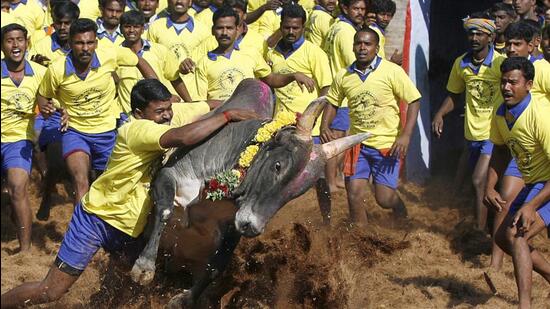
The three states enacted separate laws following the 2014 verdict and got Presidential assent to give it legal cover. They introduced additional safeguards for conducting the events under a separate set of rules to bring their laws in line with the 2014 judgment and argued that the rules would ensure no cruelty is meted out to bulls, bullocks or buffalo and no human life is lost in the process.
As the court concluded the hearing of arguments presented over seven days, the bench, headed by justice KM Joseph and comprising justices Ajay Rastogi, Aniruddha Bose, Hrishikesh Roy and CT Ravikumar, asked the petitioners to suggest additional safeguards they would seek from the state in the event the rules are upheld by the court.
“The state is amenable to suggestions to be given by this court. In the event we are upholding the rules, what would you (petitioners) like to place to improve the conditions of animals.” The court even asked the petitioners to list the rights that would vest in animals who otherwise cannot approach the court if these rules get breached.
Senior advocate Shyam Divan who appeared for People for Ethical Treatment of Animals (PETA) showed recent news reports and photographs of Jallikattu events in Tamil Nadu where casualties were reported of both humans and bulls. Although Tamil Nadu argued that Jallikattu was a traditional custom that was meant to sustain and preserve a special breed of bulls trained specially for such events, Divan termed Jallikattu a “blood sport”.
The bench said such a reference was improper. “Just because death occurs, it doesn’t mean that it is a blood sport. We do not think anybody going there to embrace a bull wish to see blood. They use no weapon. People are mounting the bull with bare hands.”
The bench added. “Even mountaineering is dangerous. People die while climbing mountains, so do we stop people from climbing mountains? You cannot stop the adventure spirit in man.”
The Tamil Nadu government told the court that none of the documents produced by PETA could be replied to as it was not part of the court record.
Representing yet another animal welfare organization, senior advocate V Giri told the court that in the arguments over the past week, the TN government failed to show that Jallikattu is part of the fundamental rights of a certain section of people relating to Article 29 of the Constitution (which protects culture) or an essential religious practice of the Hindu religion.
The petitioners had maintained that the laws introduced by Tamil Nadu and the two other states continued to perpetrate cruelty as the new set of rules were merely “old wine in a new bottle”. The states have already finished their arguments and even defended the Presidential assent given to them that had not been challenged by the petitioners.
Senior advocates Kapil Sibal, Rakesh Dwivedi and Mukul Rohatgi appeared for the Tamil Nadu government while Maharashtra was represented by solicitor general Tushar Mehta and Karnataka was represented by advocate Nikhil Goel.
In February 2018, the top court referred the amendment passed by TN reviving the Jallikattu event and the other two laws for the buffalo race (Kambala) in Karnataka and the bullock-cart race in Maharashtra for consideration by a five-judge bench.


