
 E-Paper



First national survey of domestic workers launched
Domestic workers are believed to be a million strong, but there is little official information on their actual numbers


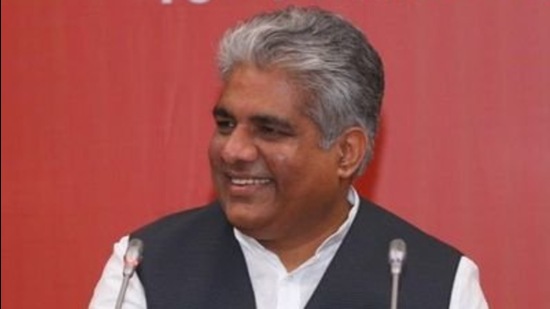
Union labour minister Bhupender Yadav on Monday rolled out the country’s first survey of domestic workers, the latest among a group of five national jobs enumeration campaigns aimed at discerning data on the country’s vast informal workforce that will feed a forthcoming national employment policy in Asia’s third-largest economy.
Domestic workers are believed to be a million strong, but there is little official information on their actual numbers and parameters, such as work conditions and average pay. Lack of such data leaves them out of any formal policy governing the country’s informal workers, who make up a majority of the total workforce.
The survey is designed to fill this gap and offer “time-series data on domestic workers”, the minister said.
The survey for domestic workers is among five national jobs surveys that will be conducted periodically and provide crucial data for an upcoming national employment policy being planned by the Modi government, an official said, requesting anonymity.
In September, the government had released the results of the first All-India Quarterly Establishment-based Employment Survey (AQEES) for the April-June 2021 quarter.
Along with the latest survey, the AQEES is part of four other annual surveys conducted by the labour bureau. These are the All-India Survey of Migrant Workers, All-India Survey of Domestic Workers, All-India Survey of Employment Generated by Professionals and All-India Survey of Employment Generated in the Transport Sector.
The survey, for the first time, will provide a headcount of domestic workers and their employers through a nationwide household-based survey.
According to the manual of the survey, specific features of domestic work such as living conditions, their employment relationships, would be looked at extensively which are usually not covered in the traditional labour force surveys.
“The numbers, thus, thrown up would improve the availability of official data on DW and would provide a basis for meaningful social dialogue,” the manual states.
The parameters the survey aims to capture include the number and proportion of household workers by major states, with separate rural and urban break-ups, their percentage distribution, households that employ them and socio-demographic characteristics.
The labour bureau’s all India quarterly establishment-based employment survey (AQEES) in September showed a 29% increase in employment in nine sectors during the peak Covid-19 months of April-June 2021 over a base of 2013-14. The survey showed a jump in jobs in sectors such as IT, business process outsourcing and manufacturing.
India lacks official short-term, high-frequency jobs data and the AQEES is meant to fill the critical gap. Economists usually depend on the Periodic Labour Force Survey, a government jobs survey, or data from the Centre for Monitoring Indian Economy (CMIE), a private data firm.


