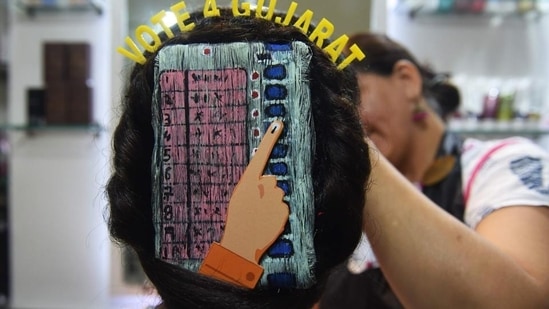
The Election Commission of India (ECI) announced elections to the legislative assembly of Gujarat on November 3. These elections will be held in two phases on December 1 and December 5 and the counting of votes will be on December 8. Here are five charts that explain the nature of the contest in these elections.
A win alone will not be enough for the BJP. This is because of the prestige
The results may set the narrative in the opposition camp
Gujarat has traditionally seen a BJP versus Congress contest, and the latter, even though it has not won elections in a long time, has always ended up with a creditable vote share. Given the fact that the on-ground campaign of the Aam Admi Party (AAP) is more visible than that of the Congress, the question is whether the former can finish ahead of the Congress. If this happens, it will strengthen AAP’s position within the opposition in the run-up to 2024 elections and make the Congress’ fight for relevance that much more difficult.
{{^htLoading}} {{/htLoading}} BJP’s winning streak doesn’t mean the state’s population is homogeneous
BJP’s prolonged dominance in Gujarat politics might suggest that the state’s electorate is homogeneous in nature. This is not true. For example, while Scheduled Tribes (STs) are only 16.2% of the state’s population, according to the National Family Health Survey (NFHS) conducted in 2019-21, they are geographically concentrated. In seven of 33 districts of the state, STs are in a majority, which makes them electorally important in a first-past-the-post system . There is a similar divide in the urban nature of districts and their wealth profile. 41% of the state is urban, which would make it a “mixed” state (rural population between 40% and 60%) according to HT’s classification. However, at the district level, only six of 33 districts are “mixed” while 24 are rural (with more than 60% rural population) and just three are urban (less than 40% rural population). Similarly, the figure for the state taken as a whole suggests that the state is in the “very rich” category by HT’s classification (top 20% richest of India are the most over-represented wealth quintile in the state). However, only eight districts can be classified as belonging to the group. 12 districts are in the lower rung of “rich” category, two in the “middle” and “poor” category, and nine in the “very poor” category.
{{^htLoading}} {{/htLoading}} The Gujarat elections went down to the wire the last time
According to an analysis based on CSDS-Lokniti’s surveys in The Hindu (published December 19, 2017), 43% voters decided their voting preference in the last two weeks of campaigning in 2017. Hindu voters’ preference for the BJP increased by seven percentage points between November and the December election day (and three percentage points higher than in 2012). Given the fact that the BJP’s seat tally in 2017 was the lowest since 1995, it can be said that the last minute swing was crucial to its victory. However, the Congress – the main opposition party in the state so far – has at least lost some ability to exploit this since 2017. In that election, it had the support of three young community leaders ,Jignesh Mevani, Hardik Patel, and Alpesh Thakor. This gave it a boost in the SC, Patel, and Thakor communities, respectively. Only Mevani now remains with the Congress. To be sure, the entry of AAP could make the old equations irrelevant in the Gujarat elections this time.
{{^htLoading}} {{/htLoading}}