
 E-Paper



Food grain distribution more than doubles since lockdown
With barely seven of India’s 2,067 large wholesale food markets functioning in the initial days of the lockdown, the Food Corporation of India (FCI) and Indian Railways went into overdrive to ferry grain stocks from food-surplus states to deficient ones.

 Prefer HTon Google


Indian Railways has transported 5.2 million tonnes of foodgrains in the month since the country went under a lockdown on March 25 to curb the spread of the coronavirus disease, more than double the quantity the national transporter carried in the same time a year ago, as the Centre tried to avert the spectre of hunger by making sure every region had plentiful food stock.
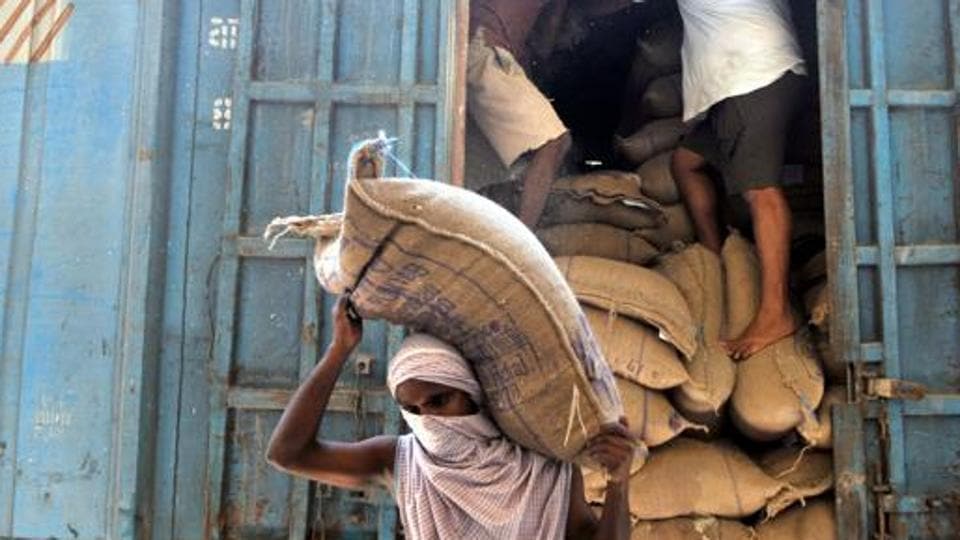
With barely seven of India’s 2,067 large wholesale food markets functioning in the initial days of the lockdown, the Food Corporation of India (FCI) and Indian Railways went into overdrive to ferry grain stocks from food-surplus states to deficient ones.
“The railways’ transportation of food stocks has played the single most important role in combating hunger during the lockdown,” acknowledged K. Mani, an economist with the Tamil Nadu Agricultural University.
India’s farm output has grown consistently, helping it reach food self-suffiency. Up from barely 50 million tonnes in 1950-51 to over 257 million tonnes in 2018-19, increasing foodgrain output has helped India avoid a situation in which the pace of growth in food output lags behind population.
Yet, according to economists such as Amartya Sen, it is not the lack of food output, but bad distribution that has caused previous crises in India such as the last major famine of 1943 that killed an estimated 3 million people.
Indian Railways has proved to be a lifeline during the coronavirus crisis, filling the large gap left by frayed private sector supply chains and a near-collapse of the wholesale markets.
“Maintaining continuity in supply chain was stiffer on account of tough working conditions due to lockdown. A constant coordination for terminal release/labour availability with DMs {district magistrates} at district level, state coordinating officers, and at apex level with MHA {ministry of home affairs} is being done by operating officers of Indian Railways,” a railway ministry spokesperson said.
Meticulous prior planning with FCI on destinations to which the foodgrains must be carried had also paid off, the spokesperson said.
To be sure, Indian Railways has suffered considerable losses because of the suspension of passenger trains during the lockdown as well as a decline in transport of commodities like coal and coke, the primary commodities it ferries, earnings from which dropped 48.91% to Rs 2,336.4 crore in April from a year ago.
Earnings from transport of foodgrains, flour and pulses shot up by more than 90% during the same period Rs 817.96 crore, according to railway ministry data reviewed by Hindustan Times.
“The first task for us was to identify surplus depots. Some depots already had railheads. Those were the first ones to be serviced,” said a food ministry official, requesting anonymity.
Punjab and Haryana account for 80% of outbound freight for wheat while 60% of rice reserves came from Chhattisgarh, Punjab, Haryana, Uttar Pradesh and Tamil Nadu, according to official data.
Interestingly, with no passenger trains plying on its network, Indian Railways has for the first time in decades found the tracks decongested enough to run its freight trains at record speeds; it has also begun joining two goods trains for the transportation of foodgrains. Under this concept, two freight trains loaded from two different originating stations are clubbed at the nearest junction point and proceed to a common destination.
Over 1,000 train trips have been undertaken to carry grains, pulses and horticulture produce from state to state since the lockdown. On April 22, the network saw total cargo traffic of 102 trainloads carrying about 280,000 tonnes of grains, the highest single-day movement so far.
The FCI moved 158 trainloads carrying 442,000 tonnes of foodgrains (22,000 tonne of wheat and 420,000 tonnes of rice) during the first 25-day period of the countrywide lockdown to the mountainous northeastern states, double its normal average of about 80 trainloads per month.
One of the landmarks was to reach over 22,000 grains to the farthest depot on the Indian side in Manipur’s Ukrul, which borders Myanmar. The northeast’s hilly terrain means states in the region have few railheads.
To ferry food to Arunchal Pradesh, which shares a boundary with China, food trains have been chugging on a meter-gauge track till Mukukchaleng in Assam’s Dhemaji district, an outback from where trucks make an onward journey to the higher reaches of Pasighat, a tribal town in Arunchal.
“These truck movements were undertaken in extremely challenging conditions,”said Lalrothang, an FCI official in Nagaland, who goes by one name.


