The Assam government on Friday decided to conduct forensic tests of the 18 elephants that reportedly died due to lightning two days ago in Barhampur area of Nagaon district.
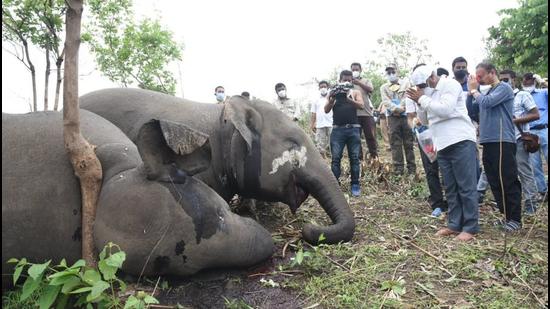
The bodies of the elephants, all adults and sub-adults, were buried on Friday after a team of veterinarians conducted the post-mortem. Some remains have been sent to the state forensic laboratory in Guwahati for further tests.
The incident took place at Bamuni Pahar under Kothiatoli forest range of Nagaon district. Bodies of the pachyderms were found on Thursday-- four were found at the bottom of a hillock and 14 others on top of it.
Though initial inquiry had revealed lightning to be the likely cause of the deaths, wildlife experts had suspected that mass poisoning could also be a reason as Assam had earlier witnessed deaths of elephants due to poisonings.
“From what we saw, it appears the deaths were caused due to lightning as there were no visible signs of struggle before the elephants died. But the exact cause will be known only after reports of post mortem and forensic examinations,” said forest and environment minister Parimal Suklabaidya.
The Assam government has constituted a team to be headed by a senior forest officer and seven veterinarians to probe the incident. They will submit their preliminary report within three days and a detailed one in 15 days.
{{/usCountry}}The Assam government has constituted a team to be headed by a senior forest officer and seven veterinarians to probe the incident. They will submit their preliminary report within three days and a detailed one in 15 days.
{{/usCountry}}On Friday, almost the entire day was spent on conducting post-mortems, bringing the bodies of the pachyderms down from the hillock and burying them in open grounds.
“The post-mortem reports will be available in a day or two, but we may have to wait a little longer for outcome of the forensic tests. A visit to the area had revealed that some trees near the bodies of the elephants were burnt, which suggested that lightning may have struck the area,” P Sivakumar, director, Kaziranga National Park and Tiger Reserve (KNPTR) said.
Elephant experts and CEO of Aaranyak, a wildlife NGO, Bibhab Talukdar, said that though it initially appeared unlikely that lightning could have resulted in the deaths, but evidence now suggests that it was the most probable cause.
“Our studies have revealed that in Assam, the most intense lightning strikes happen prior to dawn and in the period between April-May, our region is the third most prone to lightning after parts of Central Amercia and Australia. An international weather website had also shown lightning strikes happening in the area where the elephants died on Wednesday,” said Rahul Mahanta, professor of Physics at Cotton University.
“There have been previous instances in the past where large numbers of animals have died due to lightning. In 2016, over 300 reindeer died in Norway in a lightning strike. Photos and videos of the incident at Nagaon suggest that the elephants died in an instant after their nervous system got severely affected by the lightning strike,” he added.