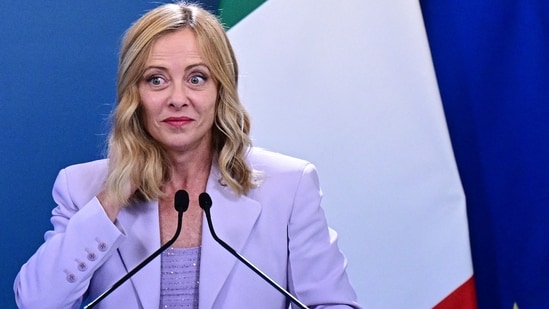
Italian Prime Minister Giorgia Meloni on Saturday pushed back against growing European momentum toward recognising the state of Palestine and called such a move "counter-productive".
Italy's Prime Minister Giorgia Meloni said on Saturday that recognising the State of Palestine before it is established. (AFP)
"I am very much in favour of the State of Palestine, but I am not in favour of recognising it before establishing it," Meloni told Italian daily La Repubblica. "If something that doesn't exist is recognised on paper, the problem could appear to be solved when it isn't," she added.
In addition to Italy, Germany also indicated that it was not planning to recognise the state of Palestine in the short term, adding that its priority now is to make "long-overdue progress" towards a two-state solution.
France set to recognise Palestinian state
Her remarks come just days after French President Emmanuel Macron announced that France would recognise a Palestinian state at the United Nations General Assembly in September, a move that has drawn sharp criticism from both Israel and the United States.
{{^htLoading}} {{/htLoading}}
{{^usCountry}}
Macron's announcement marks a significant shift in European diplomacy and has sparked debate across EU capitals.
{{/usCountry}}
{{#usCountry}}
Macron's announcement marks a significant shift in European diplomacy and has sparked debate across EU capitals.
"True to its historic commitment to a just and lasting peace in the Middle East, I have decided that France will recognise the State of Palestine. I will make a formal announcement at the United Nations General Assembly in September," the French head of state wrote on X and Instagram.
After the inclusion of France, Palestinian statehood is now recognised by 142 countries, according to an AFP tally, though Israel and the United States strongly oppose recognition.
{{^htLoading}} {{/htLoading}}
In 1947, a resolution of the UN General Assembly decided on the partition of Palestine, then under a British mandate, into two independent states — one Jewish and the other Arab.
The following year, the State of Israel was proclaimed. For several decades, the vast majority of UN member states have supported the idea of a two-state solution: Israeli and Palestinian, living side-by-side peacefully and securely.
Follow the latest breaking news, major developments and agenda-setting stories from India and around the world with the newsdesk at Hindustan Times. Operating round the clock, the desk brings together experienced editors, reporters and correspondents to deliver fast, accurate and contextual reporting across subjects that influence public policy, governance, business, society and international affairs. The HT News Desk covers politics, elections, government policies, the economy, business and markets, science and technology, the environment, law and order, infrastructure, education, climate issues and geopolitics, while closely tracking developments across states, institutions and global capitals. The team also leads coverage of major breaking news events, policy announcements, court proceedings, natural disasters, public emergencies and significant international developments. Reports published by the newsdesk are based on information gathered from reporters on the ground, official statements, government agencies, court records, regulatory filings, recognised institutions and other authoritative sources. Stories undergo editorial scrutiny and verification processes to ensure accuracy, fairness and relevance, and are updated as events evolve and additional information becomes available. Whether covering a key political decision in New Delhi, an economic policy shift affecting millions, a landmark court ruling or a major global event, the HT News Desk aims to provide readers with reliable, fact-based journalism that delivers not only the latest developments but also the context and analysis needed to understand their wider implications.
Get the latest World News, breaking headlines and global updates from the US, UK, Pakistan, Bangladesh, Russia and other countries. Follow major international events on Hindustan Times.
Get the latest World News, breaking headlines and global updates from the US, UK, Pakistan, Bangladesh, Russia and other countries. Follow major international events on Hindustan Times.
Home/World News/Italy's Meloni on France move to recognise State of Palestine: 'Something that doesn't exist…'
{{^htLoading}}
Advertisement
{{/htLoading}}
SHARE THIS ARTICLE ON
{{#usCountry}}{{/usCountry}}
Notifications
Get breaking alerts directly from the newsroom
Notifications are on!You'll be notified when news breaks