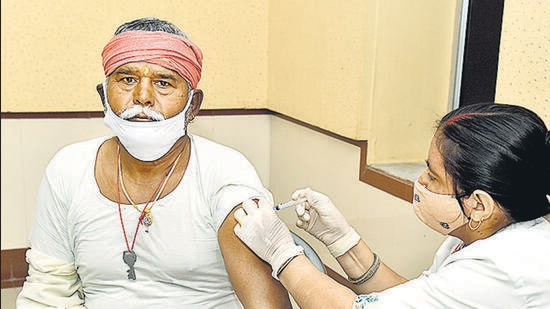
The 75-day nationwide window for free Covid-19 booster doses for all adults in India, which ended on Friday, has significantly increased the demand for the third shot of the vaccine and brought coverage among eligible population from 8% to 27%, data released by the government shows.
Data analysed by HT shows that even though more than 84% of all adults in the country are currently eligible for booster shots, less than a quarter have so far opted for the third shot – highlighting the challenge that still lies ahead in terms of booster coverage.
“PM Narendra Modi Ji’s government is committed to creating a healthy and safe India. I urge all the eligible beneficiaries to get their precaution dose at the earliest and also keep following Covid-appropriate behaviour to defeat the pandemic,” Union health minister Mansukh Mandaviya said on Twitter.
The ministry of health launched the special campaign, labelled the “Covid Vaccination Amrit Mahotsava”, on July 15, 2022, under which special vaccination drives were organised by all states and Union territories to increase the severely lagging uptake for booster shots in the country.
In all, 159.2 million precaution doses were administered during this 75-day period, government data shows.
{{/usCountry}}In all, 159.2 million precaution doses were administered during this 75-day period, government data shows.
{{/usCountry}}As part of the campaign, 11,104 camps were organized at bus stations, 5,664 camps at railway stations, 511 camps at airports, 150,004 camps at schools and colleges, and 4,451 camps at routes of religious yatras. Also, 1,130,044 camps were organised at private and government workplaces. Apart from 159.2 million precaution dose, the 75-day period of the drive saw administration of 7.6 million first doses, 23.5 million second doses.
The impact of this special drive (as well as the need for free booster shots) can be seen from the speed of vaccine administration since April.
The seven-day average of booster administration on April 16, a week after all adults became eligible for it, was a mere 0.14 million doses per day. Three months later (in mid-July), this average was still under a million – 0.56 million doses per day. The free window, however, gave this pace a significant bump. From July 21 to September 17, the seven-day average jumped to 2 million or more nearly throughout, reaching a peak of 2.65 million doses per day for the week ended August 8.
“At the start of Covid vaccination Amrit Mahotsava on July 15, 2022, only 8% of the eligible population aged 18 years and above had received the Precaution Dose. With the intervention of 75 days long free vaccination campaign, 27% of the eligible population has now received their precaution dose,” the Union health ministry said in a statement.
While these results underline the importance of making the dose free, it also shows that the task ahead remains onerous. Even at the peak booster pace of 2.65 million doses per day throughout the 75-day window, it would not have been possible for all eligible by September 30 to take a shot.
Experts say boosters are important, especially population groups that are particularly vulnerable to Covid-19 such as the elderly, and those with comorbid conditions.
“Those who are at high-risk especially need to take the booster shot as the pandemic is not yet over and it will provide that additional layer of protection to them,” said Dr GC Khilnani, former head, pulmonology department, All India Institute of Medical Sciences, Delhi.