
 E-Paper



From the Archive: A charter of liberty
That the people include all those who were formerly subjects of Indian princes was the effect of a brief announcement made by Sardar Patel

 Prefer HTon Google


From today, the people of India are the proud possessors of a Constitution embodying their free will and giving them an instrument for the government of the people by the people and for the people. That the people include all those who were formerly subjects of Indian princes was the effect of a brief announcement made by Sardar Patel, marking the climax to the final reading debate.
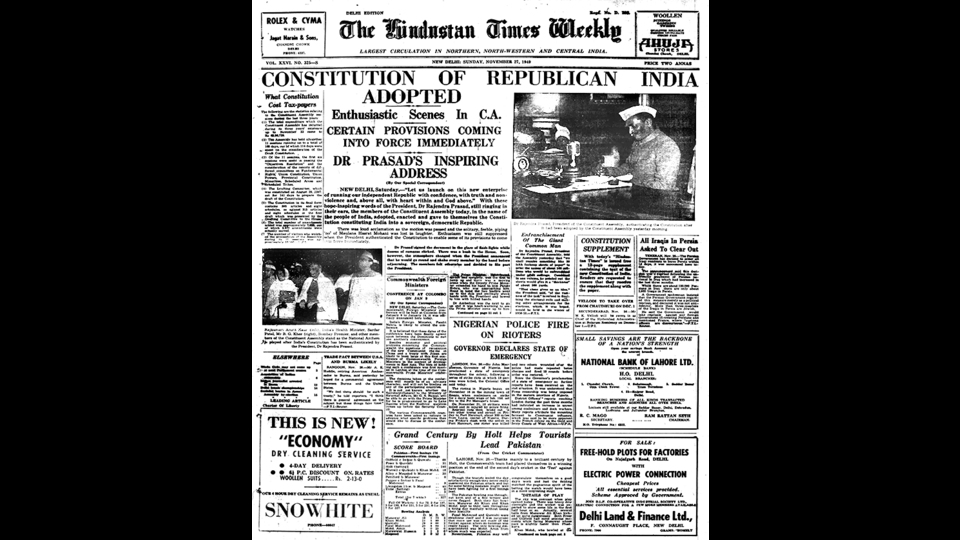
The Deputy Prime Minister stated that all the nine states, including Hyderabad, had accepted the Constitution. Passed with acclamation amidst scenes at joy by the Constituent Assembly, the Constitution has already come into force in part following authentication by the President of the Assembly. But, as a whole, it will take effect from January 26, 1950, when the Republic of India will be born giving soul-satisfying significance to the date on which the Congress proclaimed the country’s independence in 1930 even while the British were in physical possession of the land and believed their domination safe for as long as they could foresee.
Most of the 110 speeches which marked the final reading of the revised draft Constitution will provide the future leaders of public opinion and the people on whom will fall the burden of discharging the executive, legislative and judicial functions of the State with an idea of the hopes and fears of its framers. In particular, they will draw inspiration from the final address of the President, Dr Rajendra Prasad, and the observations of the Congress President, Dr Pattabhi Sitaramayya. They will find much guidance in the closing comments of its leading framers and will note the dangers against which the Chairman of the Drafting Committee, Dr BR. Ambedkar, has warned them.
The herculean task was performed in 11 sessions constituting 165 working days. Of these, the House devoted 114 days to consideration of the draft Constitution. But, while much credit is due to those who prepared the original scheme and to the drafting committee, which held 141 sittings to consider various amendments, the main credit for the achievement, as Dr Ambedkar gracefully acknowledged in winding up the debate, goes to the Congress. If the C.A. had been a motley crowd, he said, there would have been nothing but chaos, but the Congress saved the situation by bringing into the proceedings of the House “a sense of order and discipline.” What is more, it was at the daily meetings of the party that some of the most raffling political and constitutional issues were thrashed out and settled. Although in referring to the future, Dr Ambedkar used sombre words and his approach was somewhat sectional, he was right in sounding a note of warning against certain dangers inherent in the situation.
The people, he said, must place the country above creed, they must hold fast to constitutional methods and must assure that political democracy is supplemented with social democracy. In thinking that it is for the upper classes to bring about transformation in the social sphere, Dr Ambedkar appeared to forget that the Constitution has already provided the sovereign remedy for that through the steam-roller of adult franchise which will put on the electoral rolls some 160 million voters. The debate helped to bring out the salient features of the Constitution. Integration of states, abolition of untouchability, abandonment of separate communal electorate, reservation of seats, and the Fundamental Rights received general and enthusiastic approval.
Criticism was confined mainly to provisions about preventive detention, the Centre’s powers and property rights. A majority of the speakers, however, appreciated the sense of realism which had inspired the provisions objected to. It was also realised that the Gandhian ideology had not been in any way ignored for the main tenets of the teachings of the Father of the Nation had been incorporated in the Constitution in appropriate places.
Besides outlawing untouchability, the Constitution makes full provision for the development of cottage industries, for the establishment of 1 panchayats and for the uplift of the backward classes, be they Scheduled Castes or tribal people. It was in the fitness of things that many speakers, while paying homage to Gandhi ji, remembered all the fighters for freedom in gratitude. The debate, on the whole, showed clearly that the Constitution fashioned after three years’ labours has the general approval of the people who have to work it.


