A few girls at a government tribal hostel in Maharashtra’s Amravati district began crying, laughing and fainting without any clear explanation. Within days, rumours of ghosts, possession and a “chakwa” spread across nearby villages.
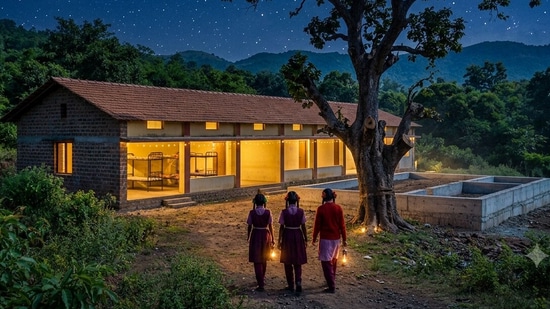
What followed was the exodus of hundreds of students from the “haunted” hostel, as parents took their children home fearing something was wrong with the campus.
The hostel is part of Shaskiya Madhyamik Va Uchha Madhyamik (Kala va Vigyan) Ashram Shala Doma, a government tribal residential school in Doma village, Chikhaldara taluka. It is run by the Tribal Development Department and was established in 1979.
A state health team that examined the affected girls found no evidence of anything supernatural. Instead, it identified dissociative or conversion symptoms and said it was a case of “selective hysteria”, news agency PTI reported.
A senior Tribal Development Department official said a team of health experts visited the Doma residential school to assess the situation. “The symptoms have nothing to do with anything supernatural. It could be a selective hysteria-like condition related to mental stress,” the official said, as per PTI.
ALSO READ | Haunted houses are in demand in Japan
{{/usCountry}}ALSO READ | Haunted houses are in demand in Japan
{{/usCountry}}A hostel source said some girls claimed they had heard the sound of anklets clanking.
“This is indeed a case of mass hysteria. Once hysterical symptoms emerge, others may also display similar behaviour after observing it. Counselling of parents is therefore essential, as patients may consciously or unconsciously reproduce such symptoms,” Dr Swati Sonone, psychiatrist and head of the District Mental Health Programme, told The Indian Express.
How the ‘haunted’ story took hold
A woman in Ektai village, around 50 km from Doma, claimed she had seen a supernatural shadow and later began behaving unusually, according to the investigating team. A student who saw her also started crying and laughing uncontrollably. Soon, other girls showed similar symptoms.
Rumours about the cause also spread. Some students and locals believed spirits lived in a mahua tree that was cut down by the school management. They believed the spirits then began troubling the students.
Another belief was that the school’s drainage channel had affected a nearby temple, angering the deity. A third theory linked the incidents to the death of an Adivasi youth in a field near the school, as per PTI.
The Maharashtra Andhashraddha Nirmoolan Samiti (ANIS) members found that some families had taken the girls to bhumkas (traditional tribal healers). “We found that the girls were fine. Some were cooking while others had gone to the fields,” ANIS state executive committee member Nandini Jadhav said, as per The Indian Express.
She said some bhumkas had told families the girls were affected by a “chakwa”, or supernatural phenomenon, after which rituals were performed.
ALSO READ | India's most haunted places: from Ramoji Film City to Bhangarh Fort
‘I don’t remember anything’
Shivani Kalsekar, a Class XII student, was among the affected girls. She complained of dizziness and has not returned to the hostel since the incident. “I don’t remember anything,” she told The Indian Express.
Class XI student Janhavi Maraskolhe witnessed the incidents. “Nothing like this happened ever before,” she said. She recalled girls crying, laughing and fainting without reason.
Janhavi has returned to the hostel, where around 50 girls are staying. Headmaster Sanjay Chaudhary said efforts were underway to counsel the girls and bring them back to school. “A few have returned,” he told PTI.
Nearly 610 students leave the hostel
The school, which began in 1979, has around 852 students. Nearly 610 students left the hostel after parents began taking their children home. As rumours began keeping hundreds of students away, teachers, health officials and anti-superstition activists started visiting villages and speaking to families.
The organisation also found that some hostel rooms had poor ventilation and were overcrowded, which it said could contribute to psychological problems.