The charts that matter
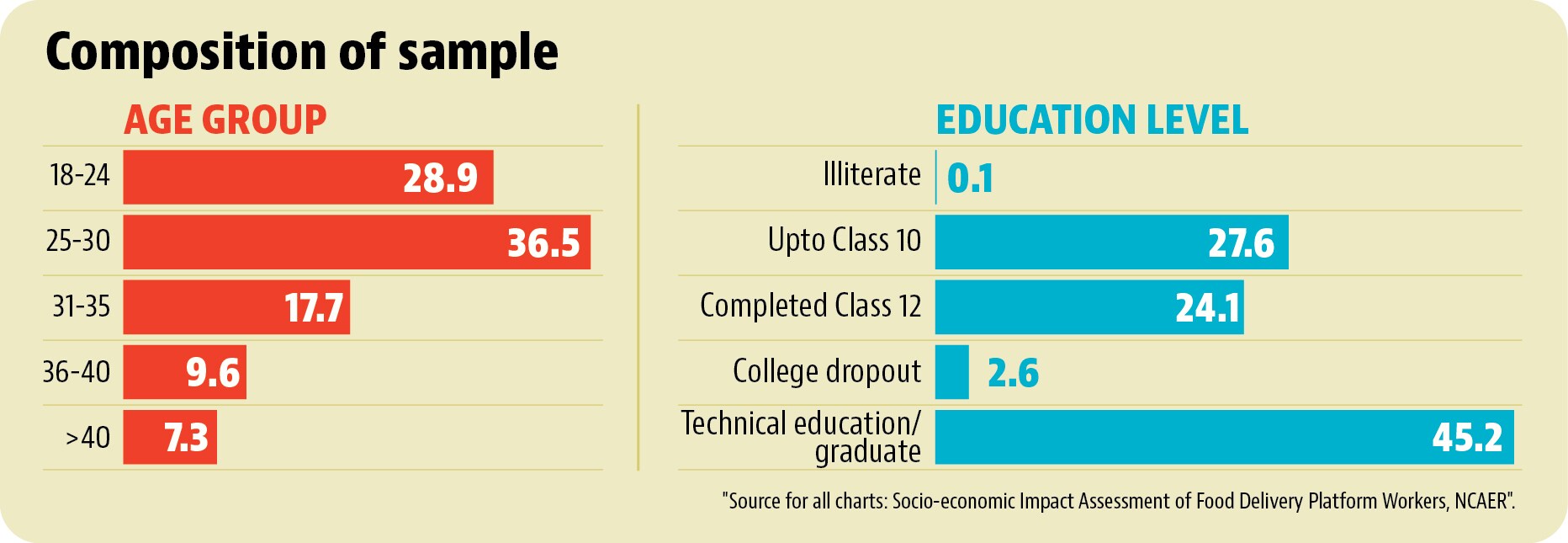 Food delivery workers are overwhelmingly young men working in their home townsThe report is based on telephonic interviews conducted between April and May 2022 with 924 food delivery platform workers from one food delivery company in 28 cities, big and small. The sample includes workers in Tier 1, 2 and 3 cities working on long- and short-shifts over different periods of time. The report shows that 84% of the total workers were 35 years old or younger and 99% of them, male. Interestingly, at least two-thirds of the workers in all types of cities are working in their home towns.
- Food delivery jobs are formal but not necessarily betterThe dominance of informal employment is often seen as one of the biggest reasons behind India’s low per capita income. However, the report shows that increasing formalization of employment does not necessarily entail an improvement in quality of employment. The report compares the jobs of long-shift active workers in the food delivery company to their previous jobs and finds that while gig work has universal written contracts (the benchmark for formal jobs) it does not necessarily lead to fewer working hours or better provision of paid leaves and that it actually leads to an increase in worker’s capital requirements (two-wheeler and smartphone ownership). This is true even for short-shift workers, the study found.
- And inflation has played a big role in squeezing real incomesTo be sure, workers are willing to brave harsh working conditions and higher working capital requirements in the hope of material gain. In fact, the report shows that higher (or additional) income (for short-shift workers) and more independence in work are the biggest pull factors in terms of the appeal of the job. However, these expectations have taken a beating because of the recent surge in inflation. The report shows that despite a rise in nominal incomes between 2019 and 2022, inflation adjusted incomes of food delivery workers have seen a fall.
- Workers are divided about the upward mobility the job providesThis is perhaps the most important question as far as the virtue of gig economy work is concerned. Given the fact that the report clearly shows that incomes of food delivery workers are anything but high, the question is whether the current job gives them skills that could boost their prospects of upward mobility in terms of better jobs of higher incomes. The report shows that workers who left these jobs to join new jobs are divided on this question and the majority does not believe that the food delivery jobs gave them useful experience or helped them get more pay.
- The larger takeaway“The platform provides a good stop-gap for people to earn while they get a more permanent job. And the majority of people joining the platform have no intention of remaining in the platform for an extended period. This is productive wait and then they go on to better opportunities – studying or working”, the report says. In macro terms, it also means that the gig economy cannot be a long-term solution to the Indian economy’s employment challenge. This is an important message for India’s economic policy establishment.
The gig economy is often portrayed as the future of work in the Indian economy. While there is a lot of talk about start-ups in the space becoming unicorns (companies with a valuation of a billion US dollars or more) there are growing concerns about the physical and mental well-being of workers in the gig economy. The Rajasthan government’s recent bill on gig workers has given this debate new traction.
To be sure, very little is known about the actual
{{^usCountry}}
Get Latest News, breaking headlines, and top India News, and today real-time updates from across the nation. Stay informed on politics, government policies, crime, Today Weather, and major developments on Hindustan Times
Get Latest News, breaking headlines, and top India News, and today real-time updates from across the nation. Stay informed on politics, government policies, crime, Today Weather, and major developments on Hindustan Times
Advertisement
{{/htLoading}}{{#usCountry}}