The Delhi government intends to ask the Centre to tweak its procedure to notify Covid-19 red and orange zones for the national capital to let them ease restrictions in areas that haven’t had a single coronavirus case.
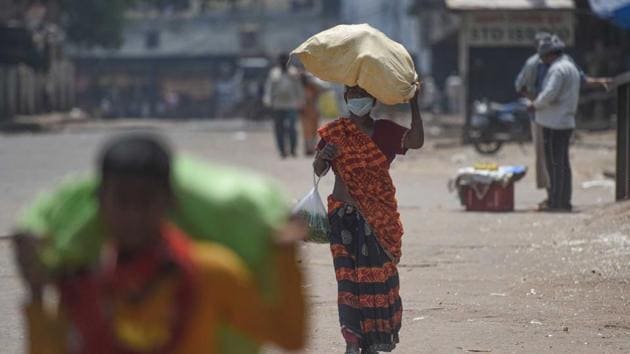
People carrying bundles of vegetables during lockdown, in at Azadpur Mandi, New Delhi, India, on Friday, May 1, 2020. (Sanchit Khanna/HT PHOTO)
{{^htLoading}} {{/htLoading}}
“We are finalising a proposal to be submitted to the Union Health Ministry to consider a municipal ward, and not a district, as a unit for notifying red zones,” a senior Delhi government official told Hindustan Times.
With the home ministry extending the lockdown for two more weeks, this means that the city’s estimated population of 19 million people would remain under the extended spell of lockdown. The home ministry on Friday evening extended the lockdown due to lapse on May 3 midnight by another two weeks.
Officials said treating the district as a unit was unfair to the people of the city and the Centre should take a smaller unit.
{{^htLoading}} {{/htLoading}}
{{^usCountry}}
“The North-East Delhi District, the country’s most densely populated district, is spread over 56 square kilometers. It is unreasonable to count the entire district as one unit and place it under a continued lockdown because there were some clusters of Covid-19,” an official said.
{{/usCountry}}
{{#usCountry}}
“The North-East Delhi District, the country’s most densely populated district, is spread over 56 square kilometers. It is unreasonable to count the entire district as one unit and place it under a continued lockdown because there were some clusters of Covid-19,” an official said.
“I think the Centre should give Delhi a break.. It is unfair,” he added.
He reasoned that if the Centre continues to use the same parameter, it would be months before Delhi moves into the green zone.
The city government believes a better strategy would be to demarcate the city into municipal wards - there are 272 wards under the three municipal corporations besides the NDMC and Delhi Cantonment Board - and count a ward as red, green or orange zone depending on the number of cases.
“This time, we have broadened the criteria. The areas have been labelled also keeping in mind the fact these should not become potential hot spots if relaxations are given as per the green zone criteria.
This implies that some places may be in the green zone but were still designated as orange or red due to their proximity to areas where the case load is high.
Shishir Gupta is Executive Editor at Hindustan Times and one of India's top journalists covering national security, strategic affairs, foreign policy and geopolitics. Over the past three decades, he has extensively reported on India's military, diplomatic and security landscape, covering every major conflict and national security challenge, from the 1999 Kargil War and the 2020 East Ladakh standoff to Operation Sindoor in 2025. He has also covered major terror attacks, including the IC-814 hijacking, the 26/11 Mumbai attacks and the 2025 Pahalgam terror strike, along with numerous Pakistan-backed terrorist incidents in the Kashmir Valley and across India. He has reported on national and state elections for more than three decades. A recognised authority on strategic affairs, Gupta has covered India's nuclear programme since the Pokhran-II (Shakti series) tests in May 1998 and has written extensively on global nuclear issues, Indian diplomacy and the country's expanding global outreach. He has also reported widely on international conflicts and terrorism, with a special focus on the Indian subcontinent. Gupta has interviewed Prime Minister Narendra Modi more than four times, including Modi's first interview with the print media after becoming Prime Minister in May 2014. His other interviews include three with the Dalai Lama, as well as conversations with Benjamin Netanyahu, Amit Shah, Yogi Adityanath, S. Jaishankar, Nirmala Sitharaman and Piyush Goyal. He is the author of Indian Mujahideen: The Enemy Within (Hachette, 2011) and Himalayan Face-off: Chinese Assertion and Indian Riposte (Hachette, 2014). He was awarded the Chevening-Wolfson Joint Scholarship at Wolfson College, University of Cambridge, UK, in 1998 and participated in the International Visitor Leadership Program (IVLP) of the US State Department in 2006. He received the Ben Gurion Prize from Israel in 2011 and the K. Subrahmanyam Prize for Strategic Studies in 2015 from the Manohar Parrikar Institute for Defence Studies and Analyses (MP-IDSA). Since 2024, he has hosted Point Blank, Hindustan Times' weekly YouTube show on global geopolitics.
Get real-time updates on CJP Delhi Protest LIVE , breaking headlines, and top India News, breaking headlines, and real-time updates from across the nation. Stay informed on politics, government policies, crime, Today Weather, and major developments on Hindustan Times
Get real-time updates on CJP Delhi Protest LIVE , breaking headlines, and top India News, breaking headlines, and real-time updates from across the nation. Stay informed on politics, government policies, crime, Today Weather, and major developments on Hindustan Times