E-Paper



Goa’s dying Kunbi saree finds fresh lease of life on fashion ramp
The surge in popularity has meant that the Goa government has also begun promoting the saree, pumping in money to launch six handloom training centres.

 Prefer HTon Google


When Goan fashion designer Verma D’Mello first suggested that she would drape her models in “indigenous tribal wear” at the 2019 Cannes festival, she was met with bemusement, she remembers. Her forte was bridal collections, and this, after all, was one of the world’s biggest stages. D’Mello took the leap nonetheless, and jaws dropped when her models glided down the ramp in costumes made entirely of material indigenous to Goa’s Kunbi and Gauda tribes. That year, she was given the award for “best red-carpet designer.”
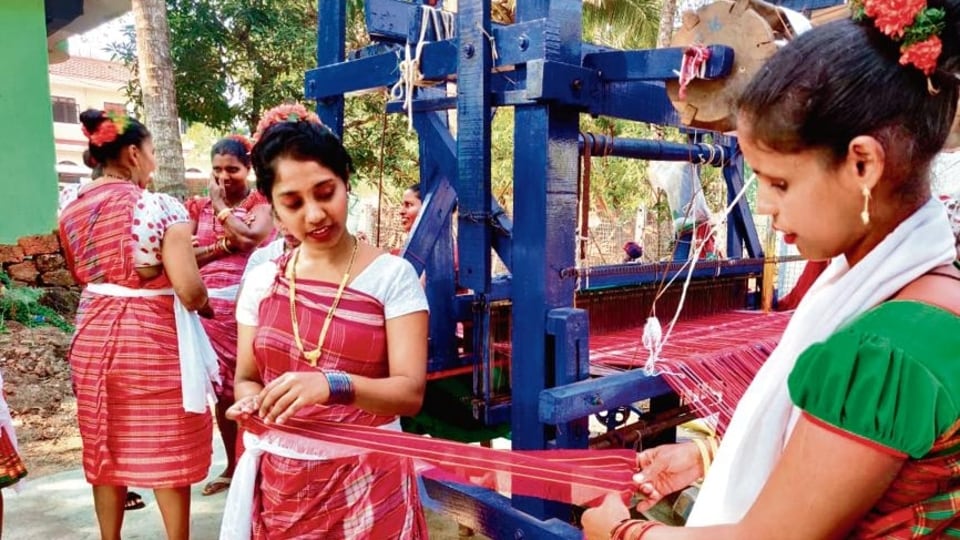
It gave fillip to a revival once unimaginable.
On August 22 this year, President of India Droupadi Murmu arrived in Goa, and at the state reception honouring her, she was given a shawl woven of Kunbi fabric and a full length Kunbi saree.Earlier in the year, when Australian member of parliament Zaneta Mascarenhas visited India for the 17th Pravasi Bharatiya Divas meet in January, she wore a Kunbi saree gifted to her by D’Mello.
Over the decades, as demand evaporated, handlooms shut and modernity took over, it had seemed the Kunbi saree was fading into oblivion, relegated to a token curiosity from the villages of Goa. The reasons for its decline weren’t just external. For generations, the saree had become a caste and identity marker for scheduled tribes that wore them almost exclusively. As aspirational youth began to try and break free of those shackles, the Kunbi fabric was the first thing they shed.
But now, the Kunbi saree is back in India’s imagination of Goa, and Goa’s imagination of its heritage. It is front and centre on the fashion ramp; at ceremonial functions; even the focus of a government push that mandates all guests will be honoured with the saree.
But there are questions that linger. There are concerns of whether the benefits of this return to prominence is filtering down to the communities involved. And most importantly, given the complex questions of caste and identity, if the fate of the Kunbi saree should be left to the tribes themselves.
The Kunbi saree and its decline
Handwoven out of cotton yarn and then dyed in the earth, the Kunbi saree was for long ubiquitous with the Kunbis and the Gaudas, two scheduled tribes in Goa that live in the hills; are known for subsistence agriculture; and were employed as mining labourers during Portuguese rule.
Patterned in square checks, the material was used by women to drape a saree, usually up to the knee. The men used it as a loincloth, locally known as kashti. “The pattern mainly consists of a chequered design in various sizes with a striped border called a Dobby. Originally made only in red, white and yellow, the introduction of other dyes like indigo also brought colours like blue and purple, used in times of mourning,” a white paper released in 2022 by the Goa Livelihoods Forum, an NGO working with rural livelihoods, said.
The cotton saree was knotted in the right shoulder that “allowed women to work freely in the fields” and was also convenient for them to do household chores, “providing comfort and ease in the sultry weather.” Before the Portuguese arrived on Goa’s shores in the early 1500’s, women would wear the saree without a blouse, until a colonial law forced them to include it as part of the dress.
But come the 21st century, the Kunbis and the Gaudas began to disassociate themselves with the most visible sign of their identity, looking to assimilate with a state changing around them. “We were discriminated against, called names and looked down upon. The saree was only worn at cultural events and performances where men and women would re-enact their cultural legacy,” said advocate João Fernandes, a Kunbi and an advocate for tribal rights.
There was a time, Fernandes said, the sarees were sought after as far as Ankola in coastal Karnataka. “We used to buy the sarees and the material from local handloom makers. But because of declining demand, all of them shut shop and trade died out,” Fernandes said. Officials of the state handicrafts department said that in 1961, the year Goa was liberated from colonial rule, there were 450-500 handloom weavers in the state. All of them had abandoned the traditional occupation by the turn of the century.
The revival
The first flash of resuscitation came in 2010, when model and actress Lisa Ray appeared in a saree, part of the “Kunbi Tribe” collection by the late Wendell Rodricks, at the Wills Lifestyle India Fashion week in 2010. Rodricks, a Goan, admitted at the time that in his efforts to revive the saree, he had to “change the colours and the checks to make the saree desirable to all castes.”
In the next decade, fashion designers such as D’Mello were eager to experiment with garments that weren’t just unique, but had a singularly cultural story to tell. “When I started to learn more about its existence, I learnt that Kunbi weaving had ceased in Goa. Not even a single weaver does it anymore. That really moved me,” said D’Mello , also the executive director of Goa Sudharop, a California based Goan NGO. She has since presented the Kunbi fabric at Cannes, Africa and Paris.
But there are very few, D’Mello said, that still know how to make the fabric, and those that do are fading fast. “A few men from the tribe and other rural areas were identified and trained in weaving, dyeing and other aspects of the Kunbi Process. The other difficulty was to convince rural parents to allow their young girls to be part of their heritage. We went through long counselling sessions, with the help of village elders, to gain their trust,” D’Mello said. A handloom centre, with help from the Goa Sudharop, has been set up at Orlim in South Goa, and they intend to set up three more in different parts of the state. “There is more demand that we can meet,” D’Mello said.
The surge in popularity has meant that the Goa government has also begun promoting the saree, pumping in money to launch six handloom training centres for rural youth. Thus far, close to 450 women have relearnt the art of the Kunbi handloom since 2016, when the department first opened its training centres officials of the Department of Handloom Textile and Choir said.
In October 2022, Goa Chief Minister Pramod Sawant announced that as a means to preserve and promote the fabric, awardees at state functions would only be felicitated with a Kunbi shawl. Gifts to visiting dignitaries, he said, would either be the saree itself or cloth involving elements of the fabric. “We have a demand of 2000 Kunbi sarees a month but have been unable to meet the demand,” Director of Handicrafts Arvind Bugde said. The state is also in the process of applying for a GI tag, officials said.
There are however challenges to scaling up. The hard labour required to work on a hand loom, the patience that needs to co-exist with natural dyes, the low availability of authentic raw material and low pay for women who take up to 3 days to make a single saree is dissuading youngsters from taking to the job. Of the 450 women trained by the Goa government, only around 40 have taken up the job full time. “There are weavers that know how to do it, but don’t do it because cheap power looms are dominating. There is no comparison between the cost of weaving and the cost of powerloom sarees. It is impossible to ordinarily survive in the market,” D’Mello said.
The way forward
Some experts have also raised fears that the present avatar of the saree “still hasn’t gone back to the community” and has instead become confined to being showcased by the elite. “Unlike a lot of other premium handloom sarees, Kunbi sarees cannot be dissociated from their working-class roots. Its transformation into designer clothing runs the risk of snatching it away from the very community that has kept it in circulation all these years,” said Kaustubh Naik, a student of History at the school of South Asia studies at the University of Pennsylvania, and an expert on the state’s caste relations.
Naik said that those promoting the saree do not have to “inherit the humiliation”, rooted in generational apathy, that once came with a Kunbi saree. “The saree and the way it is draped is a caste marker. At last year’s Goa Heritage Festival, several upper caste women did a fashion walk draping the saree, and not one Kunbi woman was there. These modes of appropriation take the product but erase the very woman that makes it or has kept the saree in circulation all these years,” Naik added.
Members of the community said that while the revival has removed the stigma once attached to the saree , measures need to be put in place to ensure the community benefits from the revival. “The revival of the saree, the support from the government and its promotion at official events has helped change attitudes towards our communities and now there is once again interest and a willingness to wear the saree without hesitation. But while we are willing to take what we get from the government the state may look at subsidizing labour to make a saree both affordable, with workers able to earn a fair living wage,” said Blazia Fernandes, involved in preserving Kunbi cultural art.
Naik said that the solution was not that the Kunbi saree not be sold at all, but that the “autonomy” to do so should be retained by the women who make and wear it. “Perhaps a cooperative is the way forward and women that are already into making the sarees can be trained at premier institutes like NIFT where they can be encouraged to modernise the designs and prints they want. Essentially, rather than museum-ising the saree, let the community take charge of deciding its future course.”
Asha Vernekar of the Goa Livelihood Forum said, “For the Kunbi saree to sustain itself, a romantic idea of revival isn’t enough unless there’s a market and that benefits the livelihood of these people.”
But D’Mello said that the newfound recognition is already making change on the ground. “In the villages where we intend to set up the looms, the tribal sarpanch has told me that she too has begun wearing the saree once again.” The next destination for the Kunbi Saree? The October San Francisco Fashion Week.