
 E-Paper



Grand Tamasha: The precarious ties of India-US relations
There are two narratives doing the rounds about Indian Prime Minister Narendra Modi’s recent visit to Washington to break bread with US President Donald Trump.

 Prefer HTon Google


There are two narratives doing the rounds about Indian Prime Minister Narendra Modi’s recent visit to Washington to break bread with US President Donald Trump.
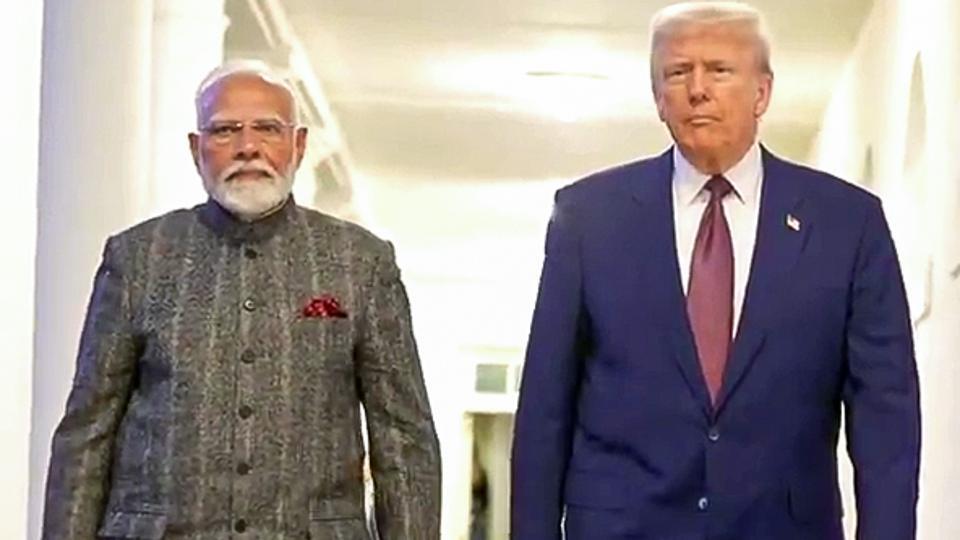
The first narrative, touted by the government and its backers, is that the Prime Minister skillfully threaded the needle with Trump, standing up for Indian interests but also giving the President some important early wins that can position India well for the future. The second narrative suggests a more pessimistic vision –– that US-India relations are at a precarious juncture, where a volatile and transactional President just might upend bilateral ties at a time when India can scarcely afford it.
To discuss where US-India ties sit in the aftermath of the PM Modi visit, Rajesh Rajagopalan was the featured guest on a recent episode of Grand Tamasha, a weekly podcast on Indian politics co-produced by HT and the Carnegie Endowment for International peace. Rajagopalan is a professor of international politics at Jawaharlal Nehru University and an expert on nuclear policy, Indian foreign policy, and US-India relations. He spoke with host Milan Vaishnav about former US President Joe Biden’s foreign policy legacy, India’s longstanding demands for technology transfers, and what he terms a “plateauing” in bilateral ties. The two also discussed Delhi’s view on Elon Musk and the future of US-China relations.
Rajagopalan argued that the world Trump takes over is even more dangerous than the one he left behind four years ago. And, despite America’s concerted shift toward the Indo-Pacific, the Biden administration’s policies have, in many cases, worsened the situation.
“There had been a number of things that had happened since Trump left that has made the world lot more dangerous and lot more unfavourable to the United States and its partners and allies,” said the foreign affairs expert. “The entire Ukraine conflict served to bring Russia and China closer to each other... [because] both see the US and the West as potentially their problems.”
Rajagopalan blamed the Biden administration for delays in various aspects of its support to Ukraine, essentially leading that conflict to being stalemated. “We ended up in a situation where there is a war that is continuing now for several years without any, without any respite, and which is taking away attention from the Indo Pacific,” Rajagopalan stated.
When it comes to current government’s equation with the new US president, Rajagopalan noted that, in advance of the Modi-Trump summit, there were early signs that the Trump administration was well disposed toward India. This fuelled a sense of confidence with the Modi government, based in part on how the government weathered the first Trump term.
“The earlier confidence had to do with the fact that there were guardrails in the last administration —Trump was trying to be respectable, and therefore had, in at least the first three years, people who were well versed with the system. These were regular conservative Washington insiders, and even others who were normal conservatives, and who were not trying to destroy the system,” explained Rajagopalan. Furthermore, to give credit to the Indian foreign policy establishment, Rajagopalan said Indian diplomats were suitably nimble during Trump’s first term.
Following Modi’s recent visit, however, Rajagopalan detects a growing degree of concern among those in the government. “This whole [tariff] reciprocity business becomes a problem for India, because the trade imbalance with the US is quite large, around $40-50 billion, [and] it’s not like you could easily correct that.” Looking forward, the biggest question, said Rajagopalan, “is not even the state of US-India relations, it is the uncertainty about the US itself.”
While India has many cards to play and is a strong and growing power, Rajagopalan lamented that India’s position is somewhat more disadvantageous today than in the 1950s or even the 1990s.


