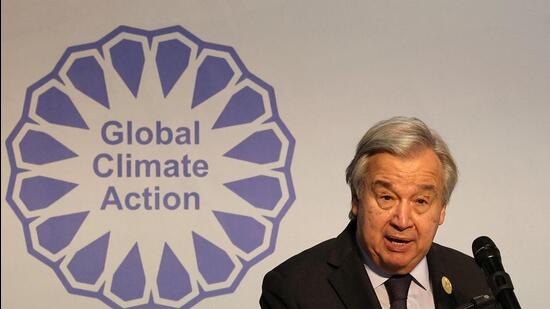
There will be zero tolerance for net zero greenwashing, or falsification of carbon emissions reports, by companies, financial institutions, cities, regions, and other non-state actors, United Nations Secretary General Antonio Guterres has said.
A report of the High-Level Expert Group (HLEG) on Net Zero Emissions Commitments of Non-State Entities at the UN Climate Change Conference (COP27) in Egypt’s Sharm El Sheikh highlighted greenwashing. Net zero greenwashing is seen as a threat to global efforts to reduce greenhouse gas emissions as part of efforts to limit warming to 1.5 degrees C above pre-industrial levels.
Guterres on Tuesday referred to a big gap in the climate space and said a growing number of governments and non-state actors are pledging to be carbon-free. “...that’s good news. The problem is that the criteria and benchmarks for these net zero commitments have varying levels of rigour and loopholes wide enough to drive a diesel truck through. We must have zero tolerance for net zero greenwashing.”
He referred to the report and called it a how-to guide to ensure credible, accountable net zero pledges. “It provides clarity in four key areas: environmental integrity, credibility, accountability, and the role of governments,” said Guterres.
{{/usCountry}}He referred to the report and called it a how-to guide to ensure credible, accountable net zero pledges. “It provides clarity in four key areas: environmental integrity, credibility, accountability, and the role of governments,” said Guterres.
{{/usCountry}}The report presented a road map to prevent net zero goals from being undermined by false claims, ambiguity, and greenwash. Regulatory changes have led to strict rules around net zero in large markets. Disclosure requirements exist or are phasing in across the EU, the UK, Japan, China, South Africa, Kenya, and India, and are proposed in the US. For instance, if a fossil fuel company announces a net zero emissions goal, then it would have to move from its core area of business to renewables, the report said.
“We have built on the existing science and best-in-class voluntary efforts to create a universal definition of net zero, based on five principles and 10 recommendations to guide the future of net zero, and focused on the actions that need to be taken by cities, states, corporations and those who regulate them,” the report said.
Indian banks, consultants, and companies that have net zero goals were consulted for the report. Mumbai has a net zero emissions goal for 2050.
The report sets out 10 practical recommendations to bring integrity, transparency, and accountability to net zero by establishing clear standards and criteria. The report refers to near and medium-term emissions reductions on a path to global net zero by 2050, integrity by aligning commitments with actions and investments, radical transparency in sharing relevant, non-competitive, comparable data on plans and progress, and establishing credibility through plans based in science and third-party accountability. It seeks demonstrable commitment to both equity and justice in all actions.
The report has recommended announcing a net zero pledge, setting net zero targets, using voluntary credits, creating a transition, phasing out of fossil fuels, scaling up renewable energy, aligning lobbying and advocacy, etc.
Catherine McKenna, chair of the UN-appointed expert group and former Canadian environment and climate change minister, said after consulting with hundreds of individuals and organisations and incorporating the latest research and science, they have the road map to ensure net zero commitments by industry, financial institutions, cities, and regions are ambitious, transparent and credible.
“This is about cutting emissions, not corners. Our road map provides clear standards and criteria that must be followed when developing net zero commitments. Right now, the planet cannot afford delays, excuses, or more greenwashing.”
Arunabha Ghosh, CEO of the Council on Energy, Environment and Water, said greenwashing by corporations must stop to get serious about net zero. He added HLEG recommends setting out clear targets and pathways but also delivering absolute emissions reductions.
“At the same time, actions towards net zero must also result in far greater climate investment in sustainable infrastructure in developing countries and deliver positive social and economic outcomes for vulnerable communities. Without such investments, the net zero transition will be neither just nor equitable.”
The Sharm El-Sheikh Adaptation Agenda outlining 30 adaptation outcomes to enhance resilience for 4 billion people living in the most climate-vulnerable communities by 2030 was also launched on Tuesday.
Each outcome presents global solutions that can be adopted at a local level to respond to local climate contexts, needs, and risks and deliver systems transformation required to protect vulnerable communities from rising climate hazards such as extreme heat, drought, flooding, or extreme weather.
Nearly half the world’s population will be at severe risk of climate change impacts by 2030 even in a 1.5-degree world, according to an analysis published by Intergovernmental Panel on Climate Change.
Simon Stiell, the executive secretary of UN Climate Change, said the agenda firmly puts key human needs at its core, along with concrete, specific action on the ground to build resilience to climate change. “As the growing number of climate emergencies throughout the world clearly shows, focusing on adaptation is a crucial, pressing necessity.”
Stiell said the agenda outlines multiple actions and combines the commitments of governments and non-party stakeholders into a joint vision and plan. “We need all stakeholders on board to deal with current and future impacts of climate change, and this is a prime example of how that can happen.”
The adaptation strategies include protecting 3 billion people by installing smart and early warning systems and investing $4 billion to secure the future of 15 million hectares of mangroves through collective action to halt loss. It seeks restoration, double protection, and ensuring sustainable finance for all existing mangroves as well as expanding access to clean cooking for 2.4 billion people.