Only asymptomatic customers should be allowed inside shops, with no entry for customers not wearing a mask, and at least a six feet distance between seats meant for customers to sit at shops in marketplaces, say revised standard operating procedures (SOPs) released by Union ministry of health and family welfare amid the Covid-19 pandemic.
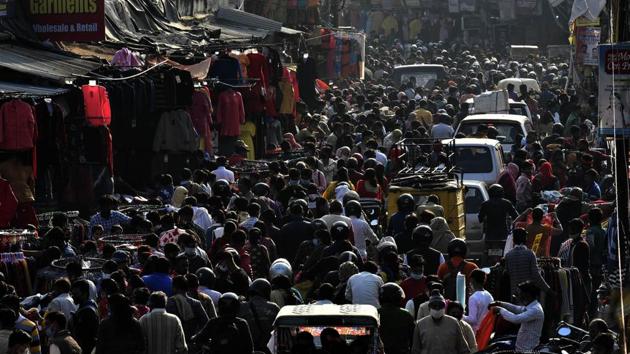
Shop owners, employees and visitors living in containment zones shall not be allowed entry into marketplaces. At the entry point of shops, all employees and visitors need to undergo mandatory hand hygiene (sanitiser dispenser) and thermal screening to check for fever.
“Staggering of visitors to be done for maintaining physical distancing of a minimum of 6 feet, when queuing up at the time of entry. Number of customers inside the shop to be kept at a minimum, to maintain the physical distancing norms. Number of people in the elevators shall be restricted, duly maintaining physical distancing norms. Use of escalators with one person on alternate steps may be encouraged,” the SOPs say.
The guidelines also suggest that civil defence volunteers, home guards, volunteers etc. should be involved to regulate crowd, there should be access control at parking lots for limiting vehicle entry, and, if feasible, separate entry and exit with unidirectional flow of visitors.
Also read | Covid-19: What you need to know today
{{/usCountry}}Also read | Covid-19: What you need to know today
{{/usCountry}}Roads within the marketplaces may be made vehicle-free (including cycle and electric rickshaws) and secured only for pedestrians and bicycles as far as possible. Strict penal action should be taken against illegal parking on market roads by law enforcing authorities.
The SOPs also suggest providing incentives or discounts to those who shop during non-peak hours.
“Provision for online booking of groceries/ items and delivery at doorstep must be encouraged. The staff for home deliveries to be screened thermally by the vendors prior to allowing home deliveries,” it said.
The SOPs make a special note of the need for proper ventilation. “As far as feasible, natural ventilation must be ensured and use of small enclosed spaces must be discouraged. Circulation of outdoor air needs to be increased, as much as possible, by opening windows and doors, using fans, or other methods,” the guidelines say.
“For air-conditioning and ventilation of closed enclosures, the guidelines of Central Public Works Department shall be followed which emphasise that the temperature setting of all air conditioning devices should be in the range of 24-30 degrees C, relative humidity should be in the range of 40-70%, intake of fresh air should be as much as possible and cross ventilation should be adequate. Air handling unit needs to be cleaned prior to switching on,” it says.
The guidelines also suggest exploring the option of allowing markets or shops to opening on alternate days, and even closure of market in case a large number of cases is reported linked to it.
Finally, special emphasis has been placed upon self-regulation by market associations in market places.
“Covid appropriate behaviour in marketplaces may be self-regulated by market associations through a number of measures, such as creation of a sub-committee for each market to facilitate and monitor implementation of Covid appropriate behaviour (within shops and establishments as well as outside),” the SOPs say.