The Madhya Pradesh high court on Wednesday issued notices to the Archaeological Survey of India (ASI), Centre and the state government on a petition pertaining to the dispute over the monument of Bhojshala in state’s Dhar district.
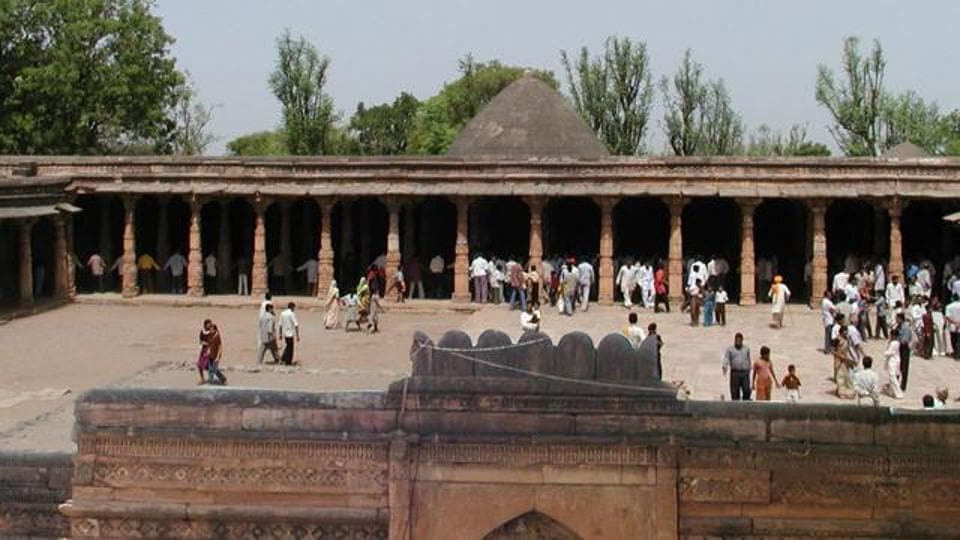
Bhojshala is an ASI protected 11th century monument, which Hindus claim is a temple of Vagdevi (Goddess Saraswati), while the Muslim community treats it as Kamal Maula Mosque.
As per the arrangement made by the ASI on April 7, 2003, Hindus perform puja in the premises every Tuesday, while Muslims offer namaz in the complex on Fridays.
On May 2 this year, a public interest litigation (PIL) was filed by an organisation Hindu Front for Justice, challenging the ASI order of April 7, 2003, imposing restriction on Hindus to worship at Bhojshala daily.
Finding the PIL “comprehensive”, a division bench of justices Vivek Rusia and Amarnath Keshwarwani issued notices to the ASI, Centre and the state government seeking response on the plea, said Harishankar Jain, the lawyer representing the petitioner.
The Indore bench of the high court also issued notices to Maulana Kamaluddin Welfare Society, which is associated with a mosque situated in the Bhojshala premises.
{{/usCountry}}The Indore bench of the high court also issued notices to Maulana Kamaluddin Welfare Society, which is associated with a mosque situated in the Bhojshala premises.
{{/usCountry}}“Only the members of the Hindu community have a fundamental right under Article 25 of the Constitution of India to perform puja (prayers) and rituals at the place of Goddess Vagdevi/ Saraswati within the premises of ‘Saraswati Sadan’, commonly known as ‘Bhojshala’ situated in Dhar,” the petition claimed. “The members of Muslim community have no right to use any portion of the aforesaid property for any religious purposes,” it added.
The PIL also urged the court to direct the Centre to bring back the idol of Goddess Saraswati from the London Museum in the United Kingdom and re-establish the same within the Bhojshala complex. The plea has cited that the then rulers of Dhar had installed the holy statue at Bhojshala in 1034 AD and it was taken to London in 1857 by the British.
“(The) Government of India should be directed to create a trust under the provision of the Indian Trusts Act, 1882, for the purposes of administration and management of the affairs of Bhojshala temple…,” the PIL prayed.
In an interim plea, the petitioners also sought radiocarbon dating to find out the age estimate of the Bhojshala complex and excavation of land/floor area in and around the complex to find out the nature of construction or any material lying therein.
One of the petitioners Ashish Goyal said, “We have now started fighting legally to reclaim our religious places. The court found our petition comprehensive and issued notice.”
The petitions are likely to be taken up for next hearing on June 27.
Former president of the Madhya Pradesh Congress committee’s minority cell, Mujeeb Qureshi, said, “Earlier too, an attempt was made by some Rashtriya Swayamsevak Sangh RSS leaders to prohibit Muslims from offering prayer in the complex, but they failed.” Qureshi, who had earlier fought for the Bhojshala issue in Dhar, added: “We will present our side before the court.”