
 E-Paper



HT Archive: Putin’s India visit stresses trade ties, curbing terrorism
Russia and India urge an end to double standards in fighting terrorism, with calls for Pakistan to stop terrorist support and become an international pariah.

 Prefer HTon Google


Russia has joined India in calling for an end to double standards in the global war on terrorism — considering Pakistan an ally in the war even though it continues to train and fund terrorists is not on.
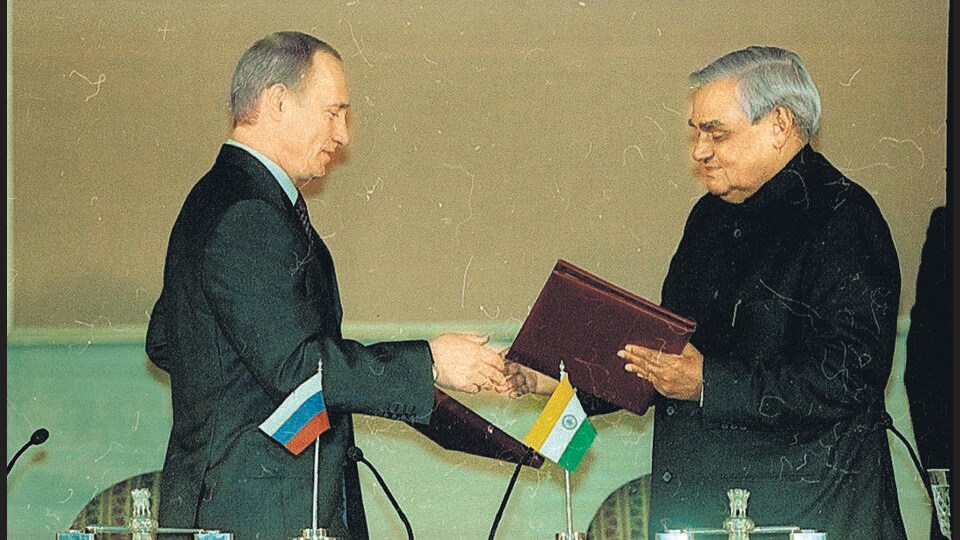
In the Delhi Declaration and joint statement adopted after their summit on Wednesday, President Vladimir Putin and Prime Minister AB Vajpayee indicated their interest in making Islamabad an international pariah.
Moscow came out in full support of New Delhi’s stand that Islamabad must stop terrorist incursions into India. The Delhi Declaration stressed the importance of Islamabad implementing “in full its obligations and promises to prevent infiltration of terrorists across the Line of Control”.
Putin made it clear that Russia saw Pakistan as much more than a South Asian problem. The combination of Islamic fundamentalism and state support for terrorism made Pakistan a threat exceeding regional frontiers.
Putin called for a system of international safeguards to ensure that weapons of mass destruction did not fall into the hands of terrorists in Pakistan. He urged the international community to treat Pakistan as a threat on two counts — terrorism and proliferation.
Unlike leaders of other P-5 nations, Putin was in no mood to mollycoddle Pervez Musharraf’s regime. His message to Islamabad was simple and unambiguous: “Liquidate support to the whole terrorist infrastructure.”
Vajpayee described the Indo-Russian strategic relationship as a “model for the world”. He joined Putin in demanding strict vigilance to ensure every UN member state fulfilled its responsibilities under Security Council Resolution 1373, making it obligatory for it to wipe out terrorism within its borders.
The two countries signed eight agreements covering closer strategic ties, the setting up of a joint working group on terrorism, economic co-operation, science and technology and telecommunications. Disappointment was expressed at the present abysmal levels of bilateral trade ($1.4 billion annually). The leaders resolved to inject a stronger economic content to the countries.
On Iraq, Putin and Vajpayee indicated that neither would tolerate unilateral action subverting the UN Charter covering non-interference in the internal affairs of member countries.
Afghanistan was recognised as a grave “common neighbourhood” issue. The role of Pakistan in fomenting trouble for the interim administration, the regrouping of former Al Qaeda and Taliban elements and the need to push the international community towards stabilising peace figured in the talks.
Putin arrived on Tuesday evening for his three-day visit and went straight to a private dinner hosted by Prime Minister AB Vajpayee at his residence. Several ministers and former Prime Minister PV Narasimha Rao also attended the dinner. Putin was greeted at the airport by Minister of State for Small Industries Vasundhara Raje and Foreign Secretary Kanwal Sibal. He is accompanied by his wife and senior cabinet colleagues like Foreign Minister Igor Ivanov and Minister for Industries Ilya Klebanov.
The Russian first couple were staying at the Maurya Sheraton hotel. Diplomatic sources say a microbiologist from the Russian Academy of Sciences has been camping in Delhi with a team of other experts to sanitise the suite his President was set to occupy at the hotel. In fact, security concerns are so high that the scientist is using his country’s national drink, vodka, to sanitise the cutlery Putin and his wife Lyudmila will be using at the hotel.
The Maurya staff, apparently, are used to such concerns over security. “All of them have their own security drill,” said a hotel official.


