Mr Sukumar Sen, Chief Election Commissioner, said in Delhi yesterday the people in Himachal Pradesh and the mountainous regions of Punjab and U.P. would go to the polls in October though the general elections in the rest of the country would begin in the first week of January and would be completed within three weeks.
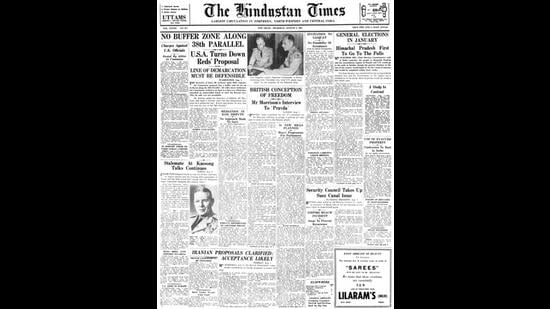
The final decision was reached following correspondence between him and the Government on the subject but a notification of the actual dates of polling would be issued a few weeks later.
The President is likely to refer to the new dates of elections in his address to Parliament, inaugurating its autumn session.
Early elections in Himachal Pradesh and the hilly tracts of Punjab are necessitated by the fact that the I regions will be snowbound during winter and polling will be impossible.
Himachal Pradesh will have to return three members to the House of the People and elect 37 members to the electoral college of the: State on the basis of adult suffrage. The elections will be held simultaneously.
The Himalayan region of Punjab has one representative in Parliament and seven in the State Assembly.
In accordance with statutory provisions, a notification of election dates must be issued at least 48 days before polling takes place and the Election Commissioner is therefore expected to request the President to issue a notification before I the end of this month or by he first week of September.
{{/usCountry}}In accordance with statutory provisions, a notification of election dates must be issued at least 48 days before polling takes place and the Election Commissioner is therefore expected to request the President to issue a notification before I the end of this month or by he first week of September.
{{/usCountry}}It was originally expected polling would be spread over two months, November and December, but the dates have been deferred to January, 1952. in response to a request by more than five major states but the polling is expected to be completed within three weeks.
The State Governments have been directed to inform the Chief Election Commissioner about suitable dates of polling in their respective States and their polling programmes. On receipt of such advice only, the Election Commission would advise the President to ‘ issue a notification of the actual lection dates in various parts of India.
Polling programme can be drawn only on the strength of the final publication of the delimitation of constituencies and the electoral rolls. The delimitation of the constituencies as finally modified and approved by Parliament is expected to be published within a week. soon I after the return to New Delhi of the Speaker. Mr Mavlankar. The final publication of the electoral rolls will take place before the end of this month.
In the meantime, the Election Commission will shortly appoint electoral registration officers-men who will be in charge of the electoral rolls constituency-wise. Certain Government servants and district authorities will be specifically authorized to do this additional work. Along with their appointment. returning officers for each constituency will be appointed on the recommendation of the State Governments. It will be the responsibility of the State Governments to appoint necessary polling officers and presiding officers. It is expected these preliminary steps will be completed in a month or two.
The draft rules under the Representation of the Peoples Act-the principal electoral Act providing for the qualification of candidates. conduct of elections. freedom of voting, etc.-have been completed and the State Governments are now being consulted on the subject.
An important provision under the rules related to the maximum expenditure a candidate can spend on the election. The sum will, however,’ be finally determined by the Central Government, and the draft provision is considered tentative.
With the finalization of the rules, along with the publication of the electoral rolls, and delimitation of constituencies, the machinery for the conduct of the elections and the regulations governing them are considered as being completed.
The delimitation of constituencies for the Upper House in the Centre has now been undertaken by the Chief Election Commissioner.
The electoral colleges in “ Part C “ States for electing members to the Council of States will themselves be constituted on the basis of adult franchise.
In regard to Upper Houses in the States too constituencies have yet to be delimited by the Chief Election Commissioner.
The proposed legislative measure in respect of the powers of the electoral colleges in Part C States may affect to some extent the polling programme in these areas.
Mr Sen anticipated the counting of votes in the general elections will last up to the middle of February. Only after the election results are announced can the Upper Houses both in the Centre and the States be constituted and Presidential election take place. This process will mean the Presidential election will be held either in March or early April 1952 at the earliest. As the President has to summon the new Parliament, the newly constituted House of the People and the Council of States are unlikely to meet before May next.
It is stated the present Parliament will therefore sit for the budget session in February-March next to deal with the budget for 1952-53 and will possibly vote the grants on credit.
The Law Ministry, it is stated, will introduce a Bill during the forthcoming session of Parliament relating to procedure in respect of Presidential election.