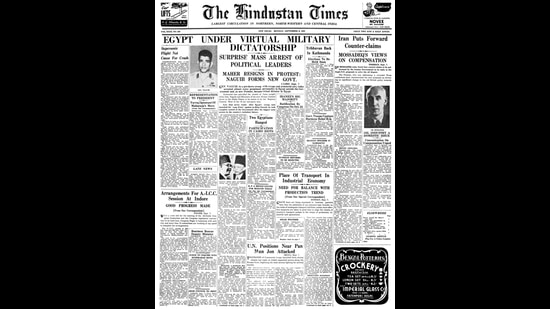
Cairo- Gen. Naguib, in a pre-dawn swoop with troops and armoured cars, today arrested almost every prominent personality in Egypt outside the Government and, as new Premier, became virtual dictator in Egypt.
Armoured cars patrolled the streets of Cairo tonight when Gen. Naguib and Ministers of his new 16-man Cabinet drove to the Abdin Palace to be sworn in by the Regency Council. Most of the 16 are non-party men.
Less than seven weeks after Egypt’s strong man launched his ‘Coup d’etat ‘ against ex-King Farouk, he took complete control of the Government after the biggest mass arrests in the country’s turbulent history.
He imprisoned over 50 politicians and leaders, including two ex-Premiers, at a stroke, and accepted the resignation of Mr Aly Maher and his Government.
The Regency Council asked the General to form a Military Government, a spokesman of the outgoing Maher Cabinet said, but Gen. Naguib told reporters at his General H.Q.: “I am going to form a Cabinet mostly of civilians.”
The new Cabinet is as follows: Prime Minister, War, Marine and C.-in-C.-Gen. Naguib; Vice-Premier and Minister for Interior- Soliman Hafez; Foreign Minister -Ahmed Farag Tayeb (now Minister to Jordan and Iraq); Finance -Dr Abdel Gelil Amary; Public Works-Murad Fahmy; Education-Ismail el Kabbany; Propaganda Fathy Radwan (extreme Nationalist Party leader); Communications -Dr Nureddin Tarraf (also leading member of extreme Nationalist Party); Wakfs (religious foundations)-Sheikh Ahmed Hassan el Bakkour (one of the Muslim Brotherhood leaders); Agriculture -Abdel Aziz Abdullah Salem; Commerce, Industry and Supply- Dr Mahmoud Abu Zed; Public Health-Dr Mohammed Sabay; Reconstruction and Building-Dr Ibrabim Bayyoumi Madkour; Social Affairs-Prof. Mohammed Fuad Galal; Municipal Ties-Abdel Aziz Aly; Justice-Abdel Hamid Soliman.
{{/usCountry}}The new Cabinet is as follows: Prime Minister, War, Marine and C.-in-C.-Gen. Naguib; Vice-Premier and Minister for Interior- Soliman Hafez; Foreign Minister -Ahmed Farag Tayeb (now Minister to Jordan and Iraq); Finance -Dr Abdel Gelil Amary; Public Works-Murad Fahmy; Education-Ismail el Kabbany; Propaganda Fathy Radwan (extreme Nationalist Party leader); Communications -Dr Nureddin Tarraf (also leading member of extreme Nationalist Party); Wakfs (religious foundations)-Sheikh Ahmed Hassan el Bakkour (one of the Muslim Brotherhood leaders); Agriculture -Abdel Aziz Abdullah Salem; Commerce, Industry and Supply- Dr Mahmoud Abu Zed; Public Health-Dr Mohammed Sabay; Reconstruction and Building-Dr Ibrabim Bayyoumi Madkour; Social Affairs-Prof. Mohammed Fuad Galal; Municipal Ties-Abdel Aziz Aly; Justice-Abdel Hamid Soliman.
{{/usCountry}}Gen. Naguib is the only soldier in the new Cabinet.
Wearing smart khaki uniforms, he led his Ministers dressed in grey morning coats and red tarbushes into the stately Palace.
He and Soliman Hafez conferred privately with the Regents for about 15 minutes before the other Ministers were summoned to be sworn in.
Later, Gen. Naguib’s party posed momentarily for Press photographers outside the Palace before driving to the Presidency. There they began their first formal Cabinet meeting, which is expected to pass the Army’s land reform measures into law without delay.
The political leaders were arrested for failing to carry out “purges” in their ranks ordered by Gen. Naguib. They included ex-Premier Ahmed Naguib Hilaly, Fuad Serag el Din, Wafdist Party leader, held “administratively responsible” for Cairo’s riots on January 26, and Hafez Afifi, former Chief of Farouk’s Royal Cabinet.
Mortada Maragi, a former Minister of the Interior, and Ibrahim Abdel Hady, former Premier and leader of the Saadist Party, were also reported to be among those arrested.
Meanwhile, a prominent Wafdist said the Army placed the Wafd leader and former Premier, Mustafa el Nahas, under house arrest. Wafdist sources said Nahas had been confined by the Army in Alexandria.
ARMY’S ACTION
The Army went into action while Cairo slept. Troops, armed police and armoured cars swept through the city and cordoned off the leaders’ residences to make the arrests, which were carried out while the leaders of the factory riots last month at Kafr el Dawar were being executed at Alexandria, 100 miles away.
After informing Mr Aly Maher of his action, Gen. Naguib demanded immediate action to be taken to promulgate the reform programme, which seeks to close the immense gap between Egypt’s few wealthy landowners and the mass of poverty-stricken population.
Mr Maher refused to rush through the reforms which, he claimed, were too far sweeping and likely to lead to economic collapse.
Mr Aly Maher told Gen. Naguib in a 45-minute interview this morning that he was resigning because of the Army’s mass arrests.
After the interview Mr Aly Maher told correspondents: ‘’My resignation has been accepted by agreement with the Army.”
Mr Maher said afterwards: It is in the best interests of the nation that power be transferred to a single hand.”
Apart from reinforcements of steel-helmeted police who patrolled the Cairo streets, the Army’s seizure of overall power passed off with few outward signs.
There were no major troop movements and no large massing of crowds. Life in the capital looked little different from a normal Sunday afternoon with most inhabitants taking their usual siesta in sweltering heat.
OFFICIAL STATEMENT
A statement from Gen. Naguib’s G.H.Q. said: The Army revolt was not only against the King but against corruption, of which the King was only a symbol.”
“The movement was also against at those, who co-operated with the ex-King and exploited close relations with him. We have repeatedly asked political organizations in the country to purge their ranks so that Egypt may enjoy a clean and healthy political life.”
“But the parties were reluctant to comply with this appeal and today we had to arrest certain individuals held in suspicion.”
Mr Aly Maher’s Cabinet, reorganized and expanded two days ago, was in session at the Presidency at noon when the Army H.Q. issued its statement. The Cabinet, which was reported to have been discussing the proposed Land Reforms Bill, then suspended its meeting.
The arrested leaders were placed under guard in a large store house, less than a quarter of a mile from Gen. Naguib’s H.Q.
An Army spokesman said that Mr Aly Maher “has been unable to keep pace with the new mentality of the nation.”
The Army regime is now facing its most serious crisis since its coup nearly seven weeks ago. There are now practically no political leaders willing and able to form a Government under Army Control.