NEW DELHI: The India Meteorological Department (IMD) on Monday launched a National Framework of Climate Services (NFCS) that seeks to reduce losses from climate hazards and extreme weather events at a function to commemorate the 150th year of the weather office.
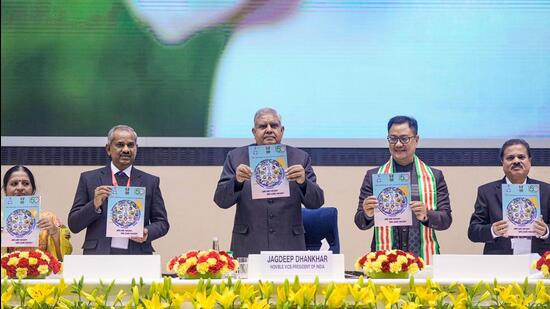
The framework seeks to build a platform for users of climate information and services that will strengthen the production, availability, delivery and application of science-based climate monitoring and prediction services for key sectors such as agriculture, health, energy and disaster management.
Vice President Jagdeep Dhankhar, who formally kicked off the IMD’s yearlong celebrations at an event on Monday, also launched IMD’s mobile app, ‘Mausam’, that integrates all services offered by the weather office and unveiled new initiatives such as the Panchayat Mausam Seva and NFCS.
Dhankhar praised the weather office for a huge improvement in the quality of its predictions, saying IMD’s impact transcended mere weather forecasts and has emerged as a safety net, protecting national interests and helping to shield citizens from the wrath of nature.
IMD director general M Mohapatra traced the organisation’s evolution that provided port warnings back in 1865, and stated ocean forecasts in 1898 and flood alerts in 1966. IMD, he said, continues to face challenges in forecasting cloudbursts, lightning events and localised extreme weather events.
{{/usCountry}}IMD director general M Mohapatra traced the organisation’s evolution that provided port warnings back in 1865, and stated ocean forecasts in 1898 and flood alerts in 1966. IMD, he said, continues to face challenges in forecasting cloudbursts, lightning events and localised extreme weather events.
{{/usCountry}}Earth sciences minister Kiren Rijiju said IMD has been able to mould itself as a world-class national meteorological service that uses the latest technological tools for monitoring predictions and warning of extreme weather and climate events in the country and helping the country to build resilience against risk related to disaster and climate change,
Rijiju said IMD has been trying to improve its forecast of cloudbursts and glacial lake outburst floods by increasing the number of Doppler radars from 15 in 2014 to 39. The minister said 25 more Doppler radars will be set up for a better forecast of cloudbursts in the next 2-3 years.
Rijiju said there has been a 40% improvement in the accuracy of forecasting severe weather events over the last five years.