The Madhya Pradesh forest department will shift cheetahs to the Veerangana Durgavati Tiger Reserve (VDTR), home of 30 tigers, making it a first attempt of cheetah-tiger co-existence.
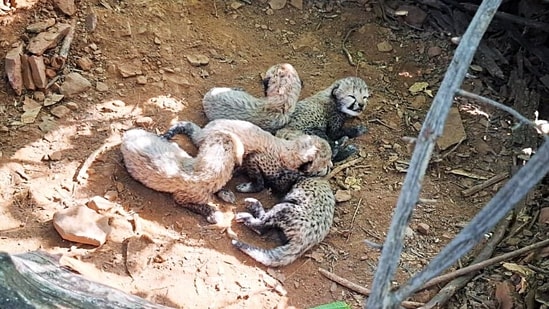
“The forest department has sought permission from the National Tiger Conservation Authority (NTCA) to chief cheetahs,” said L Krishnamurthy, additional principal chief conservator of forest (APCCF) (wildlife).
Madhya Pradesh has 60 cheetahs, 57 at Kuno National Park, where they were first translocated from African countries four years ago, and three Kuno big cats at Gandhi Sagar Wildlife Sanctuary. VDTR will become the third home for cheetahs in the state.
A South Africa cheetah expert said it would be a “learning” experience for cheetahs also.
“In South Africa, tigers are living with cheetahs at private reserves only. They are not together in wild. This would be a good experiment to see all three carnivores including cheetah, leopard and tigers together. It would be a learning for cheetahs as well,” said a cheetah expert, who refused to be named.
{{/usCountry}}“In South Africa, tigers are living with cheetahs at private reserves only. They are not together in wild. This would be a good experiment to see all three carnivores including cheetah, leopard and tigers together. It would be a learning for cheetahs as well,” said a cheetah expert, who refused to be named.
{{/usCountry}}Susan E Yannetti, who is associated with the Metapopulation Initiative, said, “The last time cheetahs and tigers had a chance to coexist was probably close to one hundred years ago in India, when they were in significant numbers. But it will be interesting to know how they do get along. A cheetah is certainly no match for a tiger. Likely, the cheetah’s flight instinct would kick in, and it would run rather than fight, if challenged.”
Cheetah expert and former Wildlife Institute dean, YV Jhala, who led the team during the translocation of cheetahs to India, said it was a positive step.
"Of course, initially we will lose some cheetahs to tigers, but cheetahs are very intelligent animals. They can sense and move away from tigers. For the expansion of the project, it is very necessary that they adapt to live with other carnivores, including tigers," he said.
"However, they should not live in bomas. It has now been four years; it is time to leave cheetahs in open spaces and allow them to live freely. Free ranging cheetahs are possible only after restoring safe habitats and prey and this is the real test for the project’s success.," he added.
VDTR field director Rajneesh Singh said there is ample historical evidence of cheetahs, tigers and leopards coexisting.
"Earlier, Asiatic cheetahs used to live with tigers and leopards here. Their prey base is totally different. Cheetahs hunt baby nilgais and deer, chitals and black bucks, while there is no such limitation for tigers," Singh said.
"Cheetahs most live in open grasslands while tigers prefer dense forests. As the area of VDTR is very large, there will be very little chance of conflict," he added.
The two cheetahs from Kuno will kept in two bomas. In total, four quarantine compartments and five soft-release enclosures have been prepared across 439 hectares, he said.
Spread over 2,300 sq km, VDTR is home to around 30 tigers. This will also be the first time in India that cheetahs will roam in rocky terrain.
African Cheetahs were translocated for first time in India in September 2022. As many as eight cheetahs from Namibia, 12 from South Africa and nine cheetahs from Botswana were translocated.