E-Paper



55 big cats, 17 of them in the wild: Taking stock of Project Cheetah as it completes four years
Cubs are being born and the prey base is stable at Kuno, but some experts say the programme has drifted towards captive breeding.

 Prefer HTon Google


In the four years of Project Cheetah, India has brought in 29 of these big cats from Africa, 36 cubs have been born in the country, 10 adult cheetahs died and 13 more cubs couldn’t survive. The programme, which marked its four-year milestone on September 17, now has 55 cheetahs in India: 51 at Madhya Pradesh’s Kuno National Park and the remaining at the state’s Gandhi Sagar Wildlife Sanctuary.
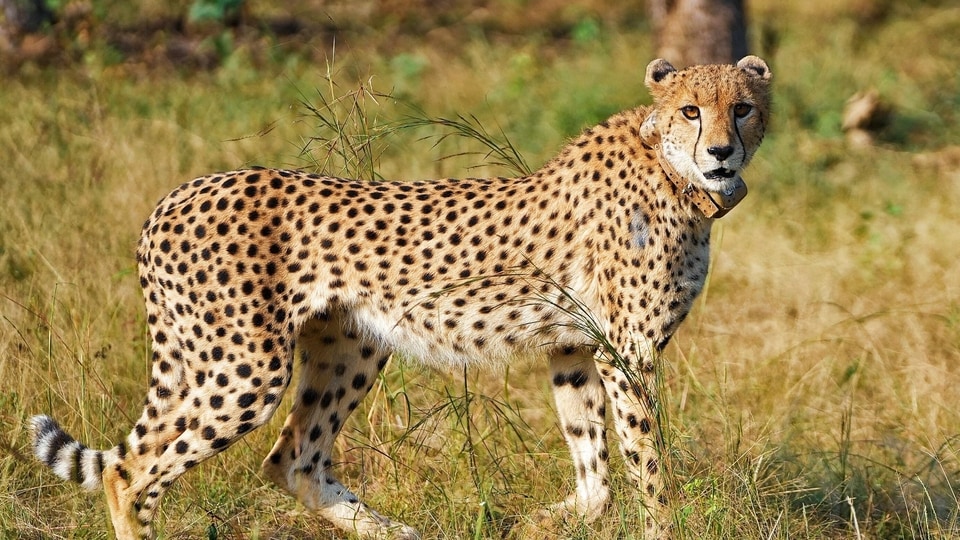
The 29 imported cheetahs came in three batches: eight from Namibia in September 2022, 12 from South Africa in February 2023 and nine from Botswana in February 2026.
The numbers include four cubs born to an India-born female cheetah, named KGP12, at Kuno last week. Days later, Radha, a three-year-old female from Botswana, became the fourth cheetah at Gandhi Sagar. And on Monday, Kuno lost Gaurav, one of the first eight cheetahs brought to the country.
Of the 55 cheetahs, 17 live free in the wild. The remaining 38 are held in soft-release enclosures and camps, large fenced areas where the big cats are kept while they adjust to their surroundings before release into the wild.
Experts say the rising total is a positive sign, but the free-ranging population remains low, and the work of restoring the habitat that the cheetahs need has lagged.
What is Project Cheetah?
The cheetah became extinct in India in 1952. Project Cheetah, launched on September 17, 2022, set out to bring the species back by importing cheetahs from Africa, breeding them, and establishing a population that lives and hunts in the wild. The eventual aim, according to the project, is a population of the big cat that can survive without further translocations.
Kuno was the first release site. Between April and September 2025, two males and a female were released at Gandhi Sagar as part of metapopulation management, which spreads the animals across more than one site, so that a setback at one location does not put the whole population at risk.
Also read: Cheetahs from MP’s Kuno likely to be relocated to Gujarat’s Banni grasslands
How many cheetahs live in the wild?
Seventeen, as of now. YV Jhala, a scientist and conservationist, said the cheetah population’s rise to 55 was an achievement, but the total did not reflect how many of these big cats were living in the open.
“We currently have only 17 free ranging cheetahs, which are really the reintroduced population of cheetahs. The rest are still within protected fencing, like at safari parks. We can only release these from fenced areas once we have safe habitats with ample prey,” Jhala said.
A senior government official overseeing the project told HT that cheetahs are prolific breeders, but need an adequate and compatible population of males and females, a supporting prey base, and suitable cover and water. “One has to take chances and make these projects work. We have seen early and late successes even in the case of Panna and Sariska,” the official said, referring to Project Tiger, under which the government had re-introduced tigers in Panna (MP) and Sariska (Rajasthan).
What has worked?
Breeding at Kuno has driven the growth in numbers, and the environment ministry’s monitoring suggests that the cheetahs released into the wild are feeding, settling and coexisting with other predators.
The Project Cheetah 2025 report, released in June this year and based on two years of continuous monitoring since 2023, found chital deer to be the principal prey both inside the enclosures and in the wild, making up 42% of detected kills in and around Kuno. Chital were followed by goats, at 30%, and cattle, at 20%.
The report found that free-ranging mothers with cubs hunted more frequently, which it attributed to higher energy demands.
Chital populations at Kuno and Gandhi Sagar showed “stable relative abundance”, the report said, though it described continued prey augmentation and habitat enhancement as “central to sustaining reproductive female cheetahs and growing cub cohorts”.
Free-ranging cheetahs travelled widely after release, covering between 560 km and 894 km in total, before gradually settling into home ranges after roughly their first month in the wild. They favoured open grassland and savanna mixed with moderate woodland. “Areas with adequate prey densities and lower anthropogenic disturbance were preferentially used,” the report said.
The report also found no significant impact on the carnivores already living around Kuno, including striped hyenas, golden jackals and jungle cats. “Preliminary findings suggested a spatial overlap with temporal partitioning – indicative of behavioural adjustments rather than direct displacement,” it said. In other words, cheetahs and the existing carnivores use overlapping areas at different times of day, which suggests the other predators have adjusted their behaviour rather than been pushed out.
Also read: Solar water pump saves Cheetah cubs from extreme heat at Kuno National Park
What hasn’t worked
The 23 deaths recorded so far include cheetah cubs lost to heat and to traffic, among other possible reasons.
HT reported in July 2025 that three cubs born to the Namibian female Jwala died of extreme heat in May 2023. A solar-powered water lift system has since been installed to protect cubs during the summer.
In December 2025, a cub was killed after it wandered onto the Agra-Mumbai National Highway and was struck by a vehicle.
Cheetahs have been reported missing or strayed beyond the park, and tracking has failed at least once.
Earlier this month, officials rescued a female cheetah that had gone missing after being separated from her three cubs, following the malfunction of her satellite collar. She was found after 11 days.
In June, a cheetah named KP-3 went missing for two weeks before the big cat was spotted in Rajasthan, tranquilised and brought back to Kuno. In December 2023, a cheetah named Agni strayed around 15 km into the Rajasthan border area and was returned the same way.
In Gandhi Sagar, the cheetah population has yet to produce a litter. “The two male and one female we introduced earlier could not result in any breeding. So, have released another female there to increase the chances. Active wildlife management is no one-size-fits-all model,” the official quoted above said.
The criticism
Experts say the project has made little progress on restoring the ecosystem and landscape around Kuno and within Gandhi Sagar. Jhala said habitat restoration was the main objective of the programme, and that the balance has since shifted towards breeding.
“Cheetah reintroduction was an ecosystem restoration project and it is currently going in the direction of captive breeding of the species. While this is partially required, it should be a small part of the project, and not the main objective as it has become,” Jhala said.
Ajay Dubey, a wildlife activist, said the project has been reduced largely to a captive breeding centre that lacks transparency. “Success is being measured solely by the birth of cubs at the moment. As per wildlife protocols, cubs born inside enclosures struggle to survive and thrive in the free-range wild,” he said. Dubey added that although 29 villages of the locally displaced Sahariya tribe were incorporated into Kuno National Park, no concrete measures have been taken for their livelihoods.
Can Gandhi Sagar become a second home?
The government hopes Radha will start breeding at the site. “We hope the introduction of the fourth Cheetah helps increase numbers here,” the official said.
The first three cheetahs at Gandhi Sagar were released into a fenced area of about 64 sq km. The sanctuary covers around 368 sq km, and the potential cheetah habitat around it is much larger. Including forests in Neemuch and Mandsaur in Madhya Pradesh and parts of Rajasthan, the connected habitat stretches to nearly 2,500 sq km, and the wider forested region across both states covers about 6,500 sq km. Managing that landscape will need long-term cooperation between the two states.
The environment ministry’s report called the site promising. “The habitat is large, the ecosystem is diverse, and steps like predator-proof fencing are already in place,” it said.
But it also recorded heavy human pressure on the sanctuary, with about 237 people per sq km in the surrounding districts, and about 88 cattle or buffalo and 45 goats or sheep per sq km.
“A road (state highway) cuts through the sanctuary, fishing communities have settled along the reservoir, and the Gandhi Sagar township, built during dam construction, continues to grow right in the heart of the area. Farming is the main livelihood for local communities… Communities like the Bhil, Gurjar, Banjara, and Thakur call this landscape their home, and continuous cooperation from these communities will be essential for the cheetah programme to succeed in this landscape,” the report said.