Much of the misuse of the Aravallis has happened with the active involvement of the state — or at least arms of it.
For instance, in the Faridabad Kant Enclave case, Haryana’s town and country planning (TCP) department played along with developers conveniently ignoring restrictions on forest land. The department on April 17, 1984, granted exemption to R.Kant and Co, the developers of the Kant Enclave, for setting up a film studio and allied complex on about 400 acres (Khasra
Much of the misuse of the Aravallis has happened with the active involvement of the state — or at least arms of it.
For instance, in the Faridabad Kant Enclave case, Haryana’s town and country planning (TCP) department played along with developers conveniently ignoring restrictions on forest land. The department on April 17, 1984, granted exemption to R.Kant and Co, the developers of the Kant Enclave, for setting up a film studio and allied complex on about 400 acres (Khasra number 9-16) in Faridabad’s Anangpur village. The exemption was granted under section 23 of the Haryana Development and Regulation of Urban Areas Act, which allows the government to exempt application of the law to persons facing “undue hardship or circumstances”.
A perusal of the government order showed that the only condition imposed was that the entire project — the development of a Film Studio and Allied Complex — should be completed within five years from the date of execution of the agreement. The developer entered an agreement with the state on March 27, 1992.
A film studio was constructed here, as per details placed by the Kant Enclave management before the Supreme Court bench on July 24, 2018.
The Supreme Court in its order dated September 11, 2018 highlighted contradictions in the actions of two departments of the state government with TCP allowing construction and the forest department trying to protect the Aravalli land. “There was, therefore, a dichotomy of views and a conflict of interest between two departments — one favouring colonisation and the other favouring environmental protection and conservation,’’ the court said.
The SC said the sequence of events clearly indicated that the TCP department was in favour of the applicant colonising the land and going ahead with the construction, ignoring orders passed by it from time to time and also August 18, 1992 PLPA notification. “The understanding of the TCP department seems to be that issues of environmental degradation, pollution and groundwater were not its concern. To say the least, the TCP department was myopic and brazen in pushing its agenda – certainly vis-à-vis the applicant versus the environment and in disregard of a statutory notification,” the SC said.
The apex court said the construction activity carried out by the R. Kant and Co. was clearly in violation of the PLPA notification of 1992 and in blatant defiance of orders passed by the SC from time to time. “Unfortunately, the TCP department has been supporting the illegalities of the applicant despite strong resistance from the Forest department.”
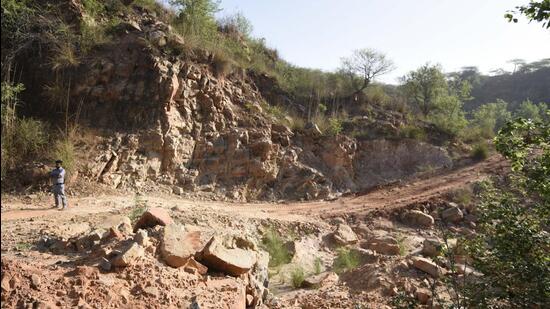
In its order on the demolition of Kant Enclave, the SC expressed concern over how influential colonisers and lobby of miners have caused “irreversible” damage to the Aravallis.
“It is not only the future generations that have to pay a heavy price for this environmental degradation, but even the present generation is paying a heavy price for the environmental and ecological degradation in as much as there is an acute water shortage in the area as prophesied by the Central Ground Water Board. In addition, what was once a popular tourist destination, namely Badkal Lake, has now vanished... What are the more severe consequences that will be felt in the years to come, only time and nature will tell,” the court said.
The Supreme Court in 2002 and then in 2009 suspended all mining operations in the Aravalli hills, over an area of 448 sqkm of Faridabad and Gurugram districts including Mewat (it was a part of Gurugram then) till a reclamation plan certified by the Centre was put in place.
After suspending mining operations in Faridabad and Gurugram on May 8, 2009, a three-member SC bench on October 8, 2009, allowed mining of minor minerals in Faridabad district including Palwal on 600 hectares of land subject to certain conditions, including preparing an environment reclamation plan.
The Supreme Court stepped in, in 2002 and 2009, to prohibit mining operations in Aravalli hills in Faridabad and Gurugram districts as illegal mining of sand and stone continued to devastate the hillocks.
In 2009, the SC said the state would revoke all licences with respect to major minerals both in Faridabad and Gurugram districts. The SC order was an outcome of a January 15, 2009 report submitted by Central Empowered Committee (CEC) before the apex court.
Following the CEC report, the SC asked Haryana to set up an Aravalli Rehabilitation Fund and a monitoring committee of mining and to allow mining in the 600 hectares (1,482 acres) in Faridabad on submission of the rehabilitation and reclamation plan, which would be approved by the Supreme Court. Subject to progress made in implementing the plan, the SC said, the permission for mining in 1,500 hectares (3,706 acres) in Gurugram and Mewat will be taken up separately. On April 9, 2010, the then solicitor general while appearing for Haryana government submitted that the state government would prepare the Environmental Impact Assessment Report and the Environmental Management Plan.
In 2021, the Haryana government again approached SC to allow the state to begin mining again in Faridabad.
An affidavit filed by the mines and geology department in the Supreme Court in March 2021 said that the state has prepared the reclamation and restoration plan of the mined-out area with respect to all mines in Faridabad district. The reclamation and restoration plan, for areas in Faridabad used for mining in the past, prepared by the state of Haryana was considered by CEC and after approval on July 7, 2010 was filed along with its detailed report before the Supreme Court. However, the major mineral lease holders objected to the same and submitted that their own reclamation and restoration plan as per prevailing provision of rules be allowed to be implemented. The SC on August 19, 2011 directed MoEF and the Union government to get the reclamation and restoration plan by lease holders as well as by the state examined through experts of the Indian Bureau of Mines. Haryana government officials say the plan is ready and since the matter has not been listed and there is no forest bench, it has not been taken up.
The state government on February 27, 2019, tabled an amendment in the Punjab Land Preservation Act (PLPA) in the state assembly to exempt lands included in the final development plans, town improvement plans or schemes published under provisions of the Punjab Town Improvement Trust Act, 1922, Punjab Scheduled Roads and Controlled Areas Restriction of Unregulated Development Act, 1963, Faridabad Complex (Regulation and Development) Act, 1971, the Haryana Development and Regulation of Urban Areas Act, 1975, Haryana Municipal Corporation Act, 1994, Gurugram Metropolitan Development Authority Act, 2017, the Faridabad Metropolitan Development Authority Act, 2018, and lands forming part of any public infrastructure, including rail, roads, canals, public institutions, government or public establishments and land which has been under bona fide agriculture use, except those lands whose owners have consented to their plots being included under the purview of PLPA.
The amendment was to come into force retrospectively, from November 1, 1966.
The operation of the PLPA (Amendment) Act, 2019 was however stayed by the Supreme Court on March 1, 2019.
As per the statement of objects and reasons of the amendment Bill, the subsisting orders and notifications issued under section 4 and/or section 5 of PLPA extend over an area of about 1.09 million hectares or about 10,945 square kilometres, accounting roughly for about 25% of the total geographical area of Haryana.
“These orders and notifications extend to the geographical area, wholly or partly, of 14 out of 22 districts. Almost the entire districts of Gurugram, Rewari and Mahendragarh are covered under these orders and notifications. A vast proportion of these lands include privately owned lands and lands that have traditionally as well as legally been under agriculture and other non-forestry uses, including lands forming part of public infrastructure such as rail, roads, canals, public institutions and government establishments. Most areas were covered under the orders and notifications under PLPA with the primary objective of regulating tree-felling (Haryana does not have a separate ‘Tree Act’ to regulate felling of trees),” the statement of objects and reasons of the amendment Bill said.
It further said that such PLPA orders and notifications were never issued either for effecting the changes in the existing land uses or to regulate the permissible land uses. The lands covered under these orders and notifications were never directly or indirectly intended to be brought under the purview of the rigours of forest or related laws. Further, PLPA, as amended in 1926, provides only for temporary and not permanent restrictions, regulations and prohibition.
However, over a period of time a number of changes have come into force with various interpretations of the provisions of the PLPA from time to time, in particular with respect to considering the areas notified under PLPA as “forest” and making the expiry of notifications issued under sections 4 and/or 5 inconsequential, thereby rendering extinguishment of the ownership right almost permanently. These have also led to large tracts under agriculture, public, infrastructure, residential, institutional, commercial and other uses becoming liable to be considered as unauthorised activities and unlawful uses even where these were explicitly permitted and came up strictly in conformity and in accordance with the then existing applicable law governing such land use and activities undertaken thereupon.
“Lakhs of dwelling units, commercial buildings, industrial units, public buildings and massive public infrastructure and agriculture activities over about one fourth of the geographical area of the state are affected. Sale and purchase of such lands and immovable properties have become liable to be considered illegal. Such unintended consequences adversely impact livelihood of millions of citizens and need to be allayed... There is no provision in PLPA to provide reasonable opportunity of being heard before imposing restrictions, prohibitions and regulations with respect to an area being proposed to be brought under such restrictions, prohibitions and regulations,’’ the Bill said.
The numbers are startling: the Aravallis lost 4,452sqkm of natural green vegetation, an area equal to 40% of Delhi, between 1975 and 2019, according to a study, ‘Assessment of Land Use Dynamics of Aravalli Range’, published in January. The study was based on topographical data and long-period satellite maps and predicted that by 2059, a total of 16,360.8sqkm (21.64%) of forest land in the region “will be converted to a settlement class,” creating huge ecological imbalances.
Narpat Singh Rathore, an associate professor of geography at ML Sukhadia University, Udaipur, said at the beginning of the 20th century, 80% of the Great Aravalli mountain region had natural vegetation. Now, just around 30% does. In the next 50 years, even that will be lost, he added.
Ritwick Dutta, environment lawyer and campaigner, added that the devastation of Aravallis took place as the administration turned a blind eye towards rampant construction, even as lower courts helped sell once common land to private builders and firms. “Even top court orders were not implemented in letter and spirit,” he said.
One Subscription.
Get 360° coverage—from daily headlines
to 100 year archives.
Archives
HT App & Website