
 E-Paper



In Firozabad outbreak, no succour at first port of call
Government records say that at least 61 children have died in Firozabad since August 20. A central team has blamed a combination of dengue, scrub typhus, and leptospirosis. The crisis has put a spotlight on the condition of rural health infrastructure and its shortcomings


Since the last week of August, queues outside Firozabad’s State Autonomous Medical College (SAMC) don’t seem to end. With wailing children cradled in arms, distraught parents stand patiently for hours, hoping to consult a doctor.
Their descriptions of the children’s symptoms differ – fever, vomiting, chills – but their experience with rural health care is common: an overstretched, or shut, local health centre in their village forcing them to travel to the city to save their loved ones.
“It has been three days since my daughter got fever. I had been running around the Humayunpur primary health centre but it cannot test blood, so I had to come to SAMC,” said Ankur Kumar, a driver.
Government records say that at least 61 children have died in Firozabad since August 20. A central team has blamed a combination of dengue, scrub typhus, and leptospirosis. The crisis has put a spotlight on the condition of rural health infrastructure and its shortcomings.
A spot check by HT last week found that the first port-of-call for villagers were shut or hopelessly overstretched. A health sub-centre shut for two years and functioning as the home of a nurse, a primary health centre functioning with a third of the medical staff required, a community health centre with just one doctor and an overstretched district hospital where bureaucratic tangles worsened already unsanitary conditions.
Due to this, parents and children often find poor or non-existent medical care in their villages, and patients are often critical by the time they reach the district headquarters. As a result, Fizorabad, once known for its decorative glass bangles, is in the grip of a grim dengue and viral fever outbreak sweeping north India.
“Out of 540, 480 beds are occupied as of now of which confirmed dengue patients are 131,” said Dr Sangeeta Aneja, principal of SAMC.
Aneja said the hospital is getting 250 patients a day, and has 60 doctors working round the clock.
In India, rural health infrastructure is three-tiered, a subcentre to cater to four villages or a population of 5,000, a primary health centre (PHC) for a cluster of villages and 30,000 population and a community health centre (CHC) for the block – around 120 villages or 120,000 people.
Firozabad has nine blocks. The National Health Mission (NHM) guidelines say each CHC should serve as a referral centre for four PHCs.
But government data shows that Firozabad has only four PHCs. Further, a PHC acts as a referral for 4-6 subcentres. An HT spot-check revealed some PHCs and subcentres were either barely functional or hopelessly overstretched. The district hospital, often the nodal institution for health care in the region, was also in bad shape.
HEALTH SUBCENTRE, NAGLA PICHIYA
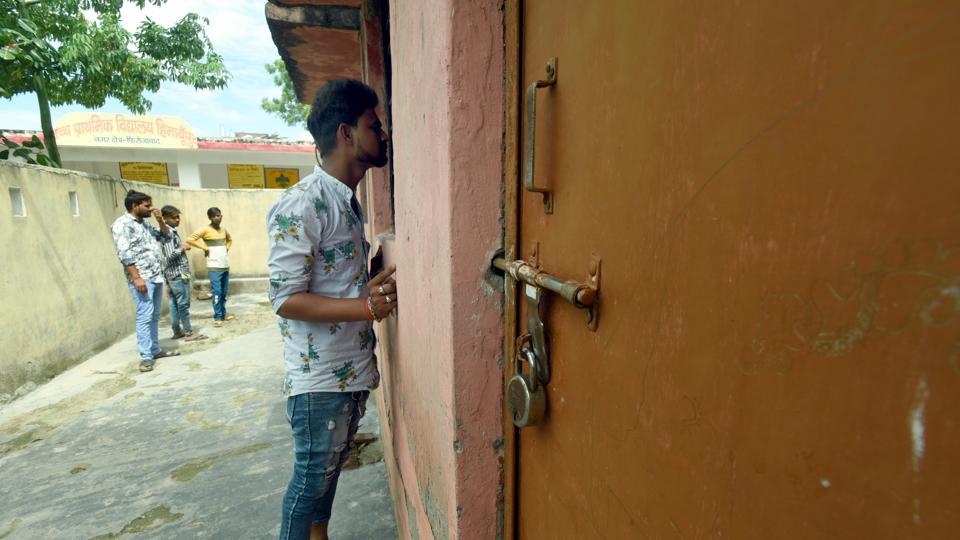
The health subcentre at Nagla Pichiya, a small village 5km from the district hospital and SAMC, has been shut for two years, said local villagers. Instead of functioning as the first port of health care for villagers, an auxillary nurse midwife (ANM) has been using the centre as her home, living here with her family. The premises are surrounded by narrow by-lanes covered with black slush.
“I was given permission to live here by the previous CMO,” said Meenu, the ANM living at the subcentre. When asked for the reason behind this arrangement, she said, “This subcentre is used to conduct vaccination on one day of the month and sometimes health officials hold their meeting here. I take care of the subcentre in the meantime.” Just ten steps away, a barren plot is filled with stagnant water, covered with garbage, insects and mosquitoes.
Every second household has at least three members suffering from fever. “We are scared for our children after we read reports of ‘mystery fever’ in the area. We do not have much income and can only afford to go to a government hospital. We rush to the district hospital even if my children develop a cough as there is no government health clinic nearby,” said Pappu Singh, a daily wager labourer who lives in front of the subcentre.
The National Health Mission (NHM) guidelines say subcentres should provide services related to maternal and child health, family welfare, nutrition, immunisation, diarrhoea control and communicable disease control.
Chief medical officer Dinesh Kumar Premi said, “I am aware that the sub-centre at Himayunpur is shut and one ANM is posted here. I have recently taken charge and will look into this matter”.
PRIMARY HEALTH CENTRE, HUMAYUNPUR
The Primary Health Centre (PHC) at Humayunpur, a small village in Firozabad, is about 5km from the district hospital. The two-bed centre is flooded with fever patients, most of whom are referred to the district hospital or medical college for blood test, as this service is not available at the PHC.
“Most of the nearby villagers go to the PHC for their treatment and get medicines and other consultations for the doctor. But now as our children are getting affected with Dengue, we have to take them to SAMC,” said Inayat Khatun, a resident.
NHM says a PHC is to be manned by a medical officer supported by 14 paramedical and other staff. It acts as a referral unit for six sub centres and needs 4-6 beds for patients.
“Our PHC has one bed, one medical officer, one staff nurse, one lab technician and six ANMs under whom 24 ASHAs are working across the villages conducting door to door survey to gather fever data. We are getting around 100 patients in the OPD every day and the only bed is occupied by a fever patient. Our PHC caters to about one lakh population in the area,” said Dr Pallavi Yadav, medical officer at the PHC.
Yadav added that the PHC did not have diagnostic services and patients had to be sent to the district hospital.
PRIMARY HEALTH CENTRE, USIYANI
The one-bed facility is about 9km from the district hospital. It is surrounded by empty plots filled with stagnant water, covered with green moss and buzzing with mosquitoes and flies. The medical officer, Dr Deependra Yadav, said the PHC staff is conducting medical camps in nearby villages to screen fever patients.
“We cater to a population of about 2.5 lakh people and have been conducting medical camps in nearby villages as per instructions of the health department. 800 fever patients are being screened on a daily bases. Of these, around 10 blood samples for dengue are sent to Lucknow for testing as per signs and symptoms of the patient,” said Dr Yadav.
When asked about cleanliness around the PHC, he said, “The premises inside PHC are our responsibility and that area is completely clean”.
Local residents said unhygienic conditions around the PHC and village have improved from two weeks ago. “The drains were overflowing with garbage at the time, now there are just filled with it. Municipal workers have been carrying out cleaning drives here one in two to three days,” said villager Shiv Kumar.
The Firozabad CMO admitted that none of the health centres, CHC, PHCs or sub-centres have pediatricians on staff. “Which is why the medical officers there cannot handle fever cases among children. As a result, the patients come to SAMC. We will try to resolve the issue at the earliest,” he said.
COMMUNITY HEALTH CENTRE (CHC), DEEMADAI
The 30-bed facility is 10km from the district hospital. When HT visited the centre at around 2pm, it had four-five patients. Government guidelines say a CHC needs four medical specialists -- surgeon, physician, gynecologist and pediatrician -- supported by 21 paramedical and other staff.
But at Deemadai, there is only one regular physician, who also doubles up as the medical superintendent. Another doctor has been deputed at the CHC under the non-communicable diseases programme. Importantly, there is no pediatrician – crucial to catch fever cases among children.
“We get about 150-200 OPD patients here on a daily basis. While we may be short staffed, but our diagnostic facilities are fully functional. This area mostly gets patients of skin diseases. Since we do not have a pediatrician, we cannot handle pediatric cases and refer them to the SAMC. For fever in adults, if the platelet count is above 20,000, we admit them and try to stabilise them but if the condition deteriorates, we have to refer them to the district hospital,” said Dr Yogendra Singh, medical superintendent.
The CHC is located in Basnat Nagar village and is surrounded by open filthy drains and unsanitary conditions. Shah Alam, a villager who lives across from the CHC, said local residents usually prefer to go to the district hospital in cases of critical illnesses. “The adults of the village have been going to the CHC in case of mild fever or cough. However when it comes to our children, we do not go to the CHC as they ask us to go to SAMC. In order to save time, we straightaway take our children there without consulting the CHC,” he said.
SN MEMORIAL HOSPITAL, FIROZABAD
The SN Memorial Hospital, which is the district hospital of Firozabad, is located behind SAMC and caters to patients across the district. Hansraj Singh, the hospital’s chief medical superintendent, said the outpatient department (OPD) is getting at least 150 patients every day, of which 80-90 are suffering from fever. The hospital here has a total of eight doctors, of which four are appointed under SAMC but deputed at the district hospital.
“There are 157 beds at the hospital, of which 154 are occupied -- 34 by Dengue patients, 95 by fever patients, and rest by other illnesses. The trauma centre at the hospital has 25 beds of which four are vacant and others are occupied with trauma patients,” said Singh.
HT found OPDs swamped with patients and filthy open drains buzzing with mosquitoes and flies right outside Singh’s office. Patients crowded outside the building with white slips in their hands, waiting for hours for their turn to see a doctor. The administration blames infighting for the poor conditions.
Singh said he got the hospital cleaned regularly but some areas may have been left out. “The hospital is overburdened with patients as four of my subordinates do not take my orders, being from the medical college and hence the workload is on the other four doctors here,” he added.
When asked whether the crowd at the hospital will be lesser if patients first visited local health centres, Singh said, “While we do not deny treatment to any patient coming to our hospital, I cannot say why they are not going to their local health centres firs.”
Firozabad chief medical officer Dinesh Kumar Premi said he was aware that four of Singh’s subordinates did not comply with his orders. “As they are appointed by the medical college, there is a conflict among the staff at the hospital. I have recently taken charge and will resolve this issue soon,” he said.


