As Nepal’s parliament took the first step on Tuesday to formalise the country’s new political map that has set up a row with India, foreign minister Pradeep Gyawali made another request to New Delhi for dialogue.
Gyawali told news agency AP that Kathmandu wanted to sit across the table with India for formal negotiations so that the two countries “with a very unique type of partnership” could develop a more inspiring relationship.
New Delhi hasn’t responded to requests for foreign secretary-level talks made after Prime Minister KP Sharma Oli cabinet hurriedly passed a new political map that counts Indian territories of Kalapani, Lipulekh and Limpiyadhura as its own.
Senior government officials told Hindustan Times that Kathmandu shouldn’t expect any dialogue on the three Indian territories either.
“Once Nepal drew the red lines on the map to serve its domestic and foreign interests, there was nothing to talk about,” he said.
In Kathmandu and New Delhi, PM Oli - who came to power on the nationalistic agenda - has been widely perceived to have rushed through the new political map to whip up ultra-nationalistic sentiments to consolidate support within the ruling Communist Party of Nepal. That sentiment, quite similar to his election rhetoric, targets New Delhi.
{{/usCountry}}In Kathmandu and New Delhi, PM Oli - who came to power on the nationalistic agenda - has been widely perceived to have rushed through the new political map to whip up ultra-nationalistic sentiments to consolidate support within the ruling Communist Party of Nepal. That sentiment, quite similar to his election rhetoric, targets New Delhi.
{{/usCountry}}Also Read: The costs of anti-Indian nationalism in Nepal | HT Editorial
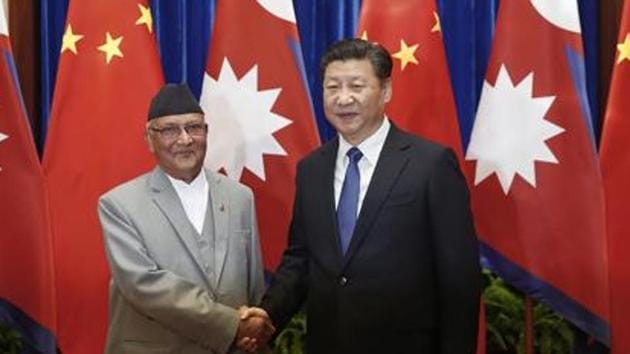
Domestic politics apart, the map also helps KP Oli score points with Beijing, Nepal’s other giant neighbour.
It hasn’t gone unnoticed in New Delhi that KP Oli had timed the new political map around the same time India and China were engaged in a standoff in the Ladakh sector.
Nepal, and PM Oli have a track record of trying to steer the India-China rivalry to his advantage. But increasingly, analysts in Kathmandu concede that China’s influence over Kathmandu was rising rapidly.
In some ways, one analyst in Kathmandu said, China, which poured millions of dollars in Nepal, has gradually encircled the himalayan nation.
Chinese investments in Nepal started to surge from 2008 when Kathmandu switched from a monarchy to a republic in 2008.
By 2014, China outranked India in terms of total investment. In 2015-16, China contributed 42 per cent of the total FDI to Nepal.
According to the latest available data, China has again surpassed India as top investor in Nepal in the first quarter of 2019-20 with a total pledge of $ 88 million FDI representing 93 per cent of total committed FDI of $95 million. Britain came next with $ 1.85 million followed by India’s $ 1.76 million.
Nepal is also getting a second Chinese cement plant being set up with $ 140 million investment; the first was Hongshi Cement.
This increase is also seen in Chinese overseas development assistance where China overtook Indian aid in 2015, growing steadily from $ 19 million in 2010-11 to $ 38 million in 2014-15 as compared to India’s $22 million.
Nepal has also been nudging Beijing to build projects worth an estimated $ 3 billion via a grant, not the soft loan that China has agreed to. If Nepal does eventually sign off on the soft loan, it would dwarf other Chinese loans including the ones extended to build Pokhara international airport and the Trishuli 3A hydropower project.
The Chinese influence was on display earlier this year also when its mission in Kathmandu rebuked the Nepal media on February 19, and accused The Kathmandu Post editor of “ulterior motives” because the newspaper had published an article critical of China’s handling of the coronavirus virus. The public reprimand, ironically, coincided with Democracy Day of Nepal. But there were no protests from the Oli government who is seen to pursue a “nationalist” agenda.