A second face-off between security forces and terrorists, not far from the Handwara house in north Kashmir where a bloody firefight killed 5 soldiers, appears to be part of a Pakistan attempt to rewrite the script for terrorism in Kashmir, a top security official told Hindustan Times on Monday evening.
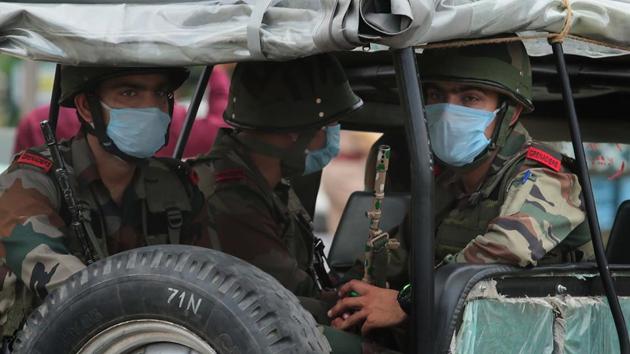
Just minutes earlier, two young men had opened fire at CRPF jawans at a security checkpoint when they were busy checking out some movement in the adjoining orchard. Two jawans were killed on the spot, the third succumbed to the gunshots later. A civilian who was caught in the cross-firing also died.
The attack is considered brazen not just because of how the terrorists targeted security personnel at a checkpoint, but also the timing.
In an overnight operation in another part of Handwara over the weekend, the security establishment had lost four soldiers including the commanding officer of the battalion Colonel Ashutosh Sharma and a police officer. At the end of the 13-hour long operation, two bodies of terrorists were found. One of them was said to be a top Lashkar commander Haider, a Pakistani national.
Top intelligence officials told Hindustan Times that they have decided to keep an open mind about the number of terrorists involved in the Handwara encounter and ascertain if this group had recently infiltrated into India.
{{/usCountry}}Top intelligence officials told Hindustan Times that they have decided to keep an open mind about the number of terrorists involved in the Handwara encounter and ascertain if this group had recently infiltrated into India.
{{/usCountry}}Handwara falls along the infiltration route from the Leepa Valley.
Intelligence agencies had earlier pointed to terror launch pads that had been activated in Pakistan-occupied Kashmir’s Dudhnial, Sharda and Athmuqam across the Keran sector on this side of the Line of Control.
It was in the Keran sector in early April that a team of army commandos killed the entire infiltrating batch of five terrorists in a close-quarter battle. Five Special Forces commandos had laid down their lives in this operation carried out in heavy snow.
Counter-terror operatives said about 25-30 terrorists are believed to have slipped through the security grid along the LoC in April alone.
The developments of the last two days appears to indicate, a senior security official said, that Kupwara district, particularly Handwara, would be the hotbed of action this summer.
This assessment also matches with intelligence inputs that suggest the Pakistan-backed terrorist groups would focus on north Kashmir. There would be some intermittent attacks elsewhere too, like the grenade that terrorists threw at CISF jawans at a power facility in Budgam. A CISF jawan escaped with some splinter injuries in his leg.
Pakistan has for years, tried to give Kashmir terrorism a local face. There was a renewed attempt at this makeover in recent months. According to an assessment presented to national security planners in late April, the ISI had messaged the 100-odd foreign terrorists to lie low and let the local terrorists front the battle with security forces.
“Foreign terrorists are seen to be consolidating logistics, expanding the overground workers facilitation network and concentrating on recruitment of Kashmiri youth,” the report accessed by Hindustan Times said. Foreign terrorists had accordingly stepped up efforts to radicalise the youth in the Doda-Kishtwar-Ramban range to prepare them for recruitment.
The intelligence brief had also predicted a spike in terror activities and attacks from April, after the starting of Ramzan.
“Our assessment is that the next 10-14 days are going to be crucial… very crucial,” a top intelligence official said, alluding to inputs that indicated an effort by terrorist group Jaish-e-Mohammed to carry out simultaneous suicide attacks targetting army and central paramilitary bases.